By Soheila Comninos*
WASHINGTON DC | 25 August 2026 (IDN) — Since joining the Funders Roundtable on the Future of Development, I have had the opportunity to attend several high-level forums on international development and observe a powerful critique threading through these spaces: old, extractive development models have created a cycle of dependency, holding back true economic transformation in the Global South.
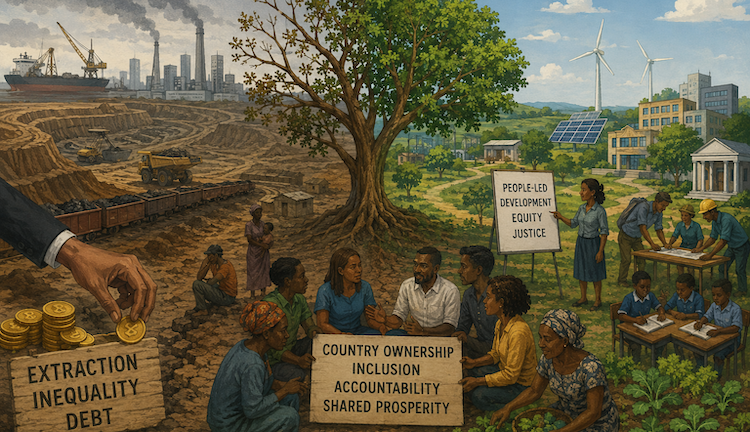
Highlighting this reality at the OECD conference on the future of international development cooperation, Mavis Owusu-Gyamfi of the African Center for Economic Transformation pointed out a stark paradox: Africa holds 30% of the world’s critical minerals but accounts for just 2% of global manufacturing; it possesses 60% of the world’s solar resources yet lacks reliable electricity. This is classic economic extraction: hollowing out a region’s natural wealth for global consumption while leaving nations without the industrial capacity and infrastructure to power their own growth.
The Extractive Model and Its Human Cost
This extraction is equally financial. At the Global Partnerships Conference, Rashed Al Mahmud Titumir, Advisor to the Prime Minister of Bangladesh, exposed a severe fiscal crisis: while debt servicing consumes 16% of Bangladesh’s budget, health and education receive a combined 5%. Arguing that the global priority should be debt relief rather than blended finance, he illustrated how a predatory financial architecture forces nations to enrich foreign creditors rather than invest in their own human capital.
Remarks like these resonate with a growing critique in the democracy and economic justice spaces regarding the influence of extreme wealth concentration on politics. Trillonaire Elon Musk’s direct intervention in public policymaking vividly illustrates how the accumulation of capital by a tiny elite translates into unprecedented political influence, routinely bypassing democratic accountability mechanisms.
Crucially, global extractive models and national wealth concentration are two sides of the same coin. At the national level, the pervasive collusion between public and private elites, alongside the rise of hyper-concentrated wealth, can engender state capture – where powerful private interests exploit public institutions for their own benefit. When this happens, institutions fail to serve the public good, governance is weakened, and citizens lose faith, justifiably viewing the system as fundamentally rigged and incapable of delivering for them – a frustration that provides fertile ground for populists and anti-democratic leaders worldwide.
At this point, the legitimacy of the entire political system becomes increasingly precarious. We see this playing out globally. Take two recent examples: In Bulgaria, deep public fury over elite corruption recently erupted into massive budget protests that toppled the government. Meanwhile, in Madagascar, a historic, youth-led uprising over systemic inequality and chronic public service failures completely paralyzed the state, culminating in a military-led transitional regime. The core failure in these contexts is not a lack of wealth generation, but its profoundly unequal distribution: while vast benefits accumulate in the hands of corporate interests, foreign donors, and domestic elites, they rarely trickle down to the rest of the population, least of all the communities whose labor and resources created that wealth.
This structural asymmetry sits at the very root of a dual crisis where concentrated wealth simultaneously drives inequalities between nations (the traditional realm of development practitioners) and fuels deep disparities within them (the primary focus of democracy groups). Connecting these dots exposes how global and local power imbalances are deeply intertwined, a critical link that is usually lost in the silos dividing these fields. Speaking on international economic policy, economist Jayati Ghosh argued that public trust will only return once we dismantle the oligarchic structures favoring elites over workers and address the systemic inequality baked into global trade policies.
Country Ownership and the New Development Debate
The global development field’s current shift toward equitable partnerships and genuine country ownership offers a critical opening to confront these imbalances. Yet, beneath the hopeful rhetoric lie two distinct, troubling tensions that threaten to reinforce the status quo.
First, the goals of donors and recipients do not always align, and this shows in the language they use. Global North donors now trade words like solidarity for terms like interest-based development and mutually beneficial partnerships, openly prioritizing their own trade and national security interests to compete with geopolitical rivals. The danger is that vital investments in democracy, human rights, and the rule of law get pushed to the back burner. While mutually beneficial partnerships can be genuine, there is a concern that the term masks new forms of dependency.
Meanwhile, Global South governments champion country-led development. They want to control their own destiny, shed externally imposed conditionalities, and assert sovereignty over their national priorities and how they utilize resources. Increasingly, they are turning to development banks and private capital to fund economic transformation on their own terms, seeking the structural investments needed to drive long-term growth and job creation. This vision took center stage among African leaders at the recent OECD and Global Partnerships conferences, and it is an ambition that the international development community should fully rally behind.
Who Actually Represents the Country?
But this brings us to the second, more critical tension: who actually represents the country? In these high-level forums, “country-led” has become shorthand for “government-led.”
This carries risks because governments do not inherently serve the public good, especially when leadership becomes unresponsive, corrupt, or detached from local realities. Sub-national government matters because it is closest to the citizens using state services, just as independent civil society and citizens are essential for exerting oversight and holding political leaders to account.
True country ownership must include perspectives of civil society and local communities alongside governments and the private sector. Yet, civic actors are routinely sidelined in these debates, despite powerful reminders of their worth – such as International Rescue Committee CEO David Miliband’s defense of civic society at the Global Partnerships Conference. By channeling funds through ruling elites to secure trade or diplomatic partnerships, donors risk financing the very elite collusion and state capture that leaves citizens feeling the system is rigged.
Tragically, civil society is being defunded and attacked around the world precisely when its creativity and oversight is needed most. This foundational work – bridging the gap between democracy groups fighting internal state capture and development practitioners fighting external economic extraction – is rarely prioritized by funders or practitioners in either sector. If we are to achieve genuine country ownership, we must dismantle these silos and fund a model where the people, not just the elites, hold the reins of their own development.
Recommendations for Funders (Philanthropy and Bilateral Donors)
Anchor bilateral agreements in true reciprocity: Focus on co-investments in global public goods – like health infrastructure, digital networks, and climate adaptation – that advance shared economic and geopolitical interests. To ensure equity, donors must ban “tied aid” favoring donor-country firms, enforce local hiring and procurement, and require joint-ownership structures that keep assets and knowledge in local hands.
Require inclusive governance within country-led frameworks: Condition development bank loans, infrastructure funds, and aid packages on a tripartite model where governments, the private sector, and independent civil society leaders share equal decision-making power, ensuring that economic transformation benefits workers and local communities, rather than merely enrich elites.
Fund economic accountability and alternative paradigms: Shift a portion of democracy portfolios toward countering state capture while actively financing alternative economic models that challenge the dogma that growth-at-all-costs is the only path to prosperity. This means simultaneously funding watchdogs tracking elite collusion and investing in locally rooted approaches that redefine wealth in terms of human well-being, ecological sustainability, and collective resilience, such as worker cooperatives, circular zero-waste systems, and Indigenous frameworks like Buen Vivir.
Recommendations for Practitioners
Break down the silos between development and democracy: Traditional service-delivery NGOs working on global development outcomes (like health, education, or climate) must partner with governance and accountability groups fighting corruption and impunity. A climate adaptation fund, for instance, should bake civic oversight into its budget from day one to help ensure funds address local needs, proving that international economic policy and local democratic trust are deeply intertwined.
Simplify the narrative: Strip away the technocratic jargon that alienates the very people development and democracy practitioners are meant to serve. Both sectors must reframe their work around a shared goal: expanding human agency so people can shape their own futures and live prosperous, dignified lives.
Move communities from grievance to actionable solutions: Validate citizens’ anger that the system is rigged against them, but do not let the conversation stop there. Leaving it at a complaint breeds paralysis and cynicism. Practitioners must provide practical, bite-sized transparency tools – like community budget monitoring – to channel that anger into specific, winnable battles for accountability.
Note: This piece reflects the author’s personal views and does not represent the stance of the Funders Roundtable on the Future of Development.
*Soheila Comninos serves as Secretariat Lead of the Funders Roundtable on the Future of Development and is an Accountability Lab Senior Fellow. Her career in human rights philanthropy and humanitarian action includes previous roles with the Open Society Foundations and the International Committee of the Red Cross. [IDN-InDepthNews]