
By Kalinga Seneviratne
BANGKOK, Thailand | 4 Dec 2025(IDN)– Saudi Arabia and Russia have signed an agreement on the sidelines of the Saudi-Russian Investment and Business Forum, held in Riyadh on the 1st December, on a mutual visa exemption for citizens of both countries, that could help to accelerate the Islamic kingdom’s fledgling tourist industry.
Saudi government has opened up the country for tourism only in 2019. Until then only foreigners allowed were Muslim Haj pilgrims.
In March this year, I took advantage of the visa liberalization for non-Muslims, and throughout my 10-day visit, I noted that they are still on a learning curve but very welcoming of tourists.
Saudi Arabia is a country of mosques from small ones in suburban street corners to grand mosques in city centers as well as many historic ones. But, Saudi Arabia, especially its cities, gives no conservative vibes anymore. In the cities, especially in Riyadh, the young women don’t wear the black Abaya now, they dress up modestly with a head scarf like Muslim women in Southeast Asia. Older ones and those outside the cities seem to still stick to the old dress code.
There are thousands of, predominantly Christian, Filipino women working in the kingdom, whom now roam the streets in their jeans and t-shirt. “Only thing we cannot wear here are shorts” one Filipina told me.
Capital Riyadh – On A Building Frenzy
Saudi capital Riyadh is a city on a modernizing frenzy. Desert is being transformed into a 21st century concrete nirvana, on the back of cheap South Asian migrant labour. A spanking new metro system that runs underground in the city center and on a skyway out of it, has only been opened in 2024 and more lines are being added at a rapid pace.
Local residents seem to enjoy the new-found transport and social freedoms. The trains were running at almost full capacity right up to midnight.
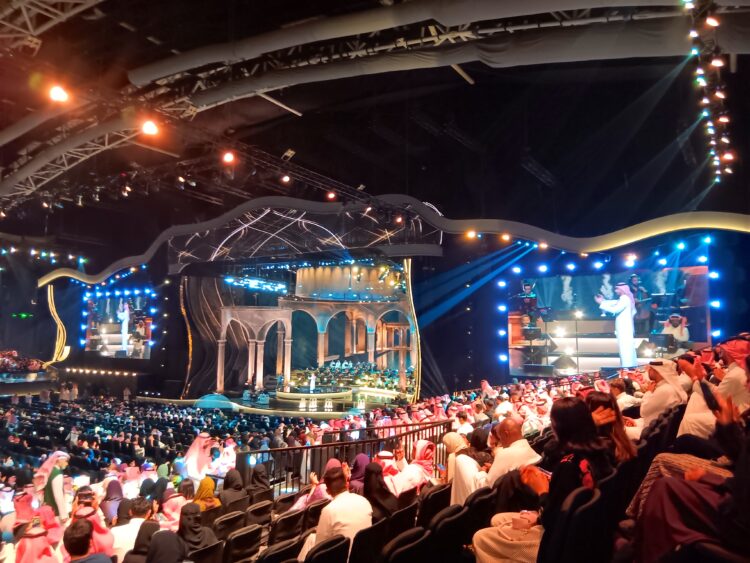
Arriving in Riyadh on the eve of the Eid (Ramadan) festival, I found the city in a festive mood. I went to an Eid concert at Riyadh’s Mohammad Abdo Arena—a large concert hall – where two popular Saudi singers were performing. Most of the capacity crowd wore Arab dress, and many women were in the black Abaya without the face covering. For some of the pop beats the young ones stood up waved their hands and shook their hips, while the men danced as if they were at a discotheque. Even the sexes were not segregated, but did not dance together.
A Pakistani who has lived in Riyadh for many years told me that this was unthinkable up to a couple of years ago. And when they needed this entertainment, they had to go to Dubai.
The Birthplace of the House of Saud
The historic UNESCO World Heritage listed Diriyah city, which is only about 30 minutes taxi ride from the Riyadh city center, shows how Saudis are preparing for a new era of commercial tourism.
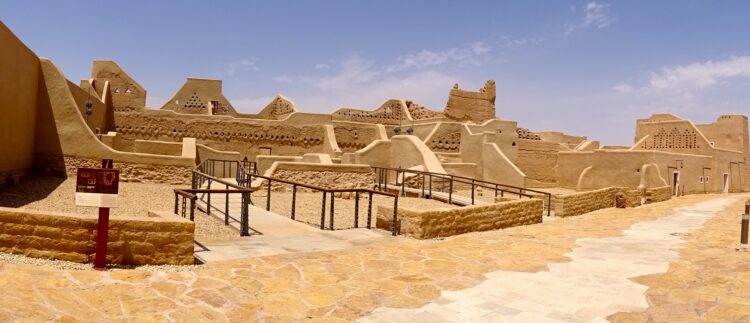
Diriyah built with sandstones and mud bricks is described as the “cradle of Saudi Arabia’s foundation”. Established in 1446 CE, it is the birthplace of the Kingdom of Saudi Arabia, and the original home of House Al Saud. Restored through a $ 62.2 billion development project to protect and preserve the kingdom’s history, the site takes you back to the ancient history of the kingdom through its old narrow streets, heritage landmarks and unique sandstone architecture. With many cafes and restaurants, mainly manned by Filipinos, Diriyah is a popular evening hangout place for locals as well as visitors, when folk musicians provide the entertainment.
Missed Date Orchards, But Discovered Natural Wonder
Fledgling Saudi tour companies now offer half and full day tours to other restored tourist villages and nature sites many 100 to 200 kms out of Riyadh.
A high-speed rail network that is rapidly developing makes travel across the vast desert, fast, smooth and luxurious now. I took an independent two-day tour out of Riyadh to Al Hufuf, which is 325 km away. The high-speed train took me to the destination in 2 hours. But, arriving at the station early morning, I found that there was no tourist information office at the stations and the taxi drivers spoke only Arabic. Thus, communication barriers deprived me of a visit to a natural springs date oasis, as the taxi driver took me to an Oasis Spa.
Instead, I was able to negotiate with another taxi driver to take me on a half-hour drive out of the city past many date palm plantations to Al Qarah a popular destination for visitors, and an amazing formation of sandstone mountains that dates back to 2.5 million years. For a small fee visitors can roam around the mountain formations or even climb them if they want a panoramic view of the 30,000 acres of date palm plantations in the desert below.
Jeddah On The Run
Saudi Arabia’s other big city, Jeddah, is a one-hour flight from Riyadh. In the cooler evenings, the old city area of Al-Balad and roaming through its Al Alawi Souq (traditional market), gives an interesting glimpse of a traditional city market. A shop there that sold only dates – over 10 varieties of them – gave a remarkable insight into the diversity of the date harvest from the deserts. I have never tasted such a variety of dates before.
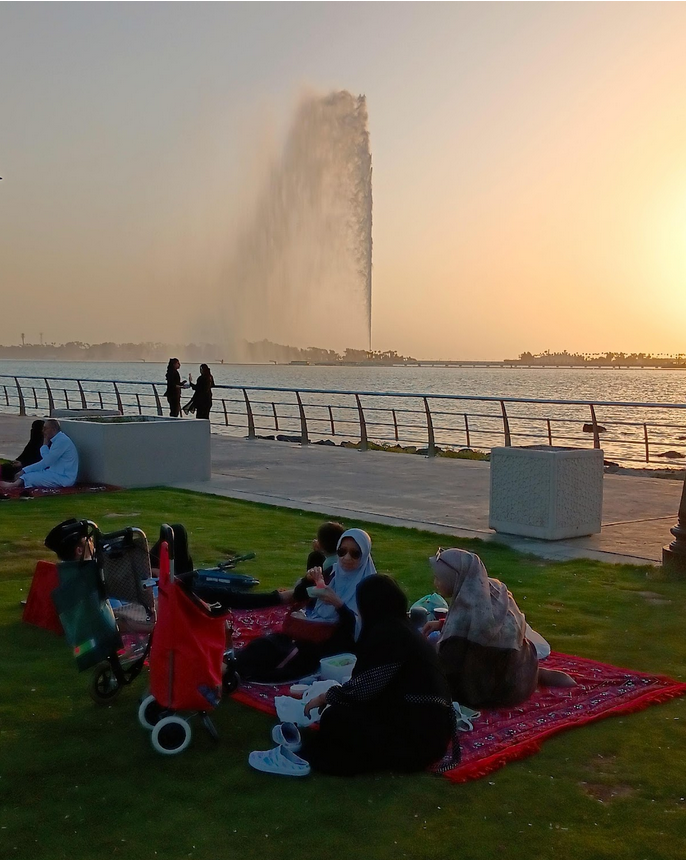
Near Al-Balad was a popular beachside park where crowds gathered at sunset to picnic and watch the sun set behind the King Fahd’s Foundation, the tallest such fountain in the world, that jets water to a height of 260 meters.
High-Speed Train and Camels Along Highway
There is a high speed train that connects Jeddah to Makkah via Medina. Non-Muslims are not allowed to disembark in Makkah—the holiest place for Muslims—but they can visit the holy city of Medina.
The train whisked you through to Medina 400 km away in less than 2 hours non-stop. The Saudi high-speed train services are being built by a Saudi-led consortium, that includes Chinese, French, and Spanish companies.
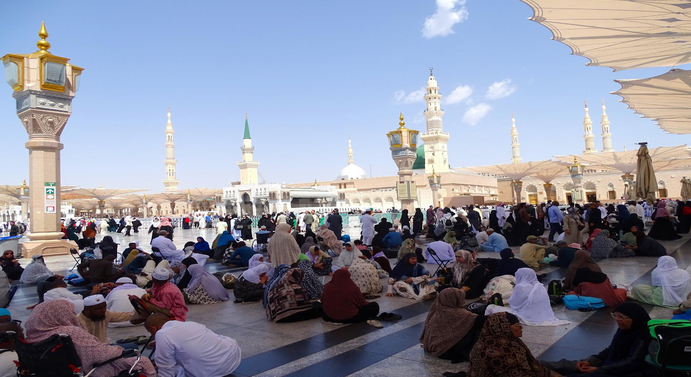
Non-Muslim tourists are allowed to visit Islam’s second most sacred mosque—Al Masjid an Nabawi—which was built by Prophet Muhammad himself in 622 CE, and he is buried here. But, they are not allowed to go inside where the Muslims go to pray. This is an impressive newly-renovated shrine, and on a crowded day it gave you a good picture of the diversity of the global Muslim community—people from Africa, Asia, Arabia, Europe, etc, all mingling as one community.
Al Ula – A Tourism Wonderland
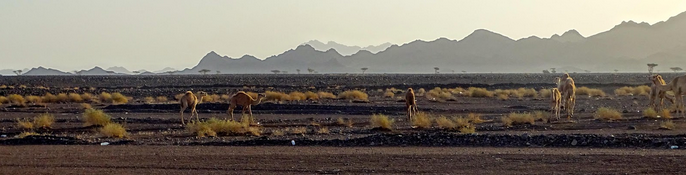
I had booked a chauffeur-driven car from a tour company to take me to Al Ula a 4-hour drive from Medinah. Fortunately, the driver was an Indian who spoke good English. Speeding through a 4-lane desert highway, we passed through some scenic rocky desert mountains that change colour from black to dark brown and to orange. Occasionally wild camels could be seen trying to dig out some sparsely visible vegetation, and they sometimes cross the road at their own leisure space.
Al Ula is a unique place, an open-air museum of rock formations and sculptures, whose true history is yet to be fully explored. At first sight upon entering Al Ula, one is awestruck to see rocks in the open air, that looks like the ancient carved rock temples of Asia.
In 2008, Al Ula became Saudi Arabia’s first UNESCO World Heritage site. It is a hidden treasure that has the potential to become a magnet for global tourists. But, Saudi authorities are careful not to overexploit this place for tourism. Many of the attractions such as Hegra – once a thriving city of the Nabataean Kingdom – can be visited only through a tour company.
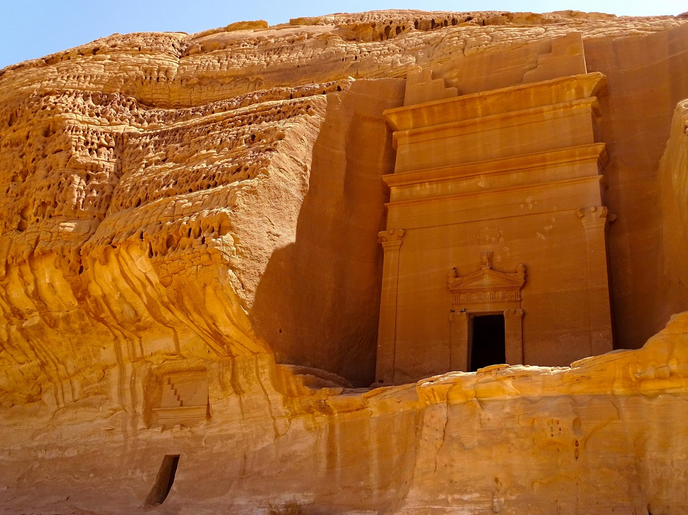
About 30 km from town, Hegra is one of the most significant archaeological sites in the Arabian Peninsula, with over 100 monumental tombs with many carved into rocks with decorative doorways dating back to 1st century BCE.
Al Ula was a major trading route connecting the Arabian Peninsula—animal images such as lions can be noted in the carvings – that hints at a pre-Islamic civilization.
Standing On Top Of A Volcano
Harrat Lookout, at 1,220 meters above sea level is the highest point in the area reachable through a treacherous mountain road with nerve wrecking elbow curves, and past lava deposits from a volcanic eruption centuries ago.
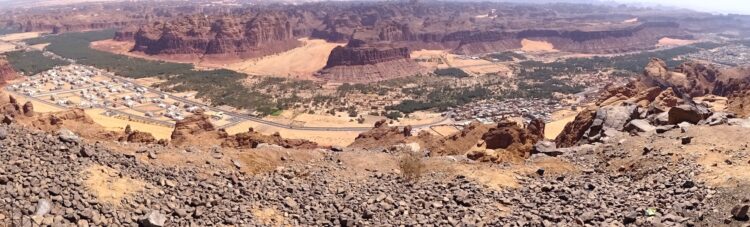
The panoramic view had all the “wow” factors overlooking deep canyons, the lush green Oasis of the Al Ula town and incredible rock formations as far as the eye can see. Here is a “yet to be discovered” wonder of the world.
The Old Town in Al Ula is a good example of how Saudi Arabia is gearing up for the tourism era. From the 7th century CE, this town has continued to prosper as a stopover point for pilgrims to the holy city of Makkah.
After moving the population to a new city in the 1980s, this is a historic town today, built up as a major tourist attraction with its mudbrick houses immaculately restored, along with a modern street in the old architectural style, with craft shops, and cafes for an evening dining experience.
Saudi Arabian tourism is really on a learning curve. With its vast wealth, the kingdom is fast becoming a new frontier of global tourism, but as the custodian of the Islamic faith, there are some limitations. (IDN-InDepthNews)
Image: The multinational Muslim pilgrims at Islam’s second holiest Al Masjid an Nabawi mosque in Medina. Credit: Kalinga Seneviratne.