
By Jonathan Power
LUND, Sweden | 16 September 2026 (IDN) — In 1995, in a little-remembered event, Li Ruthuan, a member of the Chinese Politburo (containing the top seven in the government), made a speech likening the Chinese takeover of Hong Kong to the case of a lady who had agreed to sell a 100-year-old Yi-Xiang teapot that was famous for the taste of the tea it poured. Unbeknown to her, its quality derived from the residue that had accumulated on the inside of the pot. Eager to prepare the pot for sale, she cleaned and polished it. When the purchaser tried using the pot, the tea was dreadful, and he demanded his money back.
The Lesson of the Teapot

In this way, Li Ruohan made his point that most of the Chinese leadership didn’t properly understand the key factors that made Hong Kong such a successful commercial centre. It also should remind us today that the leadership of the Communist Party is probably not a monolithic hardline group. Li was liberally minded. So was General Secretary Zhao Ziyang, who opposed the Tiananmen crackdown and visited the protesting students to calm things down. Tragically, Deng Xiaoping overruled him and ordered the tanks in, even though a majority of the Politburo supported Zhao, according to Bao Tong, Zhao’s chief of staff. If such divisions reached the top of the Communist Party in the not-too-distant past, we can be pretty sure they exist today.
I suspect that today, among parts of the current leadership, there is an appreciation that tampering too much with Hong Kong could be counterproductive. Indeed, caution over what to do about Hong Kong goes right back to the time of Mao Zedong when the victorious Communist armies stopped short at the Hong Kong border in October 1949. Stalin pressed Mao to advance, but Mao refused, convinced Hong Kong would serve China as a base for foreign trade and a political bridge to the West.
Some of them may well be lobbying Xi, pointing out that it’s not in China’s interest to intervene if it precipitates a flight of capital, a collapse of the property market (which undermines the super billionaires of Hong Kong who largely support Beijing) and a large exodus of the professionals and the elite. A mainland intervention, some could well be saying in Politburo meetings, would definitely affect the Chinese growth rate, which is already falling. This, they would add, might lead to large-scale labour unrest and the alienation of those (a big majority of the people) who have mentally traded away more freedom in return for strong economic growth and the reinforcement of the welfare state.)
Beijing’s Hard Line on Dissent
The above is an optimistic reading of current Chinese debates. But we know that the official public voice of China has made it more than clear its visceral hatred of all things democratic.
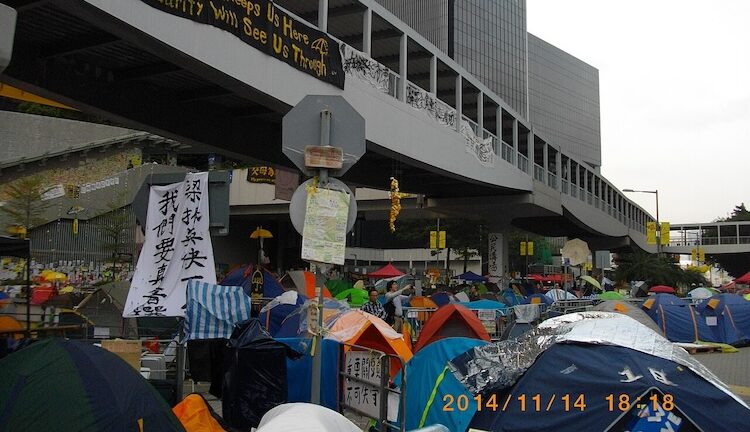
Hence the continued persecution of Joshua Wong, a former student leader who in 2020 led the protests against the increasingly heavy-handed repression of those who stood up for human rights and democracy. Already serving a five-year sentence, he was accused of foreign collusion at the beginning of this month and sentenced to a further prison term of four years and eight months. Six days ago three activists, Lee Cheuk-yan, Chow Hang-tung and Albert Ho were found guilty of organising annual vigils to commemorate the repression of demonstrators in Tiananmen Square. They were sentenced to seven years.
The Legacy of British Rule
Many of us always hoped that once the British had gone, the Chinese, having seen that the British were honourable and hadn’t absconded with the silver, would come to terms with Hong Kong’s liberal and open society. They haven’t.
Regrettably, the British leant over too far backwards to give China a good deal in accepting limits on Hong Kong’s democracy. If they had done what they did to other colonies like India and Nigeria- and introduced full democracy in internal affairs years before independence- all this would never have happened.
The students wouldn’t have had to fight to get China to honour its pledge to the departing British to move step by step towards democracy. One can blame successive British governments for this, but not Chris Patten, the last governor, who did his best to play a bad hand well. (This is not to sanctify Patten- he didn’t do enough to rid Hong Kong of its gross differentials in income distribution and to eliminate the appalling slums where hundreds of thousands still live in almost animal-like conditions without satisfactory medical care.)
Is There Still Room for Compromise?
Xi has risen to the top of Chinese society without blood on his hands. He was a small child during the Revolution, and he has never cut off any heads as he climbed the ladder to the top leadership position. He’s accumulated a lot of power and curbed the growing sense of liberty in China, but he’s no Mao, Stalin, or Hitler. He’s not even another Deng Xiaoping.
I’m sure he’s struggling to figure out how to end this confrontation without blood on the streets. The two sides must meet each other halfway. Xi must set out a timetable promising full democracy in Hong Kong, even if it’s 9 years away. (Deng once said he expected China to become democratic by the year 2035.) The demonstrators must unambiguously commit to showing more respect for the mainland and to a moratorium on demonstrations once it becomes clear that Beijing is committed to implementing such a promise. [IDN-InDepthNews]
Copyright Jonathan Power