
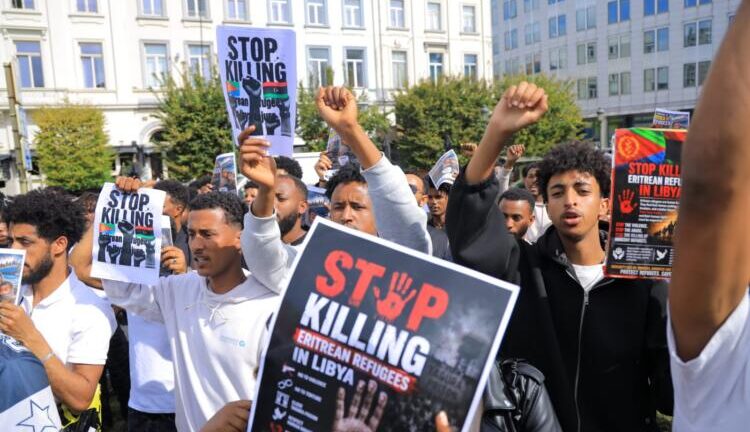
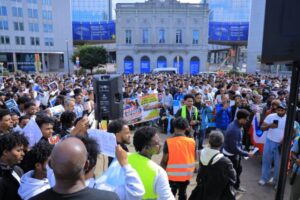
By Cedric Stephany | BRUSSELS, Belgium | 16 September 2026 (IDN) — Around 750 to 1000 people gathered on Saturday, September 12, at Place du Luxembourg in Brussels. The demonstration, held in front of the European Parliament, demanded the release of Eritrean refugees held in detention centres in Benghazi and Tajoura, Libya, and to call for stronger protection measures from European and international institutions.
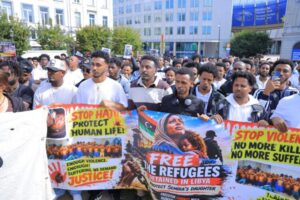
Organised by members of the Eritrean diaspora, the protest ran from 12 p.m. to 2 p.m. Protesters held signs reading “Free the Refugees in Libya” and “STOP hate! Protect Human Life!” alongside messages denouncing the situation facing Eritrean refugees in Libya.
A petition, detention centres and a name behind the numbers
The demonstration is closely tied to an online petition, “Free the Refugees Detained in Libya and Protect Semira’s Daughter” launched on Change.org on August 28 by Abraham Tesfai and addressed to UNHCR, the International Organization for Migration (IOM), the United Nations (UN), the African Union (AU), the European Union (EU) and governments with the power to provide protection and safe humanitarian pathways. As of September 16, it had gathered close to 29,000 signatures.
The petition is built around a name that has become a rallying point for the movement: Semira. She was an Eritrean mother who fled Eritrea and then Sudan as war broke out there. She was later detained in Libya and eventually registered with UNHCR along with her daughter. On August 3, while attempting to cross the Mediterranean, Semira reportedly died at sea while her daughter survived. The petition calls for the child’s identification, safe accommodation, legal guardianship, and an urgent humanitarian transfer out of Libya.
The petition also drew attention to two detention sites in particular:
In Benghazi, in eastern Libya, an estimated 6,000 people are reportedly held captive, according to figures cited by organizers with close ties to the community. On August 18, detainees reportedly asked guards for food and medical care, the request was met with gunfire. According to testimony gathered by activists, the incident left several people injured without subsequent medical treatment, around 1,200 people were involved. No independent outlets have verified this specific incident, and the claims currently rest on accounts from detainees and community contacts rather than confirmed reporting.
In Tajoura, near Tripoli, an estimated 7,000 people are held, the majority of them are Eritrean, many arrested during raids or intercepted at sea. Very little verified information reaches the outside world from inside this facility, organisers say.
Organisers also point to the death of Filmon, an 18-year-old Eritrean who died at the Ganfuda detention facility near Benghazi after contracting tuberculosis and not receiving adequate medical care.
Place du Luxembourg, EU Parliament, not a coincidence
Beyond Semira’s case, the protest aims to address demands to UNHCR, IOM, the UN, the AU and particularly the EU. In a letter addressed to the EU and the European Commission, organisers and Eritrea Democratica laid out six demands:
- Take immediate action to protect migrants and refugees detained in Libya.
- Demand immediate and unhindered humanitarian access to detention centres, particularly Benghazi, Tajura, Sabha, and Brak al-Shati. Monitor the overall situation more effectively through joint, independent, and transparent oversight mechanisms that map both official and illegal detention centres.
- Apply sustained political pressure on Libyan authorities to close all abusive detention centres. Immediately free refugees, asylum seekers, children, and human trafficking survivors.
- Urgently facilitate safe and legal pathways including resettlement, humanitarian corridors, emergency evacuations, and complementary admissions for people trapped in Libya who cannot safely return home.
- Establish an independent international forensic investigation, with Libyan cooperation to secure mass grave sites, recover and identify remains, preserve evidence, notify families, and expose any links among traffickers, detention personnel, coastguard, officials, and financial beneficiaries.
- Protect migrants from racist violence and collective punishment. Condemn anti-African incitement, discriminatory raids, forced evictions, harassment, and expulsions. Require Libyan partners to investigate attacks and guarantee equal protection, due process and access to asylum regardless of race, nationality, religion, gender or migration status.
The EU’s role in the background
The demonstration also functions as a pointed critique of the European migration policy. For years, the EU (and Italy in particular) has funded and trained the Libyan coast guard to intercept migrant boats in the Mediterranean and return them to Libyan territory, where many end up in detention.
Human rights organizations have repeatedly denounced this cooperation: Amnesty International said in mid-2026 that the EU was expanding ties with Libyan authorities even as they escalated mass arrests, arbitrary detention and collective expulsions of migrants, describing it as complicit in the abuses. The organization has also criticized a planned EU-backed maritime rescue coordination centre in Benghazi, approved in July, pointing out that the Libyan coast guard had reportedly opened fire on a rescue vessel operated by the NGO Sea-Watch just months earlier.
In July 2025, EU Migration Commissioner Magnus Brunner travelled to Libya along with the interior minister from Italy, and delegations from Greece and Malta. Seeking tougher measures from Libyan authorities to stop migrant boats from departing for Europe, the delegation held talks in Tripoli with the UN-recognized western government, but when it then tried to travel on to Benghazi to meet with eastern authorities aligned with Khalifa Haftar, it was denied entry at Benina airport and declared “persona non grata”. A diplomatic incident that underscores just how fraught, and how central to EU strategy, cooperation with Libya’s two rival authorities has become.
For the protesters gathered in Brussels, this is precisely the contradiction at the heart of the issue: a European migration policy focused on keeping people out of Europe. They argue that that cannot come at the expense of their safety once inside Libya.
Simon Rezene, member of De Eritrese Gemeenschap vzw, told us:
“The EU should closely monitor and independently assess the situation in Libya, ensure that European support does not contribute to human rights violations, and establish safe and legal humanitarian pathways for people who are entitled to international protection.”
“We are not calling for open borders or uncontrolled migration. We are asking the EU to ensure that migration policies do not come at the expense of fundamental rights.”
Independent reporting backs the broader picture
While the specific claims about the August 18 Benghazi incident remain unverified by independent media, the wider pattern described by organizers is documented elsewhere. A UN Human Rights Office and UN Support Mission in Libya report published in February found that migrants, asylum seekers and refugees in Libya face systematic human rights violations, including arbitrary detention, torture, forced labour, extortion and sexual violence, describing an exploitative system that has become normalized.
Reuters has also reported on related developments this year: in January, security sources described a mass grave containing at least 21 migrant bodies near Ajdabiya, with survivors showing signs of torture. Separately, more than 200 migrants, mainly from Somalia and Eritrea, were freed from a secret underground prison in Kufra.
What comes next
Organizers have not yet announced a follow-up demonstration but the petition remains open for signatures, and pressure on EU institutions is expected to continue as the situation in Benghazi and Tajoura remains largely opaque to outside observers.