
By Kim Scipes*
Editor’s Note: This article deliberately follows US English spelling conventions.
WESTVILLE, Indiana, USA | 17 June 2026 (IDN) — Strong support for Palestine and Palestinian workers was obvious at the recently concluded Labor Notes conference in Chicago. This bi-annual conference of labor activists took place on June 12-14 at the Hyatt Regency O’Hare Hotel.
Over 4,700 activists from across the US but also from Canada and other countries, including Brazil, Italy, Portugal, and South Korea, registered to report, share, and discuss developments effecting the labor movements in these and other countries.
Labor Notes itself is a monthly news magazine for these activists, who form an informal network around the journal, and who meet bi-annually. The slogan for the journal is “Putting the movement back into the Labor Movement.” It was established in 1979 and has continued expanding to date. The size of the conference was probably the largest to date, although cancellations because storm conditions hampered flying from the East Coast, cutting some registrants’ participation.
Much of the program was dedicated to organizing workplaces, garnering better contracts for the workers, and encouraging leadership development, including challenging reactionary leaders for elective office. Yet these efforts were not alone; cultural aspects, such as singing, writing, and acting were also emphasized.
Global Labor Solidarity
However, there is a growing awareness among the activists of needing to link up with workers in other countries. While Labor Notes has long brought a few foreign workers to previous conferences, building global labor solidarity has not been seen by this writer as a substantial issue for the journal.
And this writer is still not convinced this has changed. In the middle of the war with Iran—a war initiated by the United States and Israel—there were no formal discussions of the war at the conference. Nor were there any formal discussions of the AFL-CIO’s “labor imperialist” foreign policy, which a few of us have been challenging for the last 40 years.
However, what was unmistakable was the growth of a global understanding by this new crop of activists; for a significant number, their visions went far beyond US borders. There were many informal discussions around these and other issues.
One of the key issues discussed was that of injured GM (General Motors) workers in Bogota, Colombia; they had been injured on the job, and GM had refused to compensate them. Some of these workers have been living in tents outside of the US Embassy in Bogota, seeking respect and compensation, for the past 15 years!
Under continued pressure from a few of its members, the UAW (United Auto Workers) leadership has taken on this issue, and will be meeting with GM executives in early July in Bogota to finally address this issue. Hopefully, this will lead to a serious settlement. Auto worker activists from Brazil, Italy, Portugal, and South Korea each expressed solidarity with these injured Colombian workers, suggesting the expansion of this fight should GM demur.
Palestine at the Center
But there was no international issue discussed more than Palestine. There were two formal panels that this writer attended, with the larger having over 100 participants, and people were also sitting two-deep on the floor. The other was slightly smaller. It is clear that the Israeli/US treatment of Palestinians is not only deemed unacceptable, but that these activists are working hard in their unions to educate fellow workers and who are taking formal action to change US Labor’s support for Israel and its US benefactors. Not surprisingly, much of this support was specifically for Palestinian workers.
Speakers reported what was happening in their unions. We were told about educational campaigns that had developed formal support for Palestine; we were told about emerging campaigns; and we were told of campaigns blocked by reactionary leaders who opposed them. And we were told of successful efforts to go around and by-pass some of these opposing efforts.
Some of these involved becoming much more familiar with their union’s constitutions and other enabling acts. Others were more inventive: a couple of cases reported establishing direct links with Palestinian unions. But it was clear that there is an emerging cadre of both leaders and aspiring leaders who not only have Palestine on their map but are consciously fighting within the labor movement to support Palestinian workers.
One of the most inspiring reports was from Canada. In May, activists in Labor for Palestine-Canada won an important vote at the recent Canadian Labour Congress—the largest Canadian labor center, comparable organizationally to the AFL-CIO—to break all ties with Israel’s Histadrut, their national labor center.
But the Histadrut is not just a regular labor center, uniting labor unions; it was a key organization in the Zionist effort to create the State of Israel; it is formally part of the Israeli state. The first Prime Minister of the State of Israel, David Ben-Gurion, had been a leader of the Histadrut, but in that role, according to author Jeff Schuhrke’s recent book, No Neutrals There: US Labor, Zionism, and the Struggle for Palestine (Haymarket Books, 2025), “He was also largely in control of the Haganah, the labor Zionist militia that fell under the Histadrut’s purview.” Another Prime Minister, Golda Meir, also had been a Histadrut leader. And, needless to say, the Histadrut treats its Jewish members—Zionists and non-Zionists—qualitatively better than its Palestinian members.
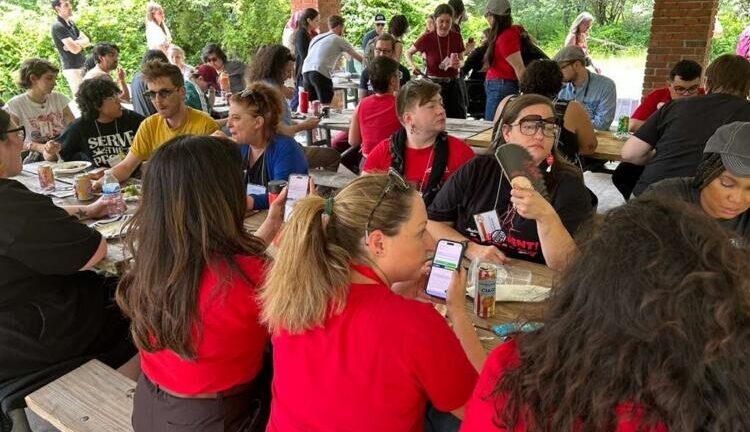
Along with these developments, there was a social gathering sponsored by Labor for Palestine-US, outside of the conference, that showed the depth of support among the activists. Apparently not approved by Labor Notes staff—or at least not willing to trust them—activists decided to meet away from the hotel site of the conference; they found a place in a public park, approximately one-quarter of a mile away from the hotel, where they had their luncheon gathering.
While some people arrived early, others kept streaming in. Elaborate displays had been put up, including Schuhrke’s book and pictures, on some tables, but they had to be removed so people could have places to sit and eat. Others gathered in a number of groups under trees. The large amount of food soon proved inadequate, so some of the later arrivals did not get full plates of food. Approximately 200 activists attended this luncheon, where they discussed a myriad of issues around Palestine and discussed ways to advance their efforts. It was a very spirited meeting and new connections among activists were made and expanded. (For more information, go to https://laborforpalestine.net.)
The importance of this was that these were mostly rank-and-file activists, present in many unions and from across the country; this was not a rogue group.
Challenging AFL-CIO Policy
However, the question not addressed was the role of the AFL-CIO top-level leadership in this process; it is not encouraging if we go back to 2004-05 developments. There had been over 30 years of work by California-based activist and plumber, Fred Hirsch, who had exposed the AFL-CIO’s regional organization at that time, AIFLD (American Institute for Free Labor Development), and its role in training and then in helping to prepare reactionary workers to participate in the military coup in Chile during 1973. Hirsch’s work was extremely well-respected, and along with others, had built up significant support for condemning the AFL-CIO’s “labor imperialist” foreign policy.
In 2004, over 400 elected representatives of California’s 2.5 million union members—one-sixth of the entire AFL-CIO at the time—voted unanimously to condemn the AFL-CIO’s foreign policy. Accordingly, this resolution was transmitted to the AFL-CIO’s national office to be considered at the 2005 National Convention in Chicago.
It was then transmitted to the Resolutions Committee of the convention, headed by AFSCME President Gerald McEntee, a strong supporter of AFL-CIO President John Sweeney, who transformed it into a resolution praising the AFL-CIO’s foreign policy. McEntee would not let any supporters of the California resolution speak in support of the way-laid resolution on the floor of the convention, and it was passed as modified: labor democracy be damned!
At the same 2005 convention, USLAW (US Labor Against the War) got a resolution passed that demanded that the US pull its’ troops out of Iraq at the first opportunity. This had been the first formal resolution passed by union members that challenged US foreign policy during a war that the US was engaged in. Despite being passed by constitutional actions, AFL-CIO leaders simply ignored it.
So, 20 years down the road, and Palestine is a major issue facing the US labor movement. Union members are organizing to oppose the genocide. Will they be able to break the hold of the top-level reactionary “leadership”? Only time will tell. But the AFL-CIO is much weaker than it was 20 years ago, and the range and intensity of support for Palestinian workers is much broader than “just” California back then; continued organizing, both in efforts and in depth of educating members, give hope this time around. And, if successful, the work done at the 2026 Labor Notes conference will be a significant milestone.
*A global labor scholar, Kim Scipes, PhD, is Professor Emeritus of Sociology at Purdue University Northwest in Westville, Indiana, a former industrial worker (printer), and long-time labor activist. His latest book, Unions, Race, and Popular Democracy: Building a Progressive Labor Movement, will be published by Cornell University Press on August 15, 2026. A leader of the 2005 effort to pass the “Build Unity and Trust Among Workers Worldwide” resolution in Chicago, he is also the author of AFL-CIO’s Secret War against Developing Country Workers: Solidarity or Sabotage? (Bloomsbury, 2010). He can be reached at kscipes@pnw.edu; his web site is at https://tinyurl.com/Kim-Scipes. [IDN-InDepthNews]