By Shihana Mohamed*
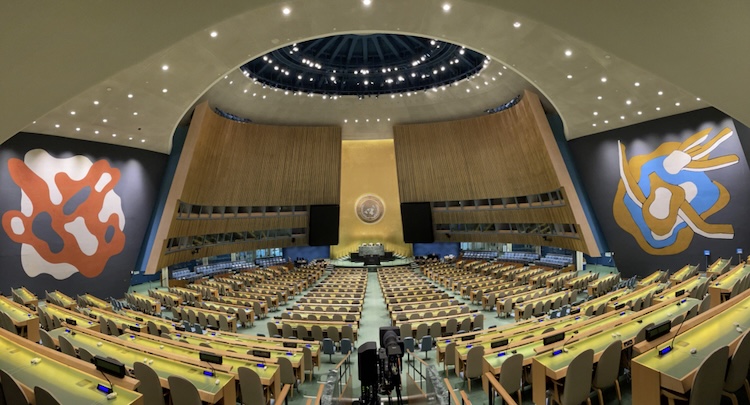
NEW YORK | 6 November 2026 (IDN) — “Outside these walls, people are not asking whether the United Nations still exists. They are asking whether it works.”
Khalilur Rahman of Bangladesh, President of the United Nations General Assembly, warned the international community in his opening remarks at the 81st Session of the United Nations General Assembly (UNGA 81).
The theme of UNGA 81 was “Restoring trust, managing transformation: A United Nations that delivers for all.” It was an attempt to repair a fracturing multilateral system and demonstrate the UN’s ability to deliver meaningful results for all.
However, statements by Asian leaders at the session highlighted several concerns. They questioned whether the UN can truly serve all nations effectively while significant inequalities persist in global decision-making.
Asia’s Major Powers
At UNGA 81, Asia’s major powers called for reforms to global governance, challenging existing imbalances in representation and the distribution of global influence.
China’s Vice President Han Zheng made his country’s position clear, declaring that “China has always spoken up for the Global South, stood up for the legitimate rights and interests of developing countries, and continued to work toward a more just and equitable global governance system.” He also stressed a people-centered approach to narrowing the digital divide.
For India’s External Affairs Minister Subrahmanyam Jaishankar, keeping things the way they are is simply no longer an option, because “large sections of humanity cannot be excluded from that process. The case for reformed multilateralism only gets stronger day after day.”
Japan’s Prime Minister Takaichi Sanae stated that “no country has any grounds to invoke the enemy state clauses anymore. We’ll continue to urge the relevant countries to get them removed.” She argued that the UN was trapped in the past, insisting that “the Security Council must be expanded in both permanent and non-permanent categories to reflect the realities of today’s international community, rather than that of 80 years ago.”
South Korea’s President Lee Jae Myung questioned: “Is the United Nations today capable of saving humanity from war, poverty, and disaster? Is the United Nations living up to its promise of restoring peace and achieving sustainable development?”
Small Nations
Small, island, maritime, and mountain nations underscored the existential costs of underrepresentation, demanding that small-state survival and sovereignty take precedence over major-power competition.
Bangladesh’s Prime Minister Tarique Rahman called for international support to resolve the Rohingya refugee crisis through safe repatriation and urged stronger climate finance and adaptation assistance to address the country’s vulnerability to climate change.
While stressing that mountain nations face climate disasters they did not cause, Bhutan’s Prime Minister Tshering Tobgay urged streamlined access to international climate finance. Nepal’s Prime Minister Balendra Shah also called for urgent, grant-based climate justice after devastating floods.
Maldives’ Vice President Hussain Mohamed Latheef urged debt sustainability reforms and financial safeguards to protect small island economies from global shocks affecting tourism and public finances.
Similarly, Sri Lanka’s Foreign Minister Vijitha Herath demanded reforms to global debt and development finance, arguing that crisis-hit economies should not bear global disruptions alone.
Inequality Within the UN
The external imbalance in global governance is mirrored within the UN itself.
Home to more than half of the world’s population and a major centre of global economic activity, Asia remains underrepresented in key decision-making structures, particularly at the highest levels of the UN system.
Western European and other States accounted for 42% of Professional and higher-category staff across the UN common system, compared with 19.4% from Asia-Pacific States.
At senior and decision-making levels, the disparity widened: Western European and other States held 49.5% of positions, compared with just 16.6% for Asia-Pacific States.
This representation gap is compounded by internal discrimination.
The United Nations Asia Network for Diversity & Inclusion (UN-ANDI) has documented systemic racism and racial discrimination in its recent report based on a system-wide staff survey.
The findings on workplace indignities affecting UN personnel of Asian nationality, origin, and descent raise serious concerns about organisational culture and barriers to career progression.
These disparities expose the gap between the UN’s commitment to equality and the experiences of Asian staff within its own ranks.
Urgent Actions by the Next Secretary-General
The current Secretary-General, António Guterres, will complete his second term on 31 December 2026. The United Nations is in the process of selecting its next Secretary-General.
The next UN Secretary-General will need negotiations and approval by Member States for major structural reforms. These include Security Council expansion, amendments to the UN Charter, and binding technology treaties.
However, the next Secretary-General can pursue administrative and operational improvements within the authority provided by the UN Charter.
The next Secretary-General should translate the following priorities into practical initiatives through their first 100-Day Action Plan:
- Fair Representation: Promote equitable geographical representation in senior-level staff appointments in the UN. Strengthen mechanisms to investigate and address discrimination and career barriers affecting Asian staff, drawing on findings from the United Nations Asia Network for Diversity & Inclusion (UN-ANDI).
- Empowerment of Women: Address the limited attention to explicit gender targets observed in statements made by Asian leaders at UNGA 81. Activate existing UN-wide gender acceleration initiatives covering all countries in Asia. Work with governments and development partners to link development programmes and funding to measurable outcomes in women’s employment, education, and leadership.
- Equitable Access to AI and Technology: Establish a high-level advisory team on AI fairness to develop open, inclusive principles for technology access, sharing and governance. Prevent wealthy countries and corporations from monopolising AI capabilities or restricting access to digital opportunities for developing countries.
- Climate Disaster Response: Reduce bureaucratic delays in climate finance by coordinating UN development and environmental agencies. Help vulnerable countries access emergency grants and rapid-response funding. Prioritise communities affected by devastating floods and rising sea levels, particularly in small island states and climate-vulnerable Asian countries.
- Refugee Protection: Coordinate UN refugee and development agencies to expand access to education, livelihoods, and pathways to self-reliance for displaced people. Work with host countries, including Bangladesh, which shelters a large Rohingya refugee population, and collaborate with regional partners to ease pressures on host communities.
- Regional Diplomacy: Use the Secretary-General’s good offices and special envoys to support US–Iran dialogue, ease tensions over shared river waters in South Asia, strengthen international water cooperation, and promote Central Asian connectivity, trade, and regional cooperation.
These measures would not replace reforms requiring Member State approval or guarantee outcomes dependent on voluntary funding and government cooperation.
They would, however, allow the next Secretary-General to demonstrate early progress by mobilising existing mandates, personnel, programmes, and partnerships.
Ultimately, the test of leadership will be whether the UN becomes more representative, accountable, and responsive to Asia and other underrepresented regions.
Delivering for All Includes Asia
UNGA 81 exposed the UN’s own contradictions in relation to its value system. The UN’s power structure is shaped by the geopolitical realities of 1945. This has become a major barrier to fully championing inclusive multilateralism in practice.
Asian world leaders have sent a unified, powerful message to the international community: the UN cannot manage a global transformation while ignoring the half of humanity residing in Asia.
The next Secretary-General must translate the UN’s commitment to equality and inclusive governance into measurable progress, both within the UN and across the wider multilateral system.
Delivering for all must mean ensuring that Asia’s peoples, perspectives, and priorities have a fair voice in shaping global decisions and the world’s future.
*Shihana Mohamed is President of the Asia Global Forum (www.AsiaGlobalForum.org) and a US Public Voices Fellow on advancing the rights of women and girls. She is founder of the UN Asia Network for Diversity & Inclusion (www.UN-ANDI.org), a human rights activist and advocate for gender equality and the advancement of women.
Editor’s Note: This article is published as opinion. The views and interpretations expressed are those of the author and do not necessarily reflect the editorial position of IDN-InDepthNews.