By Wolfgang Bittner*
The following commentary reflects the author’s personal assessment of German Chancellor Friedrich Merz’s policy towards Ukraine.
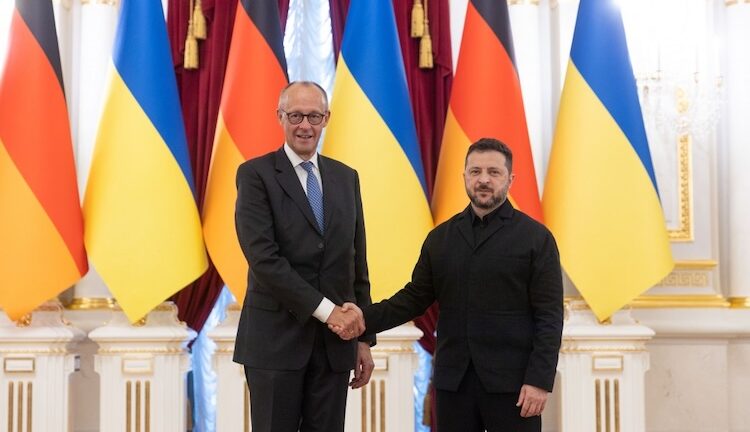
GÖTTINGEN, Germany | 9 October 2026 (IDN) — German Chancellor Friedrich Merz was pleased that Viktor Orbán was not re-elected and that the EU can transfer 90 billion euros to Ukraine. On 14 April 2026, he welcomed Ukrainian leader Volodymyr Zelenskyy to Berlin with military honours; among other things, they agreed on a “strategic partnership”. And on 4 October, he travelled to Kyiv for a solidarity visit, shortly after delivering an extremely anti-Russia speech on the occasion of the absurd awarding of the Peace of Westphalia Prize to NATO. Merz’s relationship with Ukraine is long-standing.
Ukrainian demands
Friedrich Merz has given – and continues to give – the authorities in Kyiv a boost with his support. Former Ukrainian Ambassador in Germany, Andriy Melnyk, who idolises the fascist Stepan Bandera[1] and has distinguished himself with insults and brazen behaviour, publicly approached the newly inaugurated German Chancellor in April 2025 with a downright crazy list of demands:
The coalition should pass a resolution “on the financing of arms deliveries to Ukraine amounting to at least 0.5 per cent of GDP (21.5 billion euros per year) or 86 billion euros by 2029 [ …] Initiate and implement the same 0.5 per cent rule at the EU level (372 billion euros by 2029),” as well as “the immediate delivery of 150 Taurus cruise missiles” and “30 per cent of Germany’s available fighter jets and helicopters …”.[2]
It is safe to assume such demands were not made without consulting Zelenskyy. No clearer illustration of the madness emanating from the war-government in Kyiv. The praise Merz receives from Melnyk is revealing:
“You know how much I – as a long-serving ambassador – have always valued our confidential exchanges with you as CDU chairman and CDU/CSU parliamentary group leader in the Bundestag. It would be no exaggeration to say that in April 2022, thanks to your personal commitment and the massive pressure from the opposition in parliament, we persuaded Chancellor Scholz and the “traffic light” coalition to supply heavy weapons to Ukraine after much hesitation. Your courageous visit to Kyiv in early May 2022 – as the first German statesman to do so – was also a powerful signal to spur the federal government at the time to provide much stronger military support to Ukraine.” [3]
Empty Words
This is reflected in the following passage from the coalition agreement between CDU-CSU and SPD: “Ukraine, as a strong, democratic, and sovereign state that determines its own future independently and with a Euro-Atlantic perspective, is of central importance to our own security. We will therefore substantially strengthen and reliably continue our military, civilian, and political support for Ukraine together with our partners. Working closely with our partners, we will advocate for a common strategy toward genuine and sustainable peace, in which Ukraine acts from a position of strength and on an equal footing. This also includes material and political security guarantees for a sovereign Ukraine. Germany will participate in the reconstruction of Ukraine.”
It seems to have completely escaped Merz and his coalition partners, or perhaps they refuse to acknowledge, that Ukraine is a “failed state” whose rulers, under the direction of Western warmongers, intend to make their soldiers—some of whom were forcibly conscripted—fight Russia to the last bullet.
The fact that Russia, as a nuclear power, cannot be defeated [4] is lost on the instigators, and they are already planning their business ventures in the reconstruction of the devastated areas. When the coalition agreement states, “The goal of our foreign and security policy is to preserve peace in freedom and security,” these are – as is evident from the preceding declarations of intent – nothing but empty words.
*The writer and journalist Dr. our. Wolfgang Bittner lives in Göttingen. His most recent book “Geopolitik im -. Deutschland-USA-EU-Russland” [Geopolitics at a Glance. Germany, the U.S., the EU, and Russia], was published by Hintergrund in Berlin in 2025. (IDN-InDepthNews)
Notes and sources
1 Stephan Bandera (1909–1959), a war criminal, murderer, and Nazi collaborator, is revered as a national hero.
3 Ibid.
4 See Wolfgang Bittner, “Geopolitik im Überblick. Deutschland-USA-EU-Russland “(Geopolitics at a Glance. Germany-USA-EU-Russia), Verlag Hintergrund, Berlin 2025, p. 24.