
By Benuka Senadheera*
WELIMADA, Sri Lanka | 20 February 2026 (IDN) — Sri Lanka, it seemed, was well on the way to recovering from the economic crash of 2022, when Cyclone Ditwah hit the island at the end of November last year, resulting in devastating floods in all 25 districts of the country.
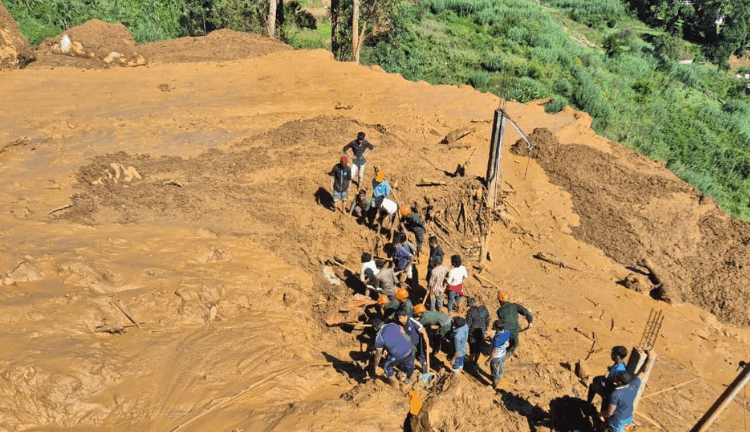
The floods washed away homes, bridges, roads, and even railroads. One of the worst hit areas was the mountainous tea-growing central hill country, where mudslides destroyed many homes and communities.
The floods caused more than 600 deaths nationwide, and an estimated damage bill of USD 4.1 billion according to a report by the World Bank, in a country which was just recovering from the 2022 debt default.
The central hill country of the island was severely affected by mudslides and floods, causing many deaths and homelessness. The government is now moving to implement new environmental laws.
President Anura Kumara Dissanayake stated in the parliament on December 5th that the government is to take firm decisions against the constructions in landslide-prone and high-risk flood zones. It was followed by the new National Building Research Institute Act, No. 20 of 2025, which states it is mandatory for any construction happening in these areas to get an assessment of the NBRO (National Building Research Organization).
This decision affects many long-standing communities and businesses. One such community is Rendapola, near Welimada town in the Central Hills. Most of those who were affected by the mudslides and the accompanying floods are still living in refugee camps here, set in public spaces like government schools and temples. Most of the people living in the community were working in the surrounding tea plantations, and were born and bred here.
Valli Mail is a mother and a plantation worker who is currently taking refuge in the camp set in Sri Ganapathy Tamil School. She and many others like her have lost their generational homes and all the belongings to the unforgiving mountains.
“That was the only home I knew from my birth,” said Valli Mail, when this reporter visited the community. Their houses were built in those areas almost a hundred years ago, before any of the official government bodies came into being. Since their village is marked as a red zone, she and others residing in the camp will never have access to their birthplace ever again. Yet, they are optimistic about the future and not averse to moving elsewhere if the government provides them with financial support.
“We understand the need to move somewhere else. We are now afraid to leave the children at home and leave for work. We don’t know what will have happened when we return”, says another traumatized resident at Nugathalawa, close to Welimada. In his community, where there were 120 houses, only 15 remain. Being a plantation worker, he is getting paid daily and cannot afford to rent a house. Managing daily expenses and educational needs for children is hard enough for them.
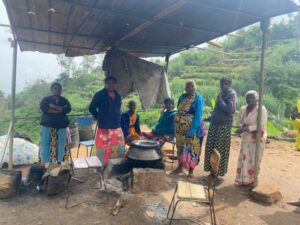
The request Valli Mail and others are making is simple. They are open to the possibility of starting a life elsewhere. But they would still need land to cultivate, or be close to the tea plantations. Since most of them are farmers or plantation workers from their childhood, starting a new livelihood at this age is impossible for them. They don’t ask to be taken care of by the government, but they need ownership of land to cultivate and live peacefully.
But relocating the community is only a part of the solution. As the vice principal of Sri Ganapathy school, S. Sivanathan pointed out, the relocated community and the existing community are going to face dilemmas concerning the cultural mix of bringing together two cultural identities. The predominantly Tamil Hindu community may need to live among the Buddhist (or Christian) Sinhalese. There will be a need for psychological guidance and consultation during the process.
Through his experiences, Sivanathan emphasized that it is important to have enforceable laws to prevent former residents from coming back to this land. In the past, people have sometimes returned to their former land after receiving compensation from the government, such as new land and houses. In the past, the institutions were weak in establishing order in such cases, he notes.
The NBRO, and Disaster Management Centre (DMC), which were established to prevent such practices, were proven to be inefficient.
“Government offices and officials are very distant from the general public, creating a barrier between the service provider and the receiver,” said P. Haridaran, the mathematics teacher of the Sri Ganapathy Tamil school.
The central highlands are famous for their tea plantations, a major export earner for Sri Lanka. Yet, the tea plants, which cover the hills and slopes of the highlands, don’t have deep roots to prevent soil erosion. Local residents say that this is a major reason for the landslides. The plantation owners have not followed safe environmental practices before, and water drainage systems are not properly maintained. The tall tree cover is also gradually fading from the plantations.
In response to the loss of property, the government is giving compensation of SLR 5 million (about USD 16, 300) to each person for a new house to be built. It will be given in three steps with an initial payment of 2 million, and two other payments of 1.5 million in two phases. The necessary requirement is to have a property that is certified by the NBRO as a safe zone from natural disasters. Those who are unable to find their own land are either provided with a house from the housing scheme built by the government, or given another 5 million to purchase a suitable property.
“People’s safety is our priority, and we try our best to let them continue their livelihood in their original lands or the lands provided elsewhere,” said Anusha Gokula Fernando, the chief secretary of Uva province.
To prevent people from coming back to their lands after acquiring compensation, the government is initiating a two-step procedure. The first step involves spreading awareness of the restricted areas through local media such as loudspeakers and communal gatherings. And the second step is to protect and restrict entry to the area with military support. Fernando believes that, as the political interference is non-existent under the current government, the law will be imposed and function properly.
The government plans to restructure the institutes, digitalizing the databases and their administrative systems to manage public relations more effectively. As the new act ensures, NBRO will function as the one authority to issue certifications for constructions, its suggestions will be strictly followed.
According to Fernando, the government is in talks with the plantation owners on the necessary guidelines to be followed. These discussions involve integrating technology, following safety guidelines, and best practices to stop soil erosion and landslides. The process will be evaluated by the Ministry of Plantation and Community Infrastructure. The government is threatening to take over any plantations that do not follow their instructions.
Sri Lankans’ resilience is being tested in communities like this. On the ruins of a disaster, people need to build sustainable communities that would not suffer such an environmental calamity again.
“The long-lasting socio-psychological impact of relocating a community is to be understood and processed carefully. The dependent mentality of the people should be analyzed and treated strategically,” argues Fernando “The aftermath of Ditwah has just started to reveal itself. But we are positive about the future. It is our duty to ensure that no future generation has to face such catastrophe again.”
* The writer is a journalism student at Kelaniya University in Sri Lanka, and an alumnus of the Global Sustainable Development Communication (GSDC) summer school of Wuhan University, China. This report is transmitted through a joint collaboration between IDN-In Depth News and GSDC.
[IDN-InDepthNews]