
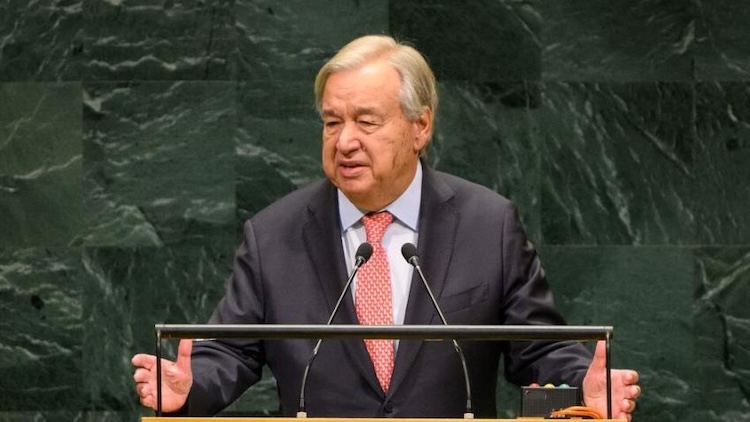
A study of eight decades of bargaining over senior UN posts raises questions about the independence of António Guterres’s successor.
By Ramesh Jaura
BERLIN | 3 October 2026 (IDN) — The contest to succeed António Guterres as United Nations Secretary-General is gathering pace. Much of the public discussion centres on the candidates, their qualifications and the long-overdue prospect of a woman leading the organisation.
A less visible contest is taking place behind the scenes. Governments—particularly the five permanent members of the Security Council—may be seeking assurances about policies, reforms and senior appointments before deciding whom to support.
A study published by the civil-society campaign 1 for 8 Billion, with the Brazilian research institute Plataforma CIPÓ, examines how such bargaining has influenced the selection of UN leaders since the organisation was founded.
The 41-page report, Backroom Deals: The Trade in Promises for Support between Member States and Candidates for UN Secretary-General, identifies more than a dozen credibly alleged attempts to exchange political support for influence over senior UN appointments.
Its warning is clear. A Secretary-General may take office already indebted to governments whose conduct he or she could later be required to challenge.
Independence promised by the Charter
The Secretary-General is not a world president. The office has no army, independent revenue or power to compel governments to follow UN decisions.
Its influence rests on diplomacy, public authority, access to governments and the ability to act as an impartial mediator. Independence is therefore essential.
Article 100 of the UN Charter states that the Secretary-General and other international civil servants must neither seek nor receive instructions from any government. Member states, in turn, undertake not to influence them in carrying out their duties.
The selection process sits uneasily with that principle. The Secretary-General is expected to remain independent of national governments but cannot be appointed without their approval.
The Security Council must recommend a candidate to the General Assembly. Any of its five permanent members—China, France, Russia, the United Kingdom and the United States—can block a contender.
Candidates must consequently win over the same governments from which they will later be expected to keep their distance.
The report draws on UN histories, memoirs and interviews or exchanges with more than 40 former senior officials, diplomats, candidates, campaign advisers, academics and journalists. Six candidates from the 2016 contest were among those consulted.
Many sources requested anonymity, and written records are scarce. The authors acknowledge that they cannot establish every case beyond dispute. The examples should therefore be described as reported or credibly alleged exchanges. Taken together, however, they point to a practice that has accompanied the UN throughout its history.
Senior offices treated as national possessions
The study pays particular attention to “ringfencing”—the practice of reserving influential UN posts for nationals of particular countries.
According to the report, a US national has held the UN’s principal political-affairs position continuously since 2007. That office, or one of its predecessors, has been led by a national of a permanent Security Council member for all but two of the 74 years since 1952.
Five French nationals in succession have headed UN peacekeeping. Four consecutive Chinese men have led the Department of Economic and Social Affairs. The last six UN emergency-relief coordinators have been British. A Russian national has headed either the UN office in Vienna or Geneva since 1993.
None of these arrangements is written into the Charter. Nor does the organisation formally acknowledge them. They endure through diplomatic custom, political pressure and the assumption that the major powers are entitled to offices matching their international position.
The consequences go beyond national prestige.
Senior officials oversee peace operations, political mediation, humanitarian relief, development and counter-terrorism. When nationality and government influence determine appointments, qualified people from smaller and medium-sized countries may never receive serious consideration.
The practice can also place an official in an awkward position. Senior appointees swear loyalty to the United Nations, but some may owe their appointment to their national government’s intervention.
The report does not claim that every official selected through such an arrangement serves national interests. Many have shown considerable independence. The difficulty lies in the method itself. It encourages suspicion, weakens confidence in the organisation and gives powerful governments access unavailable to most of the UN’s 193 members.
Bargaining from the beginning
The struggle over senior appointments began with the United Nations itself.
The report says Trygve Lie, the first Secretary-General, had little freedom to choose his senior team because the major powers had already divided important positions among themselves.
When U Thant was considered for the post in 1961, several governments sought influence over his appointments. France reportedly wanted a French national installed as his chief of staff.
U Thant refused. He told Paris, in effect, that it could veto him if it wished. France dropped the demand.
His response shows that candidates are not entirely powerless. A contender prepared to risk losing the office may be able to resist political pressure, particularly when the demand becomes known.
Later selections brought further reported exchanges.
In 1996, France reportedly requested control of the peacekeeping department in return for supporting Kofi Annan. Annan subsequently appointed a French national to lead it.
A similar demand was reportedly put to Ban Ki-moon during the 2006 contest. Ban retained the French incumbent and later appointed two more French nationals to the post.
The United States reportedly sought a senior political position for an American. It also urged Ban to remove several senior officials associated with Kofi Annan’s outgoing administration.
The United Kingdom reportedly indicated that it regarded the political-affairs department as its own. It did not secure that office, but it appointed a British national as emergency-relief coordinator. Every holder of that position since then has been British.
The price of accommodating Moscow
One of the report’s most detailed accounts concerns the selection of António Guterres in 2016.
Russia had initially indicated that it preferred a woman from Eastern Europe. Guterres, a Portuguese former prime minister and UN refugee chief, nevertheless became the leading candidate.
The study says Moscow wanted a Russian national to occupy a senior position at UN headquarters in New York. The most influential departments were already linked to other permanent members: political affairs to the United States, peacekeeping to France, and economic and social affairs to China.
Jeffrey Feltman, then the American heading political affairs, told the researchers that Guterres discussed the problem with him. Feltman proposed removing counter-terrorism responsibilities from his department and placing them in a separate office headed by an Under-Secretary-General.
The UN Office of Counter-Terrorism was subsequently established. Russian diplomat Vladimir Voronkov became its first head, and a Russian national has held the position ever since.
The report does not argue that the new office had no operational purpose. It questions whether the UN’s structure was shaped partly by the need to satisfy a permanent member’s expectations.
Political accommodation can therefore influence not only appointments but also the Secretariat’s organisation.
The researchers say Guterres’s efforts to reorganise the political and peacekeeping departments were also constrained by the need to preserve two senior positions associated with the United States and France.
Guterres was further reported to have appointed a Spanish national as his senior policy adviser after receiving firm support from Spain, then an elected Security Council member.
Such arrangements can restrict a new Secretary-General’s freedom before the term has begun. They may also make later reform more difficult because changes must preserve understandings reached during the selection campaign.
More public scrutiny—but secrecy remains.
The present contest is more open than the selections of earlier decades.
Candidates have published vision statements, curricula vitae and campaign-financing disclosures. They have appeared before General Assembly dialogues and taken part in a public town hall. Member states, journalists and civil-society groups have consequently had more opportunity to examine their records and proposals.
The decisive stage, however, remains closed.
Security Council members cast secret straw-poll ballots marked “encourage”, “discourage” or “no opinion”. Once differentiated ballots are used, candidates can see whether opposition comes from a permanent member with the power to veto them. The public is not told which government supported or opposed a particular contender.
Former Costa Rican vice-president Rebeca Grynspan led the fourth informal poll, held on 29 September. She received ten encouragements, three discouragements and two expressions of no opinion.
Guyana’s UN ambassador Carolyn Rodrigues-Birkett received eight encouragements, six discouragements and one no-opinion vote. Rafael Grossi, the Argentine head of the International Atomic Energy Agency, received eight encouragements and seven discouragements.
Following Michelle Bachelet’s withdrawal, seven formally nominated candidates remained in the contest. Others may still enter. Turkey is considering nominating former foreign minister and present Organisation for Security and Co-operation in Europe Secretary-General Feridun Sinirlioğlu, although no formal nomination had been submitted by 3 October.
A candidate needs at least nine Security Council votes and must avoid a veto. Grynspan has passed the numerical threshold, but the sources of her three discouragements are unknown. Her lead would be far less secure if one came from a permanent member.
This secrecy provides fertile ground for the bargaining described in the report. A candidate who encounters opposition may seek to discover what assurance, appointment or policy concession would persuade a government to change its vote.
Why the appointments matter
The issue is not simply whether France, Britain, China, Russia or the United States secures another prominent post.
The next Secretary-General will inherit an organisation weakened by wars it has been unable to end, division among the major powers, reduced American financial support and severe pressure on humanitarian and peacekeeping operations.
The incoming leader will have to reorganise parts of the UN, reduce expenditure and try to restore its political standing. That work becomes harder if influential departments must remain untouched because they are considered the preserve of particular countries.
The selection will also say much about the UN’s commitment to gender equality. Four of the seven formally nominated candidates are women, and no woman has led the organisation in its eight-decade history.
Appointing a woman would remove a glaring historical imbalance. It would not, by itself, guarantee institutional independence. The successful candidate could still arrive burdened by commitments made during private negotiations.
A call for public commitments
The report asks member states to declare that they will neither demand policy concessions nor seek senior appointments in exchange for supporting a candidate.
It urges candidates to oppose ringfencing, reject attempts by governments to dictate appointments and state publicly that they have made no promises to obtain votes.
The next Secretary-General, it says, should conduct open, merit-based recruitment for senior positions. The Secretariat should disclose meaningful information about selection criteria and shortlisted candidates.
The authors also support a single, non-renewable term for future Secretaries-General. Removing the prospect of re-election would free an office-holder from having to retain the favour of permanent Security Council members during the first term.
Other recommendations include ending government-provided housing for senior UN officials, requiring officials to resign from national diplomatic services before joining the Secretariat and publishing letters from governments that lobby for named candidates.
None of these measures would remove power politics from the United Nations. The organisation belongs to sovereign states, and governments will continue to advance their interests.
Nevertheless, there is an important difference between expressing a preference and secretly exchanging political support for influence over public offices.
The Security Council is choosing more than the next occupant of the UN’s highest post. Its conduct will decide whether the tenth Secretary-General begins with the freedom to appoint an independent team—or with private obligations to the governments that opened the way to office. (IDN-InDepthNews)