
COP30 and the Amazon Reckoning
This article was first published on https://rjaura.substack.com
By Ramesh Jaura
BERLIN | 28 November 2025 (IDN) — When world leaders arrived in Belém for COP30 on 10 November, the symbolism was clear. Delegates entered a city where the air is thick with humidity, the scent of river mud blends with diesel, and the vast Amazon rainforest stretches toward the Atlantic. This was the perfect place to highlight what is at risk.
Belém delivered only modest advances—more money for adaptation, new forest and health partnerships, and renewed attention to the world’s most climate-vulnerable communities—while sidestepping the central question haunting climate diplomacy for decades: how fast will the whirlwind of fossil fuels come to an end? Despite Brazil’s vision of COP30 as an “Amazon COP” centring forests, Indigenous rights, and the Global South, the gap between ambition and reality soon became apparent.
In the words of one negotiator, “It’s like we’re rearranging the furniture while the house burns.”
A Summit in the Shadow of a Forest
Hosting COP in the Amazon sent a clear message. Brazil aimed to shift global attention from conference centres and oil-rich capitals to the heart of the climate crisis. President Lula da Silva saw Belém as an opportunity for Brazil to regain climate leadership after years of environmental setbacks.
However, Belém also revealed some logistical problems. Some delegations had trouble finding places to stay, and civil society groups feared that high costs would exclude many of the voices the conference aimed to support. For diplomats from Pacific islands and sub-Saharan Africa, it was another sign that climate justice often conflicts with real-world challenges.
Even so, the Amazon was at the centre of every discussion. Delegates saw posters of Indigenous guardians, listened to riverboats at night, and sat under humid skies that made talks about “adaptation metrics” feel very real.
A Process Haunted by Old Promises
COP30 did not happen in isolation. It came after ten years of slow, step-by-step progress.
Paris 2015 created the framework: a global agreement with high temperature goals, but only voluntary national pledges. There was no enforcement or penalties. The gap between ambition and action was there from the start.
Glasgow and Sharm el-Sheikh mentioned coal for the first time. It was a timid step, but notable.
Dubai 2023 finally mentioned fossil fuels in the official text. Some called this “historic,” but critics pointed out it had no deadlines or real consequences.
Baku 2024 focused on money, delivering new finance goals but leaving vulnerable countries deeply unsatisfied.
As COP30 began, negotiators brought not just their luggage but also unresolved issues, knowing this summit had to achieve more than just symbolic gestures. After ten years of slow progress, the need for fundamental change was urgent.
Such a shift was not delivered.
What COP30 Actually Delivered
A Bigger Adaptation Pot—But Still Too Small
A key result was a promise to triple adaptation funding by 2035. This sounds ambitious and will help pay for flood defences, heat shelters, and drought monitoring. But for small island nations already losing land to rising seas, waiting for this support feels far too slow.
Negotiators also agreed on global adaptation indicators. Supporters see this as a move toward accountability. Critics call it “spreadsheet diplomacy,” saying it is a technical solution that hides a political failure.
The Silence on Fossil Fuels
The most telling part of COP30 was what didn’t appear in the decision text.
The lack of a commitment to phase out fossil fuels was the most critical outcome of COP30. Major oil and gas producers blocked all commitments: there was no fossil phase-out, no coal end-date, no limits on new oil and gas, and only support for renewables. This left the main competing economy unaffected, even with intense pressure from the EU, Colombia, and climate-vulnerable countries.
For a conference held in the world’s most significant carbon sink, the omission felt particularly jarring.
Forests, Health and Indigenous Rights: The Brighter Spots
Belém did yield meaningful advances in areas long neglected by climate negotiations:
The Tropical Forest Forever Facility aims to raise billions for forest protection.
- A major push to secure land rights for Indigenous communities—a proven safeguard against deforestation.
- The Belém Health Action Plan is the first global effort linking climate adaptation directly to public health.
These efforts—forest finance, Indigenous land rights, and connecting health to climate—are real progress. They show that climate diplomacy is expanding beyond just emissions to include justice and stewardship.
Carbon Markets: Progress Without Trust
Distrust still slows down efforts to finalise rules for international carbon markets. Negotiators in Belém made some progress after years of technical debate, but developing countries remain concerned. They fear that these markets will allow wealthy countries to offset emissions rather than actually reduce them. While COP30 moved the discussion forward, it did not do enough to address these ongoing concerns.
The Moral Outcry: Guterres’ Sharpest Warning Yet
UN Secretary-General António Guterres came to Belém with a clear warning: failing to keep the 1.5°C goal alive is a “moral failure” and “deadly negligence.” His speeches were urgent, like someone calling for the last lifeboat before a ship sinks.
He criticised fossil fuel interests for slowing progress and said governments were prioritising corporate profits over the planet’s survival. In Belém, he also supported the idea of a “Global Ethical Stocktake,” reminding everyone that climate diplomacy is not just about numbers but also about fairness, responsibility, and survival.
His words resonated, but they did not move negotiators significantly. The political tug-of-war remained stronger than the ethical appeal.

The Geopolitics No One Could Ignore
Three political forces shaped COP30 from behind the scenes:
- The absence of the United States as a full Paris participant under President Trump. Without the world’s second-largest emitter fully engaged, ambitions contracted.
- A coordinated pushback from fossil fuel producers, who framed rapid phase-outs as an attack on development and energy security.
- A more assertive but divided Global South, with Brazil and Colombia pushing forest protection, while others argued for flexibility on fossil fuels to fuel their development.
These combined geopolitical forces—US absence, opposition from fossil fuel producers, and a divided Global South—meant COP30 ended with just enough agreement for a watered-down deal, but not enough to create real change.
Is the UN Climate Process Trapped in a Blind Alley?
This question hung over Belém and remains unanswered.
The Case for “Yes”
Structural weaknesses: The Paris Agreement depends on voluntary pledges. Countries can promise anything, but may deliver very little.
Consensus paralysis: A few countries can weaken even the strongest proposals. If one country uses its veto, it limits everyone else.
Chronic underfunding: Adaptation. Loss and damage. Clean energy. The needs grow faster than the finances.
The Case for “Not Yet”
The process creates global norms: Without COPs, there would be no shared language, no unified reviews, and no global accountability, even if it is weak.
It amplifies justice claims: Small island states, Indigenous peoples, youth activists—COP is their megaphone.
It births coalitions that act faster than the negotiations themselves: From methane agreements to forest pledges, many breakthroughs happen outside the official process, not within it.
Despite its flaws and frustrations, the COP process is still the only global platform where more than 190 countries negotiate for the planet’s survival.
What COP30 Tells Us About the Future of Climate Multilateralism
COP30 revealed deeper tensions shaping the next decade of climate politics.
The Shift from Emissions to Systems
We are no longer just discussing carbon budgets. Now, the talks include energy security, public health, Indigenous rights, food systems, and investment flows. These issues are complex, political, and connected. They are harder to negotiate, but cannot be ignored.
Fragmentation of Authority
The centre of gravity is moving:
- G20 for industrial policy
- IMF/World Bank for finance
- Courts for accountability
- Regional blocs like BRICS for geopolitical leverage
COPs remain the symbolic centre, but they are less often the venue for key decisions.
The Trust Crisis
Belém’s progress on forests and health had some effect, but for vulnerable countries, the lack of sufficient adaptation funding and unclear promises to cut emissions have deepened mistrust. Fundamental structural changes, not just gestures, will be needed to restore confidence.
How the UNFCCC Could Escape the Dead End
If COP30 didn’t break the stalemate, it highlighted where reforms must happen.
Strengthen Standings, Reporting, and Accountability
Make progress reports more transparent, more public-facing, and more politically embarrassing for countries that fall behind.
Loosen the Grip of Consensus
Even symbolic majority declarations could create political momentum for a fossil phase-out or for finance obligations.
Centre Finance and Debt
Countries burdened by debt cannot invest in resilience or decarbonisation. Real climate finance reform will need cooperation with the IMF, development banks, and the G20, not just the UNFCCC.
Elevate Forests and Indigenous Rights
Belém showed that these are not “side issues.” They are essential parts of any effective climate response.
Link Climate with Peace and Security
As climate change affects migration and conflict, the climate agenda should be more closely linked to the UN Security Council, even if this is politically difficult.
What Comes After Belém?
COP30’s most significant legacy may be that it did not achieve major progress. The following two years will be crucial for global climate cooperation.
- Countries must submit new NDCs for 2035 and beyond.
- Global financial reforms will determine whether vulnerable countries receive the financial relief they need.
- Courts may force governments to act where diplomacy fails.
- Elections will shape national mandates—with consequences far beyond borders.
COP30 showed a world that is running out of both time and patience.
Has Climate Diplomacy Hit a Dead End?
Belém did not end global climate diplomacy. However, it made clear that the current system is struggling to deliver the changes that science says are needed.
The COP process is both essential and not enough. It cannot close the emissions gap or stop fossil fuel use on its own. But without it, there would be no global pressure, no shared direction, and no place for vulnerable countries to demand justice.
COP30 seemed less like a dead end and more like a narrowing path. There is still a way forward, but it will take political courage that cannot be created through negotiation alone.
Climate diplomacy will continue, but the planet’s future depends on what countries do outside the conference halls, not just during the meetings.
About the author: Ramesh Jaura is a journalist with 60 years of experience as a freelancer, head of Inter Press Service, and founder-editor of IDN-InDepthNews. His work draws on field reporting and coverage of international conferences and events. (IDN-InDepthNews)
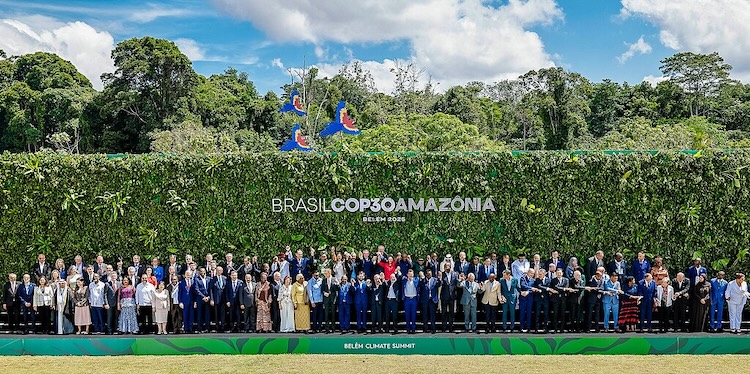
Image: President of the Republic, Luiz Inácio Lula da Silva, during the official photograph of the Climate Summit (COP30). City Park – Belém (PA)
Original link: https://rjaura.substack.com/p/why-the-ussouth-africa-rift-could
Related links: https://www.eurasiareview.com/26112025-can-global-climate-diplomacy-still-deliver-analysis/
https://www.world-view.net/can-global-climate-diplomacy-still-deliver/