From Ukraine and Myanmar to Haiti, the final days of September showed why the United Nations remains necessary and why its decisions so often fall short.
By Ramesh Jaura
BERLIN | NEW YORK | 1 October 2026 (IDN) — The United Nations Security Council ended on 30 September with a record that was neither empty nor reassuring. It brought the war in Ukraine before ministers, kept diplomatic channels open during a dangerous confrontation involving Iran, renewed international action against armed groups in Haiti and condemned a deadly air strike in Myanmar. At the same time, the UN refugee agency warned that severe funding shortages could deprive 8.3 million displaced people of essential help.
Taken together, these events offered a clearer measure of the UN than either its defenders or its critics usually allow. The organisation remains the only chamber in which adversaries, large and small states and affected countries can place their claims before the world. It can define legal obligations and authorise collective action, but it cannot make governments supply troops, money or political consent. The distance between decision and result becomes painfully visible.
That distance is the central issue. The Council should not be judged only by the number of resolutions it adopts. A more useful test is whether it identifies danger early, restrains violence, protects civilians, preserves common rules and makes powerful states answer for their conduct. During the last week of September it performed the first and last of those functions more convincingly than the others.
Ukraine and the veto
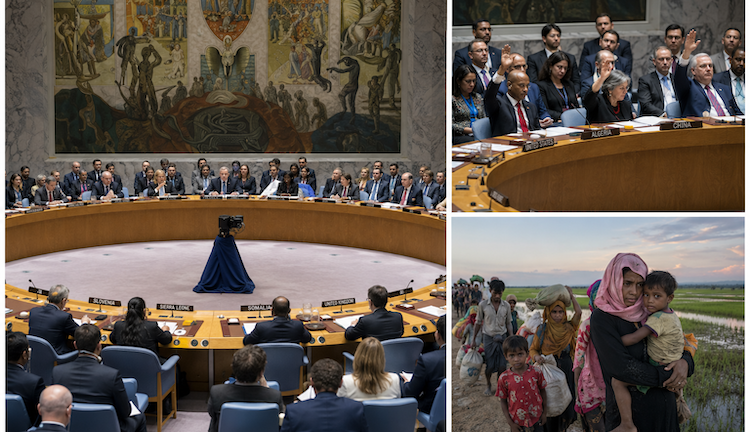
The high-level Council meeting on Ukraine heard that the war was entering a more dangerous phase. Intensified attacks, pressure on energy and civilian infrastructure and the risk of a wider regional confrontation formed the immediate background. President Volodymyr Zelenskyy used the General Assembly gathering to seek stronger support, while Russia rejected the case advanced by Kyiv and its allies.
The meeting demonstrated a real Council function. Ukraine could address the body entrusted with maintaining international peace and security. Governments could challenge Russia in public, and smaller states could restate principles that might otherwise be left to military alliances: territorial integrity, civilian protection and the prohibition on acquiring territory by force. The official record may matter later, in diplomacy or proceedings concerned with responsibility for the war.
But Russia is both a party to the conflict and one of the five permanent members able to veto Council action. No binding measure directed against Moscow can pass without its consent. The Council can debate, request briefings and address humanitarian consequences, but it cannot apply its strongest authority to a permanent member determined to block it.
The veto was the price of keeping the major powers inside the post-1945 order. Its defenders argue that enforcing peace against a major power might widen a war. The same arrangement also lets those powers shield themselves and their allies. In Ukraine, the Council was effective as a forum for scrutiny but ineffective as an instrument of enforcement. Public scrutiny carries diplomatic value, but it does not protect a family facing the next missile strike.
Haiti and the gap between mandate and means
Haiti supplied a different test. On 29 September the Council renewed the mandate of the Gang Suppression Force for six months, until 31 March 2027. Twelve members voted in favour; China, Pakistan and Russia abstained. The decision was meant to strengthen security before elections scheduled for 13 December, the country’s first national vote in a decade.
Here the obstacle was not a veto. It was the failure to match an agreed purpose with adequate means. Only about 1,500 of the planned 5,500 personnel had deployed when the mandate was renewed. Armed groups continued to control large areas, while nearly 1.5 million people had been driven from their homes. The vote followed new killings in the country’s agricultural heartland and a massacre in Kenscoff that reportedly left at least 47 people dead.
The Council therefore did what it was formally able to do: it preserved the legal basis for international assistance. Whether that decision improves life in Haiti will depend on governments supplying the remaining personnel, equipment and predictable finance. The abstaining members cited precisely these weaknesses. Their concern does not diminish the need for the mission; it points to the danger of authorising an operation that may again be blamed for failing after states deny it the resources required to succeed.
Haiti shows that Council weakness is not always caused by disagreement among the permanent five. Sometimes members agree on an ambitious mandate, applaud its adoption and leave implementation to voluntary contributions. The authority of a resolution then exceeds the capacity on the ground.
Myanmar and protection without access
The limits were starker in Myanmar. On 29 September the UN expressed alarm over reports that a military air strike in Kyauktaw, Rakhine State, had killed about 50 people and wounded at least 58. The reported victims included members of Rakhine, Rohingya, Hindu and Daingnet communities. Secretary-General Antonio Guterres condemned the violence, called for an immediate end to hostilities and demanded protection of civilians and safe humanitarian access.
Those words established an important public position. They also confirmed that conditions do not permit the safe return of refugees and internally displaced people. Yet condemnation did not give relief workers access, halt air attacks or create a protected route for civilians. Myanmar has been engulfed in conflict since the 2021 military takeover, and the Council remains divided over how far to pressure the authorities.
The episode became more troubling when Malaysia returned around 1,500 Myanmar nationals, including children, despite UN objections. Many had been held in immigration detention, and the refugee agency had not been allowed to assess whether their decisions were voluntary or whether some needed international protection. The contrast was severe: the UN warned that Myanmar was unsafe while a neighbouring country proceeded with returns.
The warning establishes a standard against which the returns can be judged. But it reveals the narrow reach of international protection when a government refuses access and no stronger enforcement follows.
Humanitarian promises without money
The UNHCR funding warning placed the problem in numerical terms. The agency said that 8.3 million refugees and displaced people could lose assistance in 2026 because it faced a shortfall of about 5.8 billion dollars. By July it had received only 32 per cent of the 8.5 billion dollars required, even as the population under its mandate was expected to reach 131.2 million by the end of the year.
The consequences were already visible. The agency had reduced its workforce by one-third and closed offices. Refugee registration had been delayed or suspended in Chad and Sudan; services for survivors of gender-based violence had been cut; and returning Afghans were receiving less support. Registration is not clerical housekeeping. It gives a displaced person recognised status and access to protection. When registration stops, people can disappear from the system that is meant to defend them.
This crisis changes the discussion about UN effectiveness. Governments frequently accuse the organisation of failing to meet needs that they themselves have asked it to address. Yet they delay payments, earmark contributions narrowly or reduce aid while displacement grows. A mandate without finance is not evidence that international cooperation is impossible. It is evidence that member states want its appearance without meeting its cost.
Representation and the succession contest
The General Assembly week also revived the argument over who holds power at the UN. Secretary-General Guterres used his final Assembly address before leaving office to say that international institutions still reflect an outdated distribution of power. Africa has no permanent Council seat. Latin America and the Caribbean have none. The ten elected members serve short terms and cannot veto decisions.
India illustrates the political cost of this imbalance. It is the world’s most populous country, a major economy and a long-standing contributor to UN peacekeeping, yet it remains outside permanent membership. Former Indian ambassador Syed Akbaruddin wrote in The Indian Express that India’s rise while the UN loses authority is a poor bargain for New Delhi. A weaker multilateral order does not necessarily free an emerging power. It can expose it to sanctions, financial restrictions and rules written elsewhere, with fewer dependable forums in which to contest them.
India is seeking an elected Council seat for 2028-29, but a temporary term cannot resolve the difference between participation and permanent privilege. Nor is India alone. Much of Africa, Latin America, and Asia still sees a Council marked by the settlement of 1945. Decisions become harder to defend, and sometimes harder to carry out, when those regions do not regard the institution as representative.
The contest to succeed Guterres illustrated the same concentration of authority. In the fourth informal Council poll on 29 September, Costa Rica’s Rebeca Grynspan moved narrowly ahead with ten votes of encouragement, three discouragements and two expressions of no opinion. If chosen, she would become the first woman to lead the UN. But the five permanent members will still make the decisive bargain before the General Assembly votes on their recommendation. The wider membership elects the Secretary-General, but in practice it receives a choice already shaped by the Council’s privileged powers.
What should effectiveness mean?
None of this supports the claim that the UN is irrelevant. An irrelevant institution would not draw presidents and foreign ministers to defend their conduct before it. Governments would not campaign for Council seats, or struggle to influence the choice of Secretary-General. UN officials still collect information, coordinate relief, support negotiations, monitor sanctions and keep channels open when bilateral relations have broken down. Council mandates give peace operations and political missions legal standing that no coalition of willing states can confer on itself.
Usefulness, however, is not adequacy. In Ukraine, a permanent member could prevent enforcement against itself. In Haiti, the Council could renew a mission but not guarantee the personnel and finance it needs. In Myanmar, the UN could condemn an attack and warn against returns but could not secure access or compliance. Across refugee operations, the organisation was expected to protect more people with sharply diminished funds.
The pattern suggests practical, if limited, steps. Council members could exercise greater restraint in using the veto where mass atrocities are alleged and give fuller public explanations when they block action. Elected members could play a larger role in drafting resolutions rather than being asked to endorse texts prepared by a few governments. Missions should not be authorised without credible commitments of personnel and finance. The General Assembly can also increase the political cost of obstruction through public debate, even when it cannot reverse a veto.
Council reform remains harder. Expansion requires agreement on new members, their status and the veto, followed by Charter amendment and ratification by all five permanent members. That procedure gives those who benefit from the present order control over its revision. Yet the difficulty is not a reason to abandon the case. Without broader permanent representation, the Council will continue to lose legitimacy precisely when it needs support for difficult decisions.
The final days of September left an uncomfortable conclusion. The Council mirrors the world’s distribution of power more faithfully than its critics sometimes admit. Its paralysis often begins in national capitals, not in the chamber in New York. But institutions must still be judged by what they achieve with the authority entrusted to them. The Security Council can expose aggression, preserve legal standards and authorise common action. It cannot manufacture political will, troops or money.
That is why the UN remains both necessary and insufficient. It gives a divided world a common chamber and a body of rules. This week, it made evasion harder, brought several crises before the public, and renewed one important mission. It did not stop the wars, protect everyone at risk, or ensure its own agencies could carry out their work. Unless governments accept restraint, representation and the cost of implementation, the Council will continue to document crises more effectively than it resolves them. (IDN-InDepthNews)
Sources
- UN Meetings Coverage and Press Releases, Security Council
- Reuters, UN renews Haiti force mandate for six months after fresh gang killings, 29 September 2026
- Reuters, UN alarmed by reports that Myanmar air strike killed 50, 29 September 2026
- Reuters, UN agency warns funding crisis could leave 8.3 million people without aid, 29 September 2026
- Reuters, Costa Rica’s Grynspan narrowly ahead in race to be next UN chief, 29 September 2026
- Syed Akbaruddin, India is rising as the UN loses authority, The Indian Express, 26 September 2026