
By Sam Ben-Meir*
NEW YORK | 24 November 2026 (IDN) — Ebenezer, the newest film adaptation of Charles Dickens’ A Christmas Carol, stars Johnny Depp in the eponymous role of Scrooge. The film has been called a “Christmas Carol for Capitalists” by David Crow, writing in Den of Geek—presumably because the poor are portrayed as dishonest, taking advantage of the well-off through fraudulent means, while those who seem to be acting on behalf of the poor are in reality lining their pockets with the charity of others. Or, like the unfortunate and generous-hearted Mr. Fezziwig, they wind up knifed to death by one of the underclass—a gratuitous act of violence, perhaps, and one not to be found in Dickens’ original story.
Crow goes so far as to suggest that the film might have been designed by the Heritage Foundation, so thoroughly does it appear to vindicate Scrooge’s suspicions of the poor and those who claim to represent their interests. In this reading, Ti West has transformed Dickens’ indictment of the wealthy into something approaching an apology for their prejudices. However, I think this is an unfair criticism, unless one clings to the delusion—unfortunately not uncommon among liberals—that destitution somehow makes one morally upright, that deprivation produces truthfulness, that suffering necessarily ennobles those who endure it. Dickens knew better.
Poverty and moral judgement
Is it not the very point of the personifications of Ignorance and Want that these social ills degrade and dehumanize? Dickens presents them not as innocent children whose goodness shines through their misery, but as monstrous embodiments of a society that has abandoned its most vulnerable members. The point is struck home by West’s genuinely horrific depiction of these anthropomorphized calamities. Their grotesque appearance is not a betrayal of Dickens’ vision but a realization of something already implicit in it: that poverty and ignorance do not simply deprive human beings of material comforts but can disfigure the very conditions of their humanity.
It can truly be said that the film refuses to romanticize the poor—but so far as I can tell, so does Dickens. Perhaps he does not go to the same lengths as West, but I would not call this film an apology for Scroogism, as Crow implies. There is, after all, a crucial difference between portraying the poor as capable of dishonesty, cruelty, and violence, and suggesting that they deserve the conditions under which they live. The former is entirely compatible with a radical critique of capitalism; indeed, it may be indispensable to one. The latter is the ideological position that Dickens rejects.
Crow’s criticism is not without force. If a film repeatedly vindicates the suspicions of the wealthy while presenting the poor as opportunists, it risks shifting responsibility for social misery from the institutions that produce it onto those who suffer its consequences. But that is not the only way to understand West’s choices. The dishonesty of the poor and the corruption of their supposed benefactors may equally be understood as symptoms of a world in which human relations have been poisoned by economic necessity, competition, and the pursuit of advantage.
Indeed, the murder of Fezziwig, however gratuitous it may initially appear, is especially revealing in this regard. Fezziwig represents the possibility of benevolence within commercial society, the employer whose generosity and good spirits stand in contrast to Scrooge’s cold calculation. But what if even such generosity cannot protect him from the violence of a brutalized social world? What if individual goodness is simply insufficient to overcome the antagonisms generated by the economic order itself?
That would hardly amount to a defense of capitalism. On the contrary, it would suggest that the problem runs considerably deeper than the moral character of particular capitalists. Indeed, I would go so far as to say that West’s film, despite its shortcomings, may be considerably more subversive than the genuine Christmas carol for capitalists, namely Frank Capra’s It’s a Wonderful Life.
The sacrifices of George Bailey
Too much ink—digital or otherwise—has already been spilled critiquing the underlying ideology of self-sacrifice and capitalism with a human face that defines Capra’s classic. George Bailey is presented as a fundamentally decent man whose life consists in subordinating his own aspirations to the needs of others. His reward is not emancipation from the conditions that have made his life a succession of sacrifices, but the discovery that those sacrifices were worthwhile after all.
To be sure, Capra is not an uncritical defender of capitalism. Mr. Potter is an unmistakable embodiment of its predatory tendencies, and Bailey’s Building and Loan offers an alternative grounded in mutual assistance and community. But this is precisely the limitation of Capra’s vision: the answer to capitalism’s destructive logic is a better capitalist, a man willing to sacrifice his own happiness to hold back the worst tendencies of the system.
The moral blackmail of the Pottersville sequence is the ideological heart of the film. Bailey is shown what the world would have become had he never existed: a nightmare of greed, exploitation, and moral decay. The implication is unmistakable. Without his sacrifices, the community would have fallen into the hands of Potter, and everything worthwhile would have been destroyed.
The alternatives are thus reduced to two: either Bailey accepts the life of sacrifice that has brought him to the brink of suicide, or the world becomes Pottersville. The possibility that the social arrangements themselves might be transformed, that human flourishing might not depend upon the endless self-denial of exceptional individuals, is never seriously entertained.
The solidarity of Bedford Falls is genuine, and the community’s rescue of Bailey is not without moral beauty. But the question is why the survival of that community should depend upon the extraordinary sacrifices of one man, rather than upon institutions that make such sacrifices unnecessary. In the end, Bailey is reconciled to the very conditions that drove him to despair. The film offers its audience the comforting assurance that goodness will be rewarded, provided one is willing to give enough of oneself away. One can hardly imagine a more effective ideological consolation.
What redemption demands
The difference between Dickens and Capra is, at its deepest level, the difference between the possibility of genuine transformation and facile acquiescence to the world as it is. This is not to suggest that Dickens offers a revolutionary program. Scrooge does not overthrow capitalism, abolish private property, or transform the economic institutions of Victorian England. His redemption remains, in an obvious sense, personal. But the transformation demanded of him is nonetheless fundamental. He must come to recognize that the principles by which he has organized his existence are not merely unkind but profoundly destructive of his own humanity and that of others.
Scrooge must become another kind of human being. Bailey, by contrast, must learn to accept the kind of life he has already been living. That difference should not be underestimated. For Dickens, the horror lies in the recognition that an entire way of life has been organized around a monstrous misunderstanding of what it means to be human. Scrooge’s wealth has not liberated him but imprisoned him; his independence has become a form of isolation, his self-sufficiency a spiritual impoverishment. He has sacrificed the possibility of genuine human relations to the accumulation of money.
West knows how to make a horror film—and part of me wishes that he had not pulled so many punches in his Christmas offering. Perhaps his motivations were understandable, given the expectations surrounding a holiday film intended for a broad audience. But the truth of Dickens’ tale is that it is horrific. Or, more specifically, it grasps the horror that is industrial capitalism: that it destroys the humanity of both worker and capitalist, that it reduces human relations to relations of exchange, and that it renders the suffering of others an unfortunate but acceptable cost of doing business.
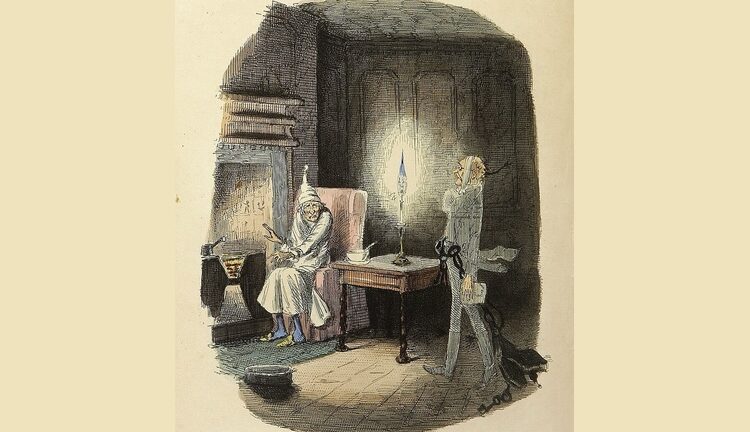
The chains carried by Marley’s ghost are not simply the punishment awaiting an exceptionally wicked individual. They are the visible manifestation of a life governed by accumulation, a life in which the instruments of commerce have become the instruments of bondage. Marley has forged his own chains, link by link, but the materials from which they are fashioned belong to the economic world he inhabited.
And to Dickens’ credit, he does not offer us the cheap consolation that if we are prepared to sacrifice our lives, we can hold back the darkest tendencies of capitalist logic. His ending is undoubtedly sentimental, and his faith in individual conversion leaves the structures of exploitation largely untouched. Yet the horror he has disclosed cannot be so easily contained by the happiness of the final pages. The distinction, then, is not that Dickens offers a structural solution where Capra offers only an individual one. Neither does. It is rather that Dickens exposes a horror his sentimental resolution cannot finally dispel, while Capra’s sentimental resolution invites us to believe that the underlying antagonism has been overcome.
The limits of individual goodness
The development of neoliberalism over the past four decades has revealed with the utmost clarity just how ideologically driven the consolations of Capra’s Christmas vision truly are. We have been told repeatedly that individual responsibility, charitable generosity, and personal sacrifice are the answers to social problems that are, in fact, systemic. Workers must accept insecurity, families must shoulder the costs of care, and communities must rely upon the benevolence of those who have prospered under arrangements that leave others increasingly vulnerable.
The demand is always for another George Bailey: someone prepared to give up his dreams, surrender his security, and hold together a world that ought not to require such sacrifices in the first place. West’s Ebenezer, for all its imperfections, at least allows the horror of Dickens’ world to remain visible. The poor are not necessarily virtuous, the charitable are not necessarily honest, and the wealthy are not necessarily monsters. But none of this absolves the social order that pits human beings against one another and makes their degradation possible.
The real ideological mystification is not to portray the poor as capable of cruelty or dishonesty. It is to imagine that the destructive logic of capitalism can be overcome through the goodness and self-sacrifice of individuals, without transforming the conditions that make such sacrifices necessary. The horror of A Christmas Carol is not that Scrooge is a monster. It is that the world which made him monstrous survives his redemption.
*Sam Ben-Meir teaches philosophy at the City University of New York, College of Technology. He is the author of Ethical Interanimality: Toward a Relational Philosophy of Nature (Westphalia Press, 2026).
Editor’s Note: The views expressed in this article are those of the author and do not necessarily reflect the editorial position of IDN-InDepthNews.