BUT IT IS NOT INEVITABLE
By Ramesh Jaura
This article was first published on https://rjaura.substack.com/
BERLIN | 3 January 2026 (WorldView) — There was a time when humanitarian statistics startled the world. A million displaced people made headlines. A famine declaration triggered emergency summits. Images of starving children or bombed-out cities forced leaders to respond, if only to be seen responding.
Today, the numbers are so large that they risk becoming abstract:
· Two hundred and thirty-nine million people need humanitarian assistance.
· Twenty countries are facing severe deterioration.
· Nearly 90 per cent of the world’s extreme humanitarian need is concentrated among a small fraction of the world’s population.
The danger is not just that suffering is increasing. It is that we are getting used to it.
The 2026 Emergency Watchlist from the International Rescue Committee (IRC) is based on solid data, including 74 indicators, trend analysis, and frontline reporting. But its main message is not about numbers. It is about morals and politics. It shows that the crisis has become routine, that emergencies no longer end, and that the global system established after World War II to protect civilians is quietly deteriorating.
As the world entered the New Year, António Guterres described this moment with clear and direct words: “As we enter the New Year, the world stands at a crossroads. Chaos and uncertainty surround us. Division. Violence. Climate breakdown. And systemic violations of international law.”
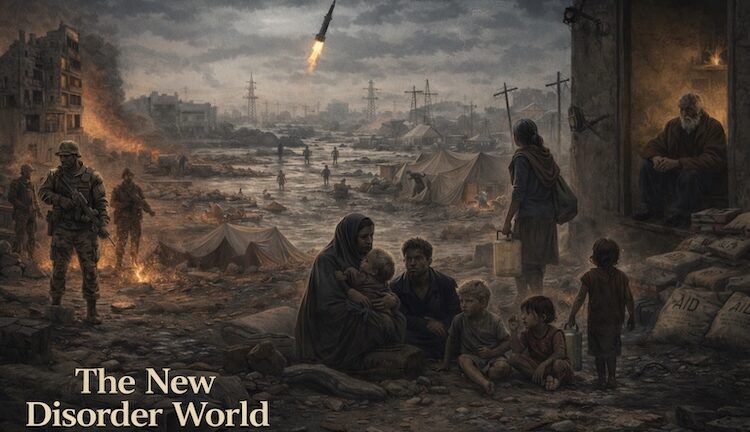
The IRC calls this reality the “New Disorder World.” It is not a sudden collapse, but a slow unraveling. Wars continue without solutions, climate disasters happen again and again without recovery, aid budgets get smaller as needs grow, and civilians are left to deal with the consequences.
To truly understand this disorder, we need to look beyond rankings and risk scores. We must pay attention to the lived experiences behind these numbers, especially those of children.
Poverty poisons childhood and societies
Poverty is not just a lack of income. It is a harmful force that damages childhood itself.
It claims children’s lives, undermines their health and development, and limits their ability to learn. The consequences last a lifetime: adults who grew up in poverty are more likely to struggle to find decent work, to live shorter lives, and to experience depression and anxiety.
However, poverty affects not only individuals. It also harms entire societies.
When poverty limits children’s potential, it hurts future economic growth. By separating the rich from the poor, it weakens the ties that bind communities. And when people lose hope, it creates the conditions where violence and extremism can grow.
While global military spending has reached a record US$2.72 trillion, hundreds of millions of children still lack basic necessities such as schooling, clean water, healthcare, or a safe home.
Why?
UNICEF’s The State of the World’s Children 2025 makes it clear: the problem is not a lack of resources, but a matter ofpriorities.
When progress was possible — and why it is slowing
The tragedy is not that child poverty cannot be reduced. The real problem is that the world already knows how to minimize it, but is now losing momentum.
Between 2000 and 2023, real progress was made. In low- and middle-income countries:
· In 2000, three out of five children lived in severe deprivation.
· By 2023, this had fallen to 2 out of 5 children.
This progress did not happen by accident. It stems from strong political will, evidence-based policies, and a clear commitment to prioritize children’s rights.
Countries that reduced child poverty made it a national priority. They included children’s needs in economic planning, protected social investment from economic shocks, provided cash assistance to families, expanded access to education and healthcare, and supported decent work for parents and caregivers—rights enshrined in the Convention on the Rights of the Child.
According to the World Bank Group, the extreme child poverty rate fell from 20.7 percent to 15.9 percent between 2013 and 2022, but this progress has since slowed as new global pressures intensify.
The future is no longer far away; it is already shaping childhood.
As UNICEF warns, the future that policymakers once imagined in abstract terms is already here.
Three major forces are changing childhood in the New Disorder World:
Climate breakdown
Already, four out of five children are exposed to at least one extreme climate hazard each year, such as flooding, drought, heatwaves, or storms. These climate shocks destroy livelihoods, interrupt schooling, displace families, and push those already struggling into extreme poverty.
Conflict on a historic scale
In 2024, almost one in five children worldwide lived in a conflict-affected area, nearly double the share in the mid-1990s. Beyond the violence, conflict disrupts education and healthcare, sets back economic growth for generations, and traps societies in long-term poverty.
Digital inequality
As economies become more digital, the digital divide between those with and without access to technology increasingly affects access to education and opportunity. Children without internet, devices, or digital skills are being left behind, making existing inequalities worse.
These forces do not act alone. They strengthen each other, and they come together most acutely in the countries highlighted by the IRC Watchlist.
When “emergency” becomes permanent
In recent years, people thought of emergencies as temporary. A crisis would occur, aid would arrive, stability would return, and reconstruction would begin. That story no longer fits.
In many Watchlist countries, crisis is not a break from everyday life; it is normal life.
In South Sudan, children are born in displacement camps and may grow up and raise families there. In Syria, a generation has come of age amid ruins and exile. In Afghanistan, conflict spans a lifetime. For these communities, the word “emergency” has lost its sense of urgency. There is no ‘after.’ There is only endurance.
The Watchlist points to places where coping mechanisms have collapsed. Families have sold their belongings, taken children out of school, moved again and again, and still cannot survive without help. These societies are not lacking resilience; they are worn out by it.

Sudan: catastrophe in plain sight, silence in response
For the third year in a row, Sudan ranks first on the Watchlist. This is an unprecedented and troubling fact.
Fighting between rival military factions has uprooted millions. Neighbourhoods have emptied. Villages have burned. Markets have collapsed. Health systems have disintegrated. In parts of the country, famine conditions have taken hold.
Children leave school not because education is undervalued, but because schools no longer exist or are unsafe. Mothers skip meals so children can eat.
What makes Sudan a symbol of the New Disorder World is not just the violence, but also the global response—or the lack of it. The warning signs were clear. Yet diplomatic efforts were hesitant, humanitarian appeals were underfunded, and political attention was brief.
Sudan demonstrates how a humanitarian disaster can unfold in real time, with complete documentation, yet still fail to prompt decisive action.
Gaza and Ukraine: when the world is watching — and still fails
In Gaza, humanitarian collapse has been rapid and brutal. Families are displaced again and again. Homes, schools, and hospitals are damaged or destroyed. Access to food, water, and medical care is severely constrained. Parents carry injured children through overcrowded clinics, unsure whether treatment will be available.
In Ukraine, the war has settled into a grinding phase. Repeated strikes on energy infrastructure have turned winter into a weapon. Elderly residents sit in dark apartments. Children learn to sleep through air-raid sirens.
Ukraine receives much more aid than many Watchlist countries. Still, its situation shows a hard truth: even strong international support cannot fully protect civilians when conflict drags on and becomes normal.
Together, Gaza and Ukraine reveal a key paradox of the New Disorder World: being seen does not guarantee protection.
Crisis without front lines: fear as daily life
Not all humanitarian crises look like war.
Haiti shows a distinct and deeply troubling kind of collapse. There are no clear front lines, no ceasefires, and no peace talks. Armed gangs control neighborhoods. Kidnappings are common. Sexual violence is widespread. Families are afraid to leave their homes.
Children stop going to school not because of bombs, but because the streets are too dangerous. Hospitals struggle to operate as staff fear abduction.
This is what a crisis looks like when the social contract falls apart. Authority breaks down, and civilians are left to face daily life in fear.
Aid fatigue, debt, and the theft of futures
One of the most painful findings of the Watchlist is the widening gap between need and response.
Humanitarian funding is shrinking as crises increase. Appeals go unanswered. Clinics close. Food rations are cut. Education programs are suspended not because needs have declined, but because funding has.
UNICEF’s warning is even starker. Unprecedented cuts in development aid are projected to result in the deaths of at least 4.5 million children under five by 2030. International assistance for education is expected to fall by nearly a quarter by 2026, leaving six million more children at risk of being out of school — the equivalent of emptying every primary school in Germany and Italy.
At the same time, growing debt is limiting national investment. Forty-five developing countries now spend more on interest payments than on health, and twenty-two spend more on interest than on education. This creates a vicious cycle: not investing in children harms economic growth, which, in turn, makes debt even more difficult to repay.
UNICEF warns of an “indebted generation”: children whose futures are limited by debts taken on before they were even born.
A world prepared for war, not for children
is brings us back to the arithmetic highlighted by António Guterres.
Global military spending has risen to $2.7 trillion, almost 10 percent above pre-pandemic levels. This is 13 times the amount of all development aid and about the same as Africa’s entire GDP.
At a time when conflict is at its highest since World War II, the world is spending far more on weapons than on fighting poverty, preventing conflict, or protecting children.
As Guterres put it: “A safer world begins by investing more in fighting poverty and less in fighting wars. Peace must prevail.”
“Whose future?” and whose responsibility
Young people are acutely aware of the gap between rhetoric and reality. As a UNICEF Youth Foresight Fellow, Nahjae Nunes observed:
“They said the economy was recovering. We didn’t feel it.
They said schools were open. Ours were underwater.
They said children were resilient. We were exhausted.
They said we were the future. We asked: Whose?”
The answer is unavoidable.
Theirs.
And whose responsibility?
Ours.
Choosing differently before the disorder hardens
The destroyed villages of Sudan, the ruined neighborhoods of Gaza, the dark apartments of Ukraine, and the fearful streets of Haiti are not isolated tragedies. They are signs of a global system that has learned to accept suffering as background noise.
The IRC has sounded the alarm. UNICEF has laid bare the cost to children. The UN Secretary-General has issued a moral challenge.
The facts are known. The resources exist. The question is one of priorities.
The New Disorder World is not inevitable. But changing it will take something rare: the collective courage to choose children, peace, and justice over war, neglect, and indifference, before disorder becomes permanent. (IDN-InDepthNews)
*Ramesh Jaura is a journalist with 60 years of experience as a freelancer, head of Inter Press Service, and founder-editor of IDN-InDepthNews. His work draws on field reporting and coverage of international conferences and events.
Original link: https://rjaura.substack.com/p/why-2026-marks-the-new-disorder-world
Related links: https://www.world-view.net/why-2026-marks-the-new-disorder-world/
https://www.eurasiareview.com/31122025-why-2026-marks-the-new-disorder-world-oped/