Leadership, Legitimacy and the Future of Multilateralism
By Ramesh Jaura
This article was first published on https://rjaura.substack.com/
BERLIN | 27 July 2026 (IDN) — The election of the next United Nations Secretary-General is about far more than choosing the Organisation’s ninth leader. It will test whether the international community still believes dialogue, cooperation and shared responsibility can prevail in an era marked by war, geopolitical rivalry, climate disruption and growing distrust. The candidates bring impressive credentials, but the larger question is what kind of leadership an increasingly fragmented world now requires.
A Historic Choice
The contest to choose the next United Nations Secretary-General comes at one of the most consequential moments in the Organisation’s eighty-year history. Rarely has a succession unfolded against such a demanding global backdrop. War has returned to Europe, conflict continues to devastate parts of the Middle East and Africa, strategic rivalry between the United States and China is reshaping international politics, climate change is accelerating, and rapid technological change is creating opportunities and risks that transcend national borders. At the same time, confidence in international institutions has weakened, even as the need for international cooperation has become more urgent.
Rarely has the choice of Secretary-General mattered more.
The office itself has changed remarkably little since the United Nations was established in 1945. The Secretary-General commands no armed forces, controls no independent budget and possesses no authority to compel governments to act. Yet expectations of the office have expanded dramatically. In times of international crisis, governments, civil society and public opinion increasingly look to the Secretary-General not for executive power but for political judgement, moral credibility and the ability to keep channels of dialogue open when diplomacy begins to falter.
The 2026 selection process will determine who succeeds António Guterres when his second term ends on 31 December 2026. The successful candidate will assume office on 1 January 2027 for a five-year term.
The succession is distinctive in several respects. It has produced one of the strongest and most diverse fields of candidates in the Organisation’s history, including several women whose experience places them among the most credible contenders ever to seek the office. At the same time, the Caribbean Community (CARICOM) has demonstrated unusual regional unity by endorsing Guyanese diplomat Carolyn Rodrigues-Birkett, illustrating how smaller states are seeking a stronger voice in global governance.
More fundamentally, this is not simply a contest between distinguished individuals. It is a debate about the future direction of the United Nations itself.
António Guterres will leave office at the end of 2026 after serving the maximum two terms. His successor will inherit challenges unlike any his predecessors have faced. Armed conflict, humanitarian emergencies, unsustainable debt, climate change, food insecurity, pandemics, digital transformation and artificial intelligence increasingly overlap, creating crises that cannot be understood—or resolved—in isolation.
These developments have exposed a central paradox of contemporary international politics. Never before have global challenges been so interconnected. Never before have governments found collective action so difficult.
The United Nations inevitably reflects these tensions. Critics point to divisions within the Security Council, the slow pace of institutional reform and the Organisation’s inability to prevent or end many of today’s conflicts. Such criticisms deserve serious attention. Yet they sometimes obscure a more fundamental reality. Whenever governments seek to negotiate peace, coordinate humanitarian relief, confront climate change, advance sustainable development or establish international norms for emerging technologies, they continue to turn to the United Nations. No other institution combines universal membership with comparable political legitimacy.
That paradox defines the forthcoming election. The next Secretary-General will not determine whether states choose cooperation over confrontation. Those decisions remain the responsibility of sovereign governments. But the office can influence the quality of international dialogue, encourage compromise where compromise remains possible and remind governments that long-term security ultimately depends on their willingness to act collectively.
Leadership without coercive power has always been the defining characteristic of the Secretary-Generalship. In today’s fractured international environment, it has become its greatest challenge—and perhaps its greatest strength.
Understanding why requires a closer look at the office itself and the way successive Secretaries-General have interpreted its responsibilities across eight decades of profound international change.
The Office
Few positions in international affairs are more prominent—or more widely misunderstood—than that of the United Nations Secretary-General.
The title often conveys an impression of sweeping international authority. The reality is far more restrained. The Secretary-General commands no military forces, controls no independent budget and cannot compel governments to implement United Nations resolutions. Every peacekeeping operation depends upon troops contributed voluntarily by Member States; every major initiative rests on their political support and financial commitment.
Yet the influence of the office has never depended primarily on formal authority. Its strength lies instead in credibility, impartiality and trust. The Secretary-General occupies a unique position within the international system: expected to uphold the principles of the United Nations Charter while retaining the confidence of governments whose interests often diverge sharply. It is an office that demands diplomacy without partisanship, leadership without domination and independence without isolation.
Successive Secretaries-General have interpreted that delicate balance in different ways, each responding to the political realities of his time.
Trygve Lie established the institutional foundations of an office without historical precedent. Dag Hammarskjöld transformed it into an instrument of active diplomacy, demonstrating during the Suez and Congo crises that the Secretary-General could exercise independent political leadership while remaining faithful to the Charter. U Thant, through patience, discretion and quiet persistence, helped preserve dialogue during some of the Cold War’s most dangerous confrontations.
The end of East-West rivalry broadened expectations of what the United Nations might achieve. In An Agenda for Peace, Boutros Boutros-Ghali argued that preventive diplomacy, peacebuilding and post-conflict reconstruction should become central responsibilities of the Organisation. The tragedies of Rwanda and Bosnia, however, underscored a painful lesson that remains relevant today: the United Nations cannot act more decisively than its Member States are prepared to allow.
Kofi Annan restored much of the office’s moral authority by placing human dignity at the centre of the Organisation’s work. Under his leadership, the Millennium Development Goals reflected the growing recognition that peace, development, human rights and security could no longer be pursued as separate agendas. His advocacy of the principle of the Responsibility to Protect likewise demonstrated the determination of the international community to confront mass atrocities, while simultaneously exposing the political constraints that continued to limit collective action.
Ban Ki-moon broadened that agenda by making climate change and sustainable development defining priorities of his tenure. His leadership helped pave the way for two landmark achievements: the Paris Agreement on climate change and the adoption of the 2030 Agenda for Sustainable Development. Together they recognised that the world’s most pressing challenges increasingly transcend national borders and require coordinated international responses.
António Guterres has presided over perhaps the most turbulent international environment since the end of the Cold War. The COVID-19 pandemic, Russia’s full-scale invasion of Ukraine, the war in Gaza, widening instability across parts of Africa and intensifying strategic competition among the major powers have placed extraordinary demands upon the Organisation. Throughout these crises, he has repeatedly warned that humanity is entering what he has called “an age of chaos”, in which geopolitical fragmentation, climate disruption and technological change increasingly reinforce one another.
Across eight decades of profoundly different international circumstances, one lesson has remained constant.
The effectiveness of a Secretary-General has never depended primarily upon formal authority. It has depended upon the confidence governments are willing to place in the office. The Secretary-General can convene, mediate, warn, encourage and persuade. The office cannot substitute for the political will of Member States.
That distinction has become even more significant today.
Whoever succeeds António Guterres will inherit an Organisation whose responsibilities continue to expand even as its room for manoeuvre narrows. Expectations of the United Nations have never been higher; consensus among governments has rarely been harder to achieve. The successful candidate will therefore require far more than diplomatic experience or administrative competence. The office now demands strategic judgement, political resilience and the ability to preserve dialogue in an increasingly polarised international system.
Six Visions of Leadership
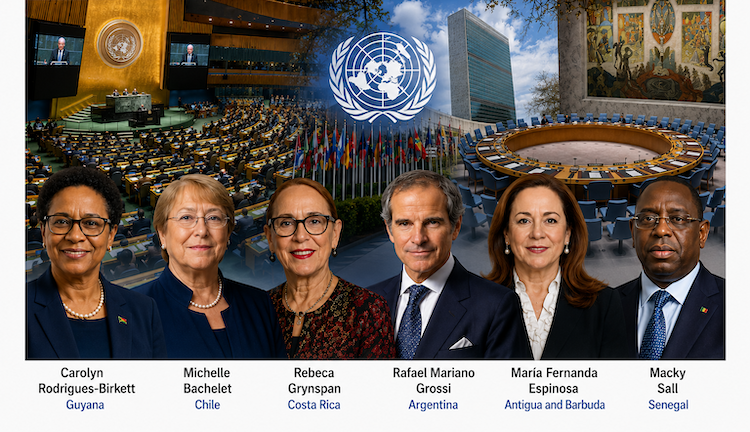
At the time of publication (in July 2026), six officially nominated candidates were contesting the post of United Nations Secretary-General. Collectively, they offered Member States an unusually diverse range of experience and perspectives. Their careers span national leadership, multilateral diplomacy, development, human rights, nuclear governance and international economic cooperation, reflecting the changing expectations of an office that has evolved alongside the international system itself.
The choice before governments is therefore not simply between distinguished personalities. It is between different visions of international leadership.
Carolyn Rodrigues-Birkett of Guyana enters the race with the unanimous backing of the Caribbean Community (CARICOM), an endorsement that reflects rare regional unity. A former Foreign Minister, she brings extensive diplomatic experience, including her successful rotating presidency of the United Nations Security Council. Her candidacy symbolises the growing confidence of smaller and middle-income countries that the leadership of the United Nations should more fully reflect the diversity of its membership in an increasingly multipolar world.
Michelle Bachelet brings perhaps the broadest combination of executive political and United Nations experience. Twice President of Chile, Executive Director of UN Women and later United Nations High Commissioner for Human Rights, she has spent much of her public life balancing principled advocacy with pragmatic diplomacy. Her record demonstrates an ability to defend universal human rights while maintaining engagement with governments across sharply differing political systems. If elected, she would become the first woman to serve as Secretary-General.
Rebeca Grynspan offers a leadership profile rooted in development economics and international cooperation. As Vice-President of Costa Rica, Secretary-General of the Ibero-American General Secretariat and later Secretary-General of UNCTAD, she has consistently argued that economic inequality, debt, climate vulnerability and sustainable development are inseparable from international peace and security. Her candidacy reflects the increasingly important view that global prosperity is itself a foundation of international stability.
Rafael Mariano Grossi, Director General of the International Atomic Energy Agency (IAEA), represents a different tradition of multilateral leadership. Throughout his tenure, he has worked at the intersection of nuclear verification, arms control and international security, including during periods of heightened geopolitical tension. His experience illustrates the importance of technical diplomacy—where scientific expertise, political judgement and patient negotiation converge in the management of some of the world’s most sensitive security challenges.
María Fernanda Espinosa, former President of the United Nations General Assembly, Foreign Minister and Defence Minister of Ecuador, combines extensive diplomatic and political experience with long-standing engagement on sustainable development, gender equality and multilateral reform. Having already presided over the General Assembly, she possesses an intimate understanding of the Organisation’s institutional dynamics and has consistently advocated a more inclusive and representative system of global governance.
Macky Sall, former President of Senegal, approaches the officeasf a head of state who has managed national development while activelyengaging in African and international diplomacy. During his presidency, he chaired the African Union and represented the continent in negotiations with major international partners. His candidacy highlights the growing influence of Africa within the United Nations at a time when many Member States argue that the continent should play a more prominent role in global decision-making.
Taken together, these candidates illustrate how profoundly expectations of the Secretary-General have evolved. Earlier generations looked primarily for an accomplished diplomat capable of managing relations among the major powers. Today’s international environment demands a broader repertoire of leadership. The next Secretary-General must be equally comfortable addressing armed conflict, humanitarian emergencies, development finance, climate change, technological transformation and the governance challenges posed by artificial intelligence.
The composition of the field is itself significant. Several candidates possess experience at the highest levels of both national government and the United Nations. The debate has therefore moved beyond the symbolic question of whether the Organisation is ready to appoint its first woman Secretary-General. The more consequential question is which candidate possesses the judgement, political skill and strategic vision required to lead the Organisation through one of the most demanding periods in its history. Yet qualifications alone will not determine the outcome.
However distinguished their records, every candidate must ultimately navigate a selection process in which professional merit and geopolitical calculation inevitably intersect. Understanding that process is essential to understanding the significance of the forthcoming election.
The Politics of Selection
If candidates present their qualifications in public, why is the decisive phase of the election conducted largely behind closed doors?
The answer lies in the constitutional architecture of the United Nations. While the General Assembly formally appoints the Secretary-General, it does so only on the recommendation of the Security Council. In practice, no candidate can reach the General Assembly without first securing the Council’s endorsement. This gives the five permanent members—China, France, Russia, the United Kingdom and the United States—a decisive influence over the outcome.
This arrangement has shaped every appointment since 1946. It reflects the political compromise upon which the United Nations itself was founded. The major powers accepted a universal organisation on the understanding that none would be required to accept a Secretary-General fundamentally opposed to its vital interests. The veto remains controversial, yet it also reflects the political realities that have enabled the Organisation to endure for more than eight decades.
The selection process has nevertheless become progressively more transparent. Candidates now participate in informal dialogues with Member States, answer questions from governments and civil society, and publish vision statements outlining their priorities. These innovations have broadened international scrutiny and strengthened the legitimacy of the process. They have not, however, altered its underlying political logic.
When consultations among the permanent members begin, geopolitical considerations inevitably become decisive. Regional representation, gender, diplomatic experience and professional competence all matter. So too does political acceptability. A candidate perceived as too closely aligned with one geopolitical camp, too confrontational or insufficiently acceptable to one of the permanent members is unlikely to secure the consensus required for recommendation.
This raises an enduring question: does the best candidate always prevail?
History offers no simple answer. Every Secretary-General has required broad confidence among Member States, but every appointment has also reflected the political circumstances of its time. Some emerged because they articulated a compelling vision for the Organisation. Others represented the most acceptable compromise among competing interests. In an institution founded on sovereign equality yet operating within an unequal distribution of power, legitimacy and political acceptability have always been inseparable.
The 2026 succession illustrates that tension with particular clarity. Several candidates possess credentials that would have made them formidable contenders in almost any previous election. Yet experience alone will not determine the outcome. The decisive question is whether the permanent members conclude that a candidate possesses not only professional competence but also the judgement to navigate an increasingly divided international environment without deepening existing fault lines.
Far from diminishing the importance of the office, this demanding selection process underscores its significance. If the Secretary-General exercised little influence, governments would invest far less political capital in choosing the occupant. Their scrutiny reflects an enduring recognition that, despite its limited formal authority, the office helps shape the tone of international diplomacy, frame global debates and preserve channels of communication when direct dialogue between governments becomes difficult.
The politics of selection therefore reveal a broader truth about the United Nations itself. The Organisation is neither an idealistic parliament of humanity nor merely an arena for great-power rivalry. It is both. Its effectiveness has always depended upon balancing universal aspirations with political realities—a balance every Secretary-General must navigate from the first day in office.
Although the United Nations Charter sets out only the broad constitutional framework, the modern selection process has become progressively more transparent. Candidates now present vision statements, participate in public dialogues with Member States and answer questions from civil society before the Security Council begins its private deliberations. While these innovations have increased public scrutiny, the decisive negotiations still take place behind closed doors.
Beyond the Election
The significance of the 2026 succession extends well beyond the choice of one individual. It raises a more fundamental question: what kind of United Nations does today’s world require?
The challenges confronting the Organisation no longer fit neatly into traditional diplomatic categories. Armed conflict, climate change, food insecurity, unsustainable debt, pandemics, technological disruption and large-scale displacement increasingly reinforce one another. No state, however powerful, can address these interconnected crises alone. Their complexity has strengthened rather than weakened the case for international cooperation.
Yet confidence in multilateral institutions has declined. Political divisions among the major powers have become more pronounced. The Security Council frequently struggles to reach agreement on issues central to international peace and security. International law is increasingly contested, while commitments to sustainable development often collide with immediate national priorities. Across many societies, scepticism towards international institutions has grown, fuelled by perceptions that they are either ineffective or insufficiently representative of today’s geopolitical realities.
These criticisms deserve careful consideration. The United Nations has never been a world government. It reflects the political will of its Member States and cannot consistently act beyond the authority they collectively grant it. When governments cooperate, the Organisation has demonstrated remarkable achievements. When they do not, its limitations become painfully apparent.
History nevertheless offers valuable perspective.
In 1980, the Independent Commission on International Development Issues, chaired by former German Chancellor Willy Brandt, argued that widening disparities between industrialised and developing countries threatened both international stability and global prosperity. Its landmark report, North–South: A Programme for Survival, maintained that peace, development and economic interdependence could no longer be treated as separate policy agendas. More than four decades later, that insight remains strikingly relevant.
The world has changed profoundly since the Brandt Commission presented its findings. Yet, its central message has endured: lasting security cannot be separated from shared prosperity, and lasting prosperity cannot be sustained without international cooperation.
That understanding has increasingly shaped the evolution of the United Nations itself. The Millennium Development Goals, followed by the 2030 Agenda for Sustainable Development, reflected the growing recognition that peace, development, environmental sustainability and human rights are mutually reinforcing. Progress in one area increasingly depends upon progress in all the others.
Whoever succeeds António Guterres will inherit this integrated agenda at a moment when implementation has become more difficult than ever. Leadership will therefore require more than administrative competence. It will demand the ability to rebuild confidence, encourage dialogue and demonstrate that international cooperation remains not merely desirable but indispensable.
The Secretary-General cannot resolve the conflicts that divide today’s world. Those responsibilities remain with sovereign governments. But the office can create political space for dialogue, remind states of their shared interests and articulate a vision of international cooperation that extends beyond immediate crises towards longer-term stability.
Ultimately, the influence of the Secretary-General derives not from legal authority but from credibility. In an age of deepening distrust, that credibility may prove one of the Organisation’s greatest assets.
Leadership for a Fragmented World
Every generation confronts moments that test the resilience of the international system. The election of the next Secretary-General will not determine whether the world ultimately chooses cooperation over confrontation. That responsibility rests with governments alone. Yet the decision they make will reveal much about the kind of leadership they believe this moment demands.
The office of Secretary-General has always occupied a unique place in international affairs. It commands neither military power nor political sovereignty. Its influence derives instead from credibility, impartiality and the capacity to persuade governments that dialogue remains preferable to confrontation. In an age of intensifying geopolitical rivalry, those qualities are not signs of institutional weakness. They are among the few resources capable of sustaining cooperation when formal agreement becomes increasingly elusive.
The candidates bring different experiences, priorities and diplomatic styles. Some have devoted their careers to conflict resolution, others to development, human rights, regional cooperation or multilateral negotiation. The central question is therefore not who possesses the most distinguished curriculum vitae, but which vision of leadership best matches the demands of an increasingly fragmented world.
History suggests that the United Nations has often proved most valuable not when international politics has been harmonious, but when political divisions have been deepest. Throughout the Cold War, during decolonisation and in successive humanitarian crises, it preserved channels of communication that might otherwise have disappeared. That remains one of its indispensable purposes today.
The international landscape continues to change with remarkable speed. New centres of economic and political influence have emerged. Digital technologies are reshaping societies at an unprecedented pace. Climate change, migration, financial instability, pandemics and armed conflict increasingly transcend national borders, reminding governments that many of the defining challenges of the twenty-first century cannot be resolved through unilateral action alone.
The next Secretary-General will therefore inherit an Organisation facing unprecedented expectations under increasingly constrained political circumstances. Success will depend less upon expanding the formal powers of the office than upon exercising its existing responsibilities with wisdom, integrity and strategic imagination. The ability to build confidence, encourage dialogue and sustain trust may ultimately prove more valuable than any institutional reform.
Ultimately, however, the future of the United Nations will not be decided in the Secretary-General’s office in New York. It will be decided in national capitals, where governments determine whether competition outweighs cooperation, whether immediate advantage prevails over long-term responsibility and whether collective action remains possible in an increasingly divided world.
The Charter of the United Nations begins with the words, “We the peoples of the United Nations…” Those opening words remain the Organisation’s moral foundation. They remind us that the United Nations was created not merely as an association of sovereign states, but as an expression of a larger conviction: that peace, justice and human dignity are responsibilities shared across national borders.
That aspiration has never been fully realised. It has often been frustrated by war, rivalry and the enduring realities of power politics. Yet it has never disappeared. Across eight decades, the United Nations has continued to embody humanity’s determination to resolve differences through dialogue rather than force and to seek common solutions to common problems.
The forthcoming election is therefore about far more than selecting the ninth Secretary-General of the United Nations. It is about reaffirming whether international cooperation remains a practical necessity in an interdependent world.
The answer will not be determined by one individual alone. Yet the leadership entrusted to that individual will influence how effectively the United Nations responds to one of the most consequential periods in its history.
For more than eight decades, the United Nations has endured because governments have recognised a simple truth: however imperfect international cooperation may be, the alternatives are invariably more dangerous.
That truth is no less compelling today than it was in 1945.
About the author: Ramesh Jaura is affiliated with ACUNS, the Academic Council of the United Nations, and an accomplished journalist with sixty years of professional experience as a freelancer, head of Inter Press Service, and founder-editor of IDN-InDepthNews. His expertise is grounded in extensive field reporting and comprehensive coverage of international conferences and events. Subscribe for free or pay and stay updated. Buy SKYWARD HAVEN – A Speculative Novel.Visit: https://www.rameshjaura.com [IDN-InDepthNews]