
By Jonathan Power*
As the United States’ invasion of Venezuela dominates headlines, it obscures a quieter but significant truth: despite setbacks, the world has steadily moved away from war as a legitimate instrument of policy.
LUND, Sweden | 6 January 2026 (IDN) — When it comes to war, the world does move on for the better, even as dramatic events like the U.S. invasion of Venezuela seize global attention. At present, there are no full-scale interstate wars. The longest civil wars of our era—in Afghanistan and Syria—are winding down. The Thai–Cambodian conflict splutters on at low intensity. Only Sudan’s civil war appears continuously inflammable. And only one country today openly threatens the use of nuclear weapons—North Korea—yet both its arsenal and credibility remain limited.
The world is certainly not as benign as it was in the 1990s at the end of the Cold War, a period that marked the lowest point in recorded warfare. There are more conflicts today than in that brief interlude, and the Cold War itself threatens to re-combust. Nevertheless, the number of soldiers killed on battlefields continues its long-term decline. In Europe—the historic epicenter of warfare—there has been no major war between states for roughly 80 years.
From Just War to the Outlawing of War
War in the early seventeenth century, at the time of the great Dutch thinker Hugo Grotius, was understood in a very different way from the way it is today. Grotius taught that war was the legitimate way in which states could enforce their rights or their side of a dispute. There was no League of Nations or United Nations to which antagonists could appeal. States had no recourse but to take the law into their own hands. Grotius upheld the morality of war and argued that it was legally applicable to disputes ranging from finance to criminal justice to territorial disputes.
Grotius built on the “just war” theory, which has its roots in the philosophy of Cicero, St Augustine, and Thomas Aquinas, the latter two of whom believed they had fashioned a concept that reflected the teachings of the Church. All of them believed that, in certain cases, war was just and legitimate. Grotius accepted this but went further, arguing that states had the right to conquer and to right wrongs.
By the time of the eighteenth century, so accepted was Grotius’s reasoning that war came to be seen as absolutely necessary, and knights all over Europe regarded it as a right of passage. By the early twentieth century and the First World War, the British war poets regarded war as “glorious,” a sentiment that would have been endorsed by Grotius.
We owe much to the successful Chicago corporate lawyer Salmon Levinson for setting aside Grotius’s philosophy. Repelled by the carnage of the First World War, he began an anti-war movement that spread fast across the Americas and Europe. He campaigned for the “outlawing of war. War was not a legal human endeavor. Even though the League of Nations was coming into existence, the concept of the illegality of war was not built into its constitution, as it was later with the United Nations.
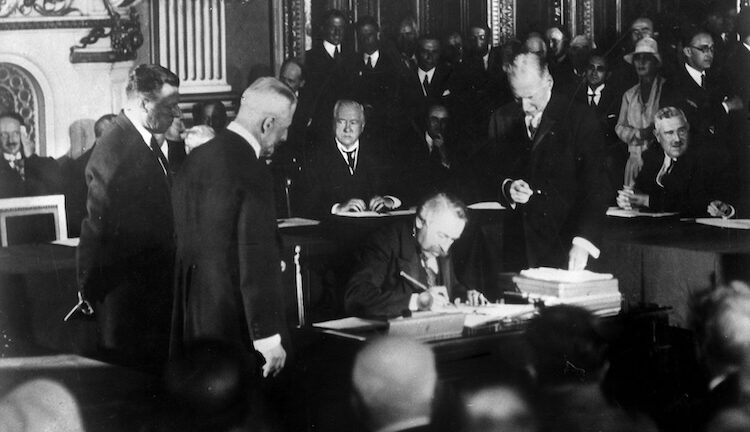
On August 27, 1928, the great powers assembled in Paris at the French foreign ministry. France’s foreign minister, Aristide Briand, declared before the assembly that that day would “mark a new date in the history of mankind” and the “end of selfish and wilful warfare”. The treaty became known as the Kellogg-Briand Pact. (Kellogg was the U.S. secretary of state.) It outlawed war as a means of resolving disputes. No longer, it said, could war be “an instrument of national policy”. The Pact remains in effect to this day. Its principles were later incorporated into the United Nations.
An Imperfect Norm That Still Matters
By the light of the times the Pact was truly idealistic and revolutionary, even though it was totally ignored by the protagonists of World War 2, the Korean War, the Vietnam, Iraq and Afghanistan wars, the Indo-Pakistan and Israeli-Arab wars and the Ukraine war today. In that sense, the Pact was a failure.
Nevertheless, it overturned Grotius’s philosophy. From 1928 onward, war was deemed illegal and not a morally acceptable means of settling disputes. Economic sanctions, previously illegal, were now permitted as an alternative means of enforcement.
Over time, despite the wars mentioned above, the concept has permeated the minds of politicians and the public and has contributed to the more peaceful state of the world we inhabit in the twenty-first century.
In one sense, World War 2 rendered the Pact meaningless. But it did lead the successful Allies to build a new structure, grounded in the illegality of war. The UN was founded. Despite its failures, its Charter has established a norm.
As we enter 2026, we should reflect that humanity is now formally committed to the pursuit of peace, that war is considered illegal, and that the number of people killed in war has gone sharply down. Simply put: we have to keep up the good work. America’s invasion of Venezuela has been criticised the world over, as has Russia’s invasion of Ukraine. Most countries don’t support either Russia or the U.S. playing at “might is right. The atmosphere has changed.
*Jonathan Power has been an international foreign affairs columnist for over 40 years and a columnist and commentator for the International Herald Tribune (now The New York Times) for 17 years. [IDN-InDepthNews]
Copyright © Jonathan Power