
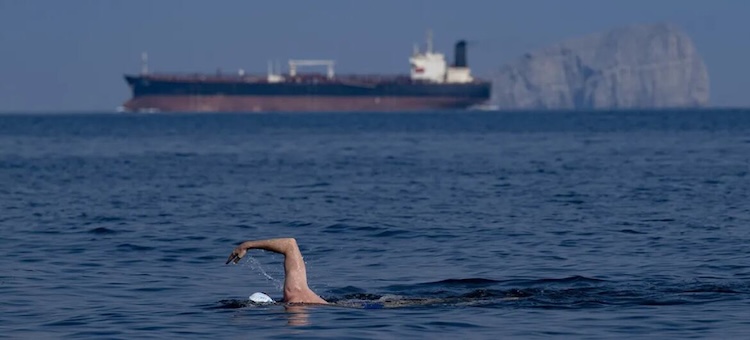
Ocean advocate Lewis Pugh’s 15-kilometre swim drew attention to a cost of the conflict that shipping figures miss: pollution can spread across borders and linger long after vessels return.
By Ramesh Jaura
BERLIN | 29 November 2026 (IDN) — On the second day of his swim in the Strait of Hormuz, Lewis Pugh saw a gas carrier burning near Oman’s Musandam peninsula, he told the Associated Press. The International Maritime Organization’s incident log records damage to the gas carrier Tara Gas on 16 November near the Omani port of Khasab. One seafarer was listed as missing. The entry recorded no pollution from that incident.
Pugh, the UN Patron of the Oceans, swam 15 kilometres over three days along the Musandam coast, rounding the Cape of Hormuz. In an interview published by UN News on 28 November, he drew attention to a question that rarely leads coverage of the strait: what happens to the sea, the shore and the people who depend on them when ships and oil facilities come under attack?
The water behind the shipping lane
Before this year’s conflict, an average of 20.9 million barrels of oil a day passed through Hormuz in the first half of 2025, according to the US Energy Information Administration. That was equivalent to roughly a fifth of global petroleum liquids consumption. The figure explains why disruption is felt far beyond the Gulf. It says little about what an oil spill can do to a fishing community on its shores.
The Persian Gulf is shallow, warm, highly saline and almost enclosed. It exchanges water with the open ocean through the narrow Strait of Hormuz. The UN Environment Programme (UNEP) says oil pollution can persist for years, while currents and tides can carry it from one country’s waters into another’s. The effects can reach fisheries, coastal tourism and desalination facilities that supply drinking water.
Pugh described mangroves on the Iranian coast and coral reefs on the Gulf of Oman side of the strait. Dolphins, sea turtles and dugongs inhabit the region’s waters. Industry, shipping and oil and gas operations had already placed these habitats under pressure before the war. Measuring the damage caused by the fighting will mean distinguishing fresh pollution from contamination that was already there.
What the incident log leaves out
The IMO’s published tally for 26 November listed 145 confirmed maritime incidents in the strait and the wider Middle East. Several entries record damage to vessels without pollution. The tally documents what happened to ships and crews; it cannot tell coastal communities how much oil reached their shores or account for contamination from strikes on land.
In a separate statement on environmental damage from the conflict, UNEP said remote sensing had confirmed strikes on oil facilities in and around urban areas, including Tehran. It also reported oil spills in marine areas and warned that munitions could release heavy metals and toxic chemicals.
A satellite image can help locate an oil slick. Establishing what has settled on the seabed, or whether contaminants have entered the food chain, takes sampling. That depends on scientists being able to reach the affected areas safely. Until then, the damage visible from the air or from a passing boat will tell only part of the story.
A recovery no country can manage alone
Gulf countries have worked together on marine protection since the 1970s. UNEP points to protected areas and joint efforts to restore mangroves and coral reefs. The same relationships matter during a spill: authorities may need to share observations, warn neighbouring coastlines and agree where to send clean-up crews. The country where a vessel is struck may not be the one where the oil comes ashore.
Pugh has called for an end to the fighting and for work to begin on the environmental damage. A safer strait would give response crews and scientists access to waters they cannot always reach now. Shipping figures will show when tankers are moving again. For people who fish the Gulf or depend on it for drinking water, recovery will be measured closer to shore. (IDN-InDepthNews)