By Jonathan Power*
LUND, Sweden | 2 December 2025 (IDN) — “George, you have to understand that Ukraine is not even a country. Part of its territory is in Eastern Europe, and the greater part was given to us.” These were the ominous words of President Vladimir Putin of Russia to President George W. Bush in Bucharest, Romania, at a NATO summit in April 2008, as reported in The New York Times.
The New York Times also reported, “Britain’s hard-edge approach was crystallised in a punchy essay by the defence secretary, Ben Wallace. Writing in The London Times, Mr Wallace rejected Mr Putin’s claims of encirclement by NATO and accused the Russian leader of crude “ethno-nationalism,” based on what he called the bogus claim that Russians and Ukrainians are one people. The essay made waves in Washington and in European capitals”.
How right or wrong are these remarks? Wallace’s remarks are dead wrong, and Putin’s are more or less correct.
A closer to the truth would be to say that Russia was part of Ukraine until the 15th century, and after that, vice versa. But there was no “giving”. Absorption would be a better word. (Maybe something was lost in translation.) Russians and Ukrainians are essentially the same intermingled people inhabiting an area first settled by Scandinavians.
Historical scholarship
Well-accepted historical scholarship points in that direction. I will explain why.
Novgorod was the first major town to be settled by Scandinavian intruders, mainly Swedish, in the early 9th century AD. The settlement today has developed into one of Russia’s main cities and was the dominant city in Rus’, the name for the original Russian and Ukrainian territory. It’s only less than four hours away from Moscow by one of Russia’s ultra-modern, Siemens-built, high-speed trains. At this time, Moscow was but a village.
Prince Oleg moved the capital of Novgorod to Kiev in 882. Kiev was to remain the dominant city of Rus’ for centuries. Over time, the Scandinavian Rus’ and their Slavs and other subjects would intermarry, and their cultures would fuse. Kiev extended its reach both eastward and southward.
Later, Prince Vladimir, the ambitious ruler of Rus’, decided at the end of the 10th century to convert to Christianity. His people were compelled to follow suit. Catholicism was rejected because no Prince of Kiev would submit himself to the authority of the Pope. Byzantine Orthodox Christianity, based in Constantinople and not requiring submission to a distant foreign leader, won him over. The Cyrillic language spread to Rus’. Constantinople had long been Rus’ main trading partner, and now the links were deepened. Oxford professor J.M. Roberts, author of the magisterial “Penguin History of the World” writes, “Probably 10th century Kiev Rus’ had in many ways a richer culture than that which western Europe could offer”.
For a few centuries, Kiev was the heart of the Russian Orthodox Church. Rus’, the name, had morphed into Russia. The Grand Prince of Kiev was the spiritual ancestor of modern Russia, meaning that Moscow, Novgorod, and their hinterlands were de facto Ukrainian for 400 years. “They were all part of one Rus’ community; they looked to Kiev as a centre of their culture, faith and identity”, writes Mark Galeotti in his superb book.
Moscow grew from a township into a city and, by the end of the 13th century, had its own cathedrals and fortresses. Kiev, for its part, became the crossroads of multiple civilisations and polities.
However, and this is the key date, in 1325 Metropolitan Pyotr moved his seat from Kiev to Moscow (Muscovy), making it the spiritual capital of all the Russians.
In 1443, Constantinople fell to the Ottoman Empire. When the Orthodox Church moved its capital to Moscow in 1492, Moscow claimed to be the “Third Rome”. Indeed, I argue that the Russian Orthodox Church is the true heir of the Church founded by St. Peter. Emperor Constantine had moved the Church from Rome to Constantinople, and from there, under Islamic pressure, it migrated to Moscow. Monasteries and cathedrals soon proliferated around Russia. Moscow was now dominant over Kiev. Ukraine became part of Russia for around 500 years.
Mischievous and counterproductive
For the US and its NATO allies to try and wrench Ukraine into their orbit is both mischievous and counterproductive — wicked — since it led to war. It’s true that President Boris Yeltsin, Russia’s first president after the collapse of the Soviet Union, was part of the decision to allow Ukraine to break away from the Soviet Union and form its own country.
According to two people close to this event that I’ve talked to, Georgi Arbatov (Gorbachev’s chief foreign affairs advisor) and Zbigniew Brzezinski (former national security advisor to President Jimmy Carter), Yeltsin, the Ukrainian president, Leonid Kravchuk and Belarus president, Alexander Lukashensko- met in the forest in front of a large log fire and roasted a deer and drank litres of vodka and, quite drunk, decided to withdraw from the Soviet Union.
Not just Yeltsin and most Russians, but President H.W. Bush (Senior) too never thought that Ukraine would then turn itself towards the West and, before that, long seek membership of NATO and the EU. Bush made it clear, during a visit to Kiev, that the US did not want to see Ukraine independent and that it would be best if the Soviet Union continued. (Republican voices like William Safire, a columnist of the New York Times, denounced Bush for this speech- “Chicken Kiev”, he called it.)
Rather than the present confrontation, in which the US and Russia seem equally militant, it is time to return to the so-called Minsk agreement, crafted in 2015 by the leaders of Germany, France, Russia and Ukraine. It was meant to end the fighting in Donbass, the Russian-speaking region near the Ukraine-Russia border.
The agreement required Ukraine to decentralise power to its regions, to ensure permanent monitoring of the border, to ensure local elections, to make Ukraine fully democratic, to withdraw mercenaries (Russian) from Donbass, to ban offensive operations, to grant amnesty to all and to enact an economic programme of recovery in Donbass.
The West broke this agreement. We have war.
The US and the NATO countries need to pull back their provocative expansion up to and along Russia’s lengthy border, despite a promise made to Russia at the end of the Cold War not to. Russia needs to free its political prisoners and its media and to allow fair elections.
But first, the West needs to understand why Ukraine is so important to Russia.
*Jonathan Power has been an international foreign affairs columnist for over 40 years and a columnist and commentator for the International Herald Tribune (now The New York Times) for 17 years. [IDN-InDepthNews]
Copyright: Jonathan Power
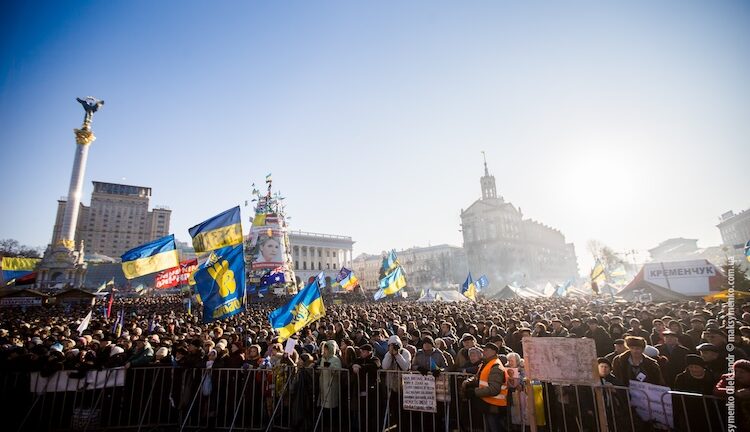
Image: Protesters at a rally on Independence Square, Kyiv, 29 December 2013. CC BY 2.0