
By Jonathan Power
LUND, Sweden | 4 March 2026 (IDN) — Besides President Donald Trump’s conviction that Iran is very close to building nuclear weapons (which the CIA disputes), there is a next crisis looming on Trump’s agenda. It might well be North Korea, which openly has the bomb, many of them. (Due to a Republican-dominated Congress killing off previous disarmament agreements.)

Kim Jong-un, the paramount leader of the North Korean dictatorship, always says he is ready to talk. Unlike Iran, Kim believes that because he has nuclear weapons, he is at an advantage in negotiations compared with Iran.
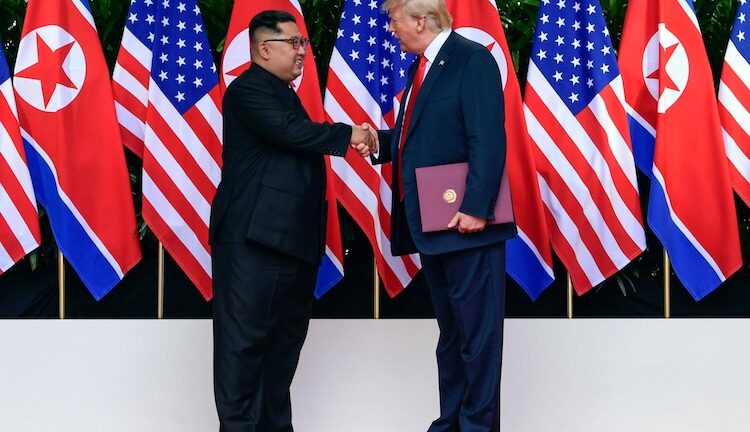
Seven years ago, the two leaders met, applauded themselves and each other and made some sort of a deal, even if it wasn’t the one Trump boasted about- the total elimination of the North’s nuclear weapons.
Nevertheless, the North stopped nuclear testing for a while. The US only stopped in 1992 and France in 1996, so this was a very important step forward.
The North also began dismantling a missile-engine test site. Set against that, the US intelligence community and independent observers say it continued to build intercontinental missiles and is concealing its nuclear assets and activities.
China’s Quiet Role
In the wings of these negotiations is China. It has long opposed what North Korea is doing, at one time joining the West and Russia in imposing sanctions. But it has never quite squeezed hard enough to have a real effect.
Some observers wonder how steadfast an ally China would be in the future if the US under Trump 2 decides it has been deceived. If war broke out between North and South Korea, how would it deal with the North’s nuclear weapons- 50 is the guess. Would it seek to impound them quickly? And if it tried to, does its army have the capability of doing so? Or would it tolerate US/UN troops crossing the border from South to North to do that job, fearing that the US would then effectively take over the North?
A handful of US scholars, most notably Oriana Skylar Mastro of Georgetown University, who wrote on the subject in Harvard’s “International Security”, believe the evidence shows that China could and would invade if it thought it necessary. She interviewed two dozen Chinese scholars – think tank researchers, scientists and military officers- as well as senior people in the main relevant bodies in Washington. From that and several international seminars, she draws her conclusions.
China’s War Plans
The US should tolerate a Chinese intervention as being in its own interests. To do the job itself would require nearly 200,000 troops. (It has already in the South a relatively modest 30,000.) Indeed, if necessary, it should provide China with its intelligence and, later, its nuclear demolition expertise. The US should also accept that, if there were reunification between North and South Korea, China would only agree to it if it didn’t swing a unified Korea against China. This would mean no American troops north of the border.
China has a lot to be angry about. North Korea tests its nuclear weapons only 130 km from the Chinese border. The North has constantly refrained from Chinese requests to avoid provocative activities, completing many missile tests and some nuclear tests. In return, China has snubbed the North by courting the South economically. There is no communist brotherhood here.
China has its contingency plans in place in case of a North/South war. China will move troops 50 km across the border. It will probably create two buffer zones. First, to blockade North Korea’s major ports. Second, to intercept and search fleeing refugees and military personnel.
Within that 50 km, the North has a good proportion of its nuclear and missile sites- 45% of the former and 22% of the latter. A fast Chinese invasion, carried out at dawn, could capture these sites within the hour.
China would welcome an improved relationship with the South. Chinese experts expect that trade volumes will increase dramatically after reunification. China would be able to export goods across the North to the South. It could use Korean ports, reducing congestion in its own southern ones.
Trump’s Strategic Choice
On the other hand, China does worry that South Korea would seize that part of the North’s bombs and missiles which are located far from its border with China.
China hears about the ongoing debate in the South about whether to be nuclear-armed or not. It should not worry. To possess nuclear weapons itself would be an extremely unpopular decision among a majority of the South’s voters. Moreover, the South would confront irresistible international pressure not to call the North’s nuclear arsenal its own.
Trump and the Chinese must be well briefed. America has power. But in this situation, China has the whip hand.
If Trump doesn’t make use of this- with a private agreement from President Xi Jinping to be his proxy- future talks will probably fail. Trump must leverage China’s strength. Later this month, when he visits China, North Korea should be near the top of their agenda. [IDN-InDepthNews]
Copyright: Jonathan Power.