
By Seevali Abeysekera*
LONDON | 28 March 2026 (IDN) — The Cold War between America and the Soviet Union existed in an era where their joint strategies were to show each other the enormous destructive capabilities of their respective arsenal of weapons, which in turn acted as the ultimate deterrent to both sides.
Mutually Assured Destruction (MAD) was the phrase used to showcase this doomsday scenario where both sides could literally destroy each other and, by default, most of humanity.
The amounts of expenditure required for this policy of building up an arsenal of weapons bigger and better than the other consumed most of their respective defence budgets.
That was until Russia invaded Ukraine in 2022, and within a few months, a new type of weapon became commonplace on the battlefield.
The era of drone warfare had begun.
Initially, high altitude Turkish attack drones capable of firing missiles were used by Ukraine with great success, particularly against Russian ground armour, but these drones were both relatively expensive and vulnerable due to their slow speeds. They were essentially remote-controlled, slow-moving aircraft which returned to base after their missions.
A revolutionary concept in the modern battlefield
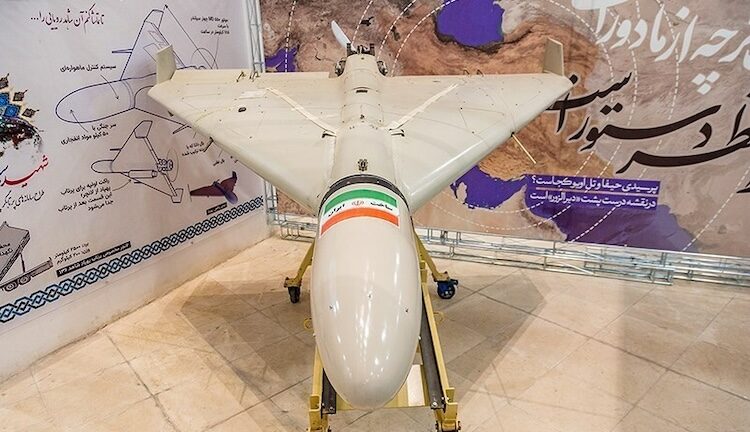
Enter the Shahed 136, a $20,000, very small Iranian Kamikaze one-way attack drone. An indigenous and ingenious Iranian drone, a revolutionary concept on the modern battlefield, that costs less than a second-hand car to manufacture.
Thus, from a military expenditure standpoint, where typical manufacturing of effective offensive weaponry is costed at millions of USD per unit, the Shahed 136 is an incredibly cheap, non-resource-intensive, non-labour-intensive, non-high-tech unit that can be manufactured quickly and in mass.
If one does the missile maths in terms of the production of cheap drones versus the cost of interceptor missiles and delivery systems required to destroy these drones, the doctrine known as asymmetric warfare makes complete sense.
The Shahed 136 is not only cheap to manufacture and thus mass-produced in their hundreds per day, but also made from materials such as balsa wood, which reflects radar waves better than metal. The engine is a cheap, reverse-engineered German two-stroke aircraft piston engine, capable of approximately 185 km/h. It weighs less than 200 kg, can be armed with a 50 kg warhead, and has a range of approximately 1500 Km.
The Shahed 136 can be launched from makeshift platforms, including being mounted on racks on the back of everyday vehicles such as pick-ups or trucks. To counter the Shahed 136, the required inventories run into the millions of dollars.
A recent video surfaced of an Emirati F16 shooting down a Shahed 136 over Dubai beach. The missile used was an AIM-9 Sidewinder missile.
The mathematics of an asymmetric shootdown
The mathematics of this asymmetric shootdown was that a $20,000 drone was shot down by an aircraft costing more than $20 million, firing a missile costing $400,000, and flown by a pilot whose training would have incurred costs of more than $1 million.
If interceptor missiles such as US Patriots are used to shoot down Shahed 136’s, the cost per unit is between $3.7 million and $7 million. These interceptor missiles are limited in terms of inventory, and replacements are slow as the production is a very complex, time-consuming process. They also require highly skilled operators to fire them.
The continuous use of interceptor missiles against incoming missiles and drones adds sustained pressure on inventory and production lines.
Extrapolate this by the tens of thousands of Shahed 136’s within the Iranian inventory, the ongoing production rates by Iran, the extremely high costs of shooting them down, and suddenly, the genius of asymmetric warfare becomes clearer.
Countering missiles and drones is a contest of endurance as much as technology. A war of attrition is fought in the military-industrial complex. A case of inventory, production capacity and the ability to launch vs the battlefield success of destroying them.
As the unprovoked illegal war against Iran now enters its fifth week, the plan devised in Tel Aviv, its two primary assets in America, Steve Witkoff and Jared Kushner, was to kill Ali Khamenei, the spiritual leader of the Shia branch of Islam — this is the equivalent of murdering the Pope or the Archbishop of Canterbury — decapitate the leadership of Iran and wait for the imminent collapse of the government and watch the people take over.
It had worked in Iraq, Libya, Syria and even Venezuela. However, it didn’t work in Iran.
A decentralised chain of command
Iran had learnt from observing the American modus operandi and had been preparing for this very moment.
It had learnt that a centralised system of governance was fatal and tilted the battlefield in America’s favour within days if not hours. Iran also realised that it can never match both America and Israel in technology and conventional warfare.
Iran, therefore, decentralised its chain of command and perfected the art of asymmetric warfare. Iran decentralised its command structure using a system known as the Mosaic Doctrine.
Think of a mosaic. Hundreds of small individual pieces, each one different, each one separate.
Iran reorganised its command-and-control structure into 31 largely autonomous units, each dedicated to its own province. Each autonomous unit has commanders able to act independently without waiting for orders from a centralised command structure.
The rationale, as we are seeing playing out now, is that each of the 31 command nodes can act according to pre-defined battle plans without waiting for instructions.
Each unit has its own missiles, drones, intelligence, and command structure. To keep the system as secure as possible, none of the units knows what the other units are doing.
The huge Shahed 136 inventory within Iran are the equivalent of expendable foot soldiers. With thousands of these drones available to Iran, they are launched as swarms to overwhelm enemy defences. Their primary aim is to force the enemy to deplete their very expensive inventory of anti-drone missile systems.
As has happened in the last four weeks, more than a few have got through the multi-layered missile defences and have hit their intended targets.
The Shahed 136 is the equivalent of the assault rifle and used as the first line of Iran’s missile strategy inventory, with jet-powered attack drones, cruise missiles, ballistic missiles and hypersonic missiles making up the rest of Iran’s considerable missile arsenal.
The Shahed 136 is an expendable asset for Iran, but one that is at the forefront of its asymmetric warfare doctrine against enemies whose conventional military and technological superiority it cannot match.
The Iranian strategy has never been to win a war against America and Israel but merely to engage in an asymmetric fight where its very survival as a nation is the sole objective. Iran is in an existential war against a combined enemy whose primary objectives are, on the part of America, a combination of unapologetic imperialism and greed, and on the part of Israel, a combination of depravity and deranged thinking from a nation whose societal values are on par with the worst excesses of Nazi Germany
It is in this context that the Shahed 136 is being used as one of the most effective and cheap countermeasures in an asymmetric war where expensive technological superiority is being countered by cheap, ingenious concepts and designs. A cheap, effective drone that is both an offensive weapon and an effective countermeasure against overwhelmingly technologically superior systems.
The history books will record how the Shahed 136 changed the theatre of modern warfare. One where a technologically inferior and cheap ingenious design overwhelmed the ability and capacity of those who had overwhelming technological superiority in the battle space.
A cheap and ingenious design where the mathematics of finance requires expensive and limited assets costing from $100,000 to $7 million, to be used to shoot down $20,000 drones manufactured in their thousands.
Such a mathematical equation is a recipe for both the rapid depletion and exhaustion of limited anti-drone inventory as well as financial Armageddon for those using incredibly expensive assets to counter cheap drones.
The genius of the Shahed 136 is that it is not only one of the most effective asymmetric weapons but one that could potentially cause the financial ruin of its foes.
*Seevali Abeysekera is a retired businessman and part-time blogger living in London – www.seevaliabeysekera.wordpress.com [IDN-InDepthNews]