
In Shenzhen, three presidents need a common nuclear language. No treaty is on offer when Xi, Putin and Trump meet on Thursday. A statement of basic principles, and a mandate for talks among the five nuclear-weapon States, would be achievement enough.
By Tariq Rauf*
VIENNA | 17 November 2026 (IDN) — On 19 November, on the margins of the APEC summit in Shenzhen, Presidents Xi Jinping, Vladimir Putin and Donald Trump are due to sit down together for the first time.1 Between them they command roughly nine of every ten nuclear warheads on earth.2 US officials already are playing the meeting down as an “entry point” from which no agreement is expected.3 They are right about the agreement, and wrong if they think that makes the meeting inconsequential. The most useful thing the three leaders can do in Shenzhen is not to haggle over numbers but to agree on “basic principles” governing strategic relations between them and nuclear weapons.
An arms race without limits
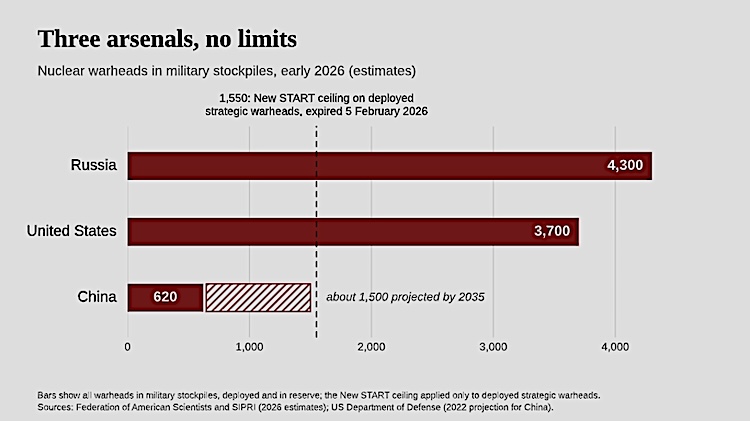
The numbers explain why. New START expired on 5 February, after Washington declined Moscow’s offer to keep observing its limits for another year.4 For the first time since 1972 no treaty limits the strategic nuclear forces of the United States and Russia: no ceilings, no data exchanges, no inspectors. Each still holds roughly 4,000 warheads in its military stockpile.2 China has more than 600 and, by American estimates, is on course for about 1,500 by 2035,5 which is in effect the New START ceiling of 1,550 deployed strategic warheads. Beijing is building toward the very level at which Washington and Moscow have just ceased to be held.
Arithmetic is the lesser problem. The three strategic forces are increasingly entangled with technologies that no treaty has ever covered. Strategic missile defence, unconstrained since the ABM Treaty was abandoned in 2002 and now revived on a continental scale as “Golden Dome”, pushes the others to build more, and more exotic, offensive arms. Anti-satellite weapons threaten the early-warning and communications satellites on which nuclear command depends. In September the United States confirmed that it has space-control weapons in orbit;20 the Outer Space Treaty bans only weapons of mass destruction there. Artificial intelligence is compressing decision time in systems that were designed around human deliberation. Each of these erodes a State’s confidence that its deterrent would survive a first blow, and that confidence, rather than any particular number, is what strategic stability means.
Mr Trump wants a three-way deal on arsenals. Mr Xi will not give him one. China has refused since 2020 to join trilateral talks, arguing that the two States with by far the largest arsenals must cut first;4 it offers instead its pledge of no first use, which it has invited the others to adopt. Russia, for its part, says any wider negotiation must take in the British and French forces,6 and has tied strategic talks to the war in Ukraine, much as China has tied its own to Taiwan. Each position is self-serving and each has a logic. Together they ensure that a numerical treaty among the three is years away, if it is reachable at all.
Principles before numbers
So consider what was done the last time numbers were hard. At the Moscow summit of May 1972, Richard Nixon and Leonid Brezhnev signed the ABM Treaty and the SALT I Interim Agreement and, three days later, a short political text: the Basic Principles of Relations.7 It bound neither side in law. It said that in the nuclear age there was no alternative to peaceful coexistence; that the two would do their utmost to avoid military confrontation and prevent nuclear war; that neither would seek unilateral advantage at the other’s expense; and that arms limitation would continue on the basis of equal security. Around it grew the 1973 Agreement on the Prevention of Nuclear War8 and, at Vladivostok in November 1974, the Ford–Brezhnev framework of equal ceilings that became SALT II.9 Summits set the principles; negotiators then turned principles into limits. Along the way two hostile establishments acquired a common strategic language, of launchers, throw-weight and national technical means, without which no later treaty could have been written.
Washington and Beijing have no such language. Washington and Moscow are forgetting theirs. A trilateral statement of basic principles is one of the few instruments all three could sign, precisely because it contains no numbers. A draft text I have used in negotiating exercises in Hiroshima and in teaching in Vienna10 shows how much is already common ground: that a nuclear war cannot be won and must never be fought; that the three are determined to prevent any war between them, nuclear or conventional; that none will seek nuclear superiority; that nuclear weapons exist solely to deter aggression and prevent war; that differences will be settled with restraint and by peaceful means; and that existing obligations to allies and partners are unaffected. The same draft sets out, in square brackets, what is contested: missile defences, anti-satellite weapons, weapons in space, hypersonic and nuclear-powered delivery systems, artificial intelligence in the control of nuclear weapons, nuclear weapons stationed on foreign soil, and the circumstances in which nuclear weapons might be used at all, where China’s no-first-use pledge meets American and Russian doctrine. To name an agenda is not to settle it. It is how settling begins.
The 1972 text is also a warning. Within three years the October War and Angola had drained it of credibility. “Restraint” was never defined, there was no body to review compliance, and it was sold at home as more than it was. The 1994 Budapest Memorandum on Ukraine repeated the fault: its only mechanism was consultation, and when consultations were called in March 2014 Russia did not attend.10 A Shenzhen statement should therefore claim little and equip itself with something: a standing crisis-stability group of the three, inside the existing process of the five, with an obligation to turn up and a date on which to review what has been done.
Bring the five to the table
Nor are the three alone in this. On 3 January 2022 the five nuclear-weapon States of the Non-Proliferation Treaty declared together that a nuclear war cannot be won and must never be fought, and that they meant to avoid arms races.11 Seven weeks later Russia invaded Ukraine, and the statement has had no sequel. In May this year, the NPT Review Conference failed, for the third time running, to agree an outcome; the five, divided on almost everything else, had cooperated in stripping specific disarmament commitments from the draft.12 The next NPT review is in 2031. The five owe the treaty’s non-nuclear members something better than five more years of silence. A follow-on to the 2022 statement should reaffirm it and add what it lacked: a mandate.
The model for that mandate is at hand. In January 1985 George Shultz and Andrei Gromyko agreed in Geneva on a single negotiation in three linked groups, covering strategic arms, intermediate-range forces, and defence and space, on the premise that offence, defence and space could not be settled apart.13 The Nuclear and Space Talks opened that March under the shadow of the Strategic Defense Initiative. That November Reagan and Gorbachev pledged “to prevent an arms race in space and to terminate it on Earth”.19 The talks produced the INF Treaty in 1987 and START I in 1991. A new round among the five would have its own baskets: strategic offensive arms; missile defence; space and anti-satellite weapons; and artificial intelligence, command and control, and risk reduction.
The format answers each capital’s stated objection. China is not singled out for a trilateral count of warheads. Russia has Britain and France at the table. The United States has China in the room. The agenda includes the weapons and defences that Moscow and Beijing say are driving their programmes. And nothing in it prevents the United States and Russia from negotiating reductions between themselves in parallel, which is what China says must come first. They could begin on Thursday: Moscow says it will keep to the expired New START limits if Washington does,18 and a matching American declaration would cost nothing.
A strategy of suffocation
There is a Canadian thread in this history that deserves to be picked up. In May 1978, at the first United Nations special session on disarmament, Prime Minister Pierre Elliott Trudeau proposed a “strategy of suffocation”: deprive the arms race of oxygen through a comprehensive test ban, a halt to flight-testing of new strategic delivery vehicles, a ban on producing fissile material for weapons, and limits on spending for new strategic systems.14
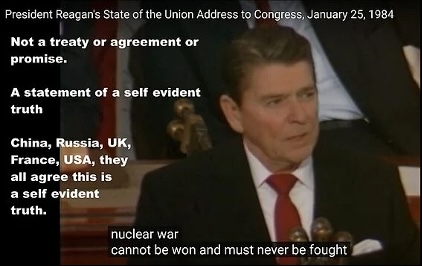 On 9 February 1984, reporting to the House of Commons at the close of a peace initiative in which he had urged that all five nuclear-weapon States be brought into negotiations, he set out ten principles of common ground between East and West.15 The first two were that both sides agree a nuclear war cannot be won, and that both sides agree a nuclear war must never be fought. President Reagan had used those words on his own account.16 Trudeau was the first leader to put them forward as a premise the two blocs already shared, nearly two years before Reagan and Gorbachev made them so at Geneva. His ninth principle, a “guarded recognition of each other’s legitimate security interests”, anticipates the closing line of the 2022 statement. It won him little thanks in allied capitals at the time. His sentence is now the one statement on nuclear war that all five nuclear-weapon States have endorsed together.
It is time for an updated strategy of suffocation, aimed at the nuclear arms competition now gathering among three powers rather than two. Keep the moratoria on nuclear testing and bring the test-ban treaty into force. Give advance notice of every strategic missile and space launch among the five, and open crisis-communication channels between their capitals. End the production of fissile material for weapons, which four of the five say they have already done. Keep a sentient human being in control of every decision to use a nuclear weapon, as the American and Chinese presidents agreed in 2024.17 Link the five through AI nuclear risk centres, modelled on the one American and Russian officers staffed together over the Y2K rollover,21 to report malfunctions and clear up ambiguous warnings within minutes. Forswear destructive anti-satellite tests and halt the further deployment and testing of weapons in orbit. Show restraint in strategic missile defence. Cap spending: the nine nuclear-armed States spent US$119 billion on their arsenals in 2025, 19 percent more than the year before.22 Few of these steps need new verification machinery, and each denies the competition some of its fuel.
Expectations for Thursday are low, and properly so. One page would do: three presidents affirming a handful of principles and instructing their foreign ministers to convene the five, draft a successor to the January 2022 statement, and open nuclear and space talks. That is not arms control. It is what has to exist before arms control can. In 1972 it took a summit to give two adversaries the words; the limits followed. Three adversaries without a common language will find that the weapons do the talking.
*Tariq Rauf is former Head of Verification and Security Policy, Office reporting t0 the Director General, International Atomic Energy Agency.
Editor’s Note: This article is published as opinion. The views and interpretations expressed are those of the author and do not necessarily reflect the editorial position of IDN-InDepthNews.
REFERENCES
- Associated Press, “Trump, Xi and Putin plan an unprecedented joint meeting on the sidelines of APEC, White House says”, 14 November 2026. https://wsvn.com/news/us-world/trump-xi-putin-shenzhen-summit/
- H. M. Kristensen, M. Korda, E. Johns and M. Knight-Boyle, “Status of World Nuclear Forces”, Federation of American Scientists, 2026. https://fas.org/initiative/status-world-nuclear-forces/
- NBC News, “Trump, Xi and Putin plan an unprecedented meeting on the sidelines of APEC, officials say”, November 2026. https://www.nbcnews.com/world/china/trump-xi-putin-plan-unprecedented-joint-meeting-sidelines-apec-officia-rcna609275
- Arms Control Association, “False Start or New Era? Trump’s Call for Multilateral Nuclear Talks”, 20 February 2026. https://www.armscontrol.org/blog/2026-02-20/false-start-or-new-era-trumps-call-multilateral-nuclear-talks
- H. M. Kristensen et al., “Chinese nuclear weapons, 2026”, Bulletin of the Atomic Scientists, July 2026 (on the Pentagon’s 2022 projection of about 1,500 warheads by 2035 and its omission from later reports). https://thebulletin.org/premium/2026-07/chinese-nuclear-weapons-2026/
- AFP, “US urges new three-way nuclear deal with Russia and China”, 6 February 2026. https://english.ahram.org.eg/News/561903.aspx
- Text of the “Basic Principles of Relations Between the United States of America and the Union of Soviet Socialist Republics”, Moscow, 29 May 1972. https://www.presidency.ucsb.edu/documents/text-the-basic-principles-relations-between-the-united-states-america-and-the-union-soviet
- Agreement Between the United States of America and the Union of Soviet Socialist Republics on the Prevention of Nuclear War, Washington, 22 June 1973. https://nuke.fas.org/control/prevent/text/prevent1.htm
- Joint United States–Soviet Statement on the Limitation of Strategic Offensive Arms, Vladivostok, 24 November 1974. https://www.presidency.ucsb.edu/documents/joint-united-states-soviet-statement-the-limitation-strategic-offensive-arms
- T. Rauf, “Toward a Document on Basic Principles of Relations Between China, Russia and the United States, Including Strategic Stability”, lecture notes and companion notes, KAS–AR Fifth Nuclear Legacy Course, Vienna, 6–10 July 2026; with the UNITAR drafting-exercise text “Basic Principles of Relations Between the People’s Republic of China, the Russian Federation and the United States of America”, Hiroshima, 7 February 2025. Unpublished; available from the author.
- Joint Statement of the Leaders of the Five Nuclear-Weapon States on Preventing Nuclear War and Avoiding Arms Races, 3 January 2022. https://www.diplomatie.gouv.fr/en/french-foreign-policy/security-disarmament-and-non-proliferation/news/2022/article/joint-statement-of-the-leaders-of-the-five-nuclear-weapon-states-on-preventing
- Arms Control Association, “2026 NPT Review Conference Stymied by Disputes”, Arms Control Today, June 2026; Chatham House, “Global cooperation on nuclear disarmament looks even further away”, June 2026.https://www.armscontrol.org/node/15343 ; https://www.chathamhouse.org/2026/06/global-cooperation-nuclear-disarmament-looks-even-further-away
- Foreign Relations of the United States, 1981–1988, vol. IV, doc. 361 (Shultz–Gromyko meeting, Geneva, 7–8 January 1985), and vol. V, Preface (Nuclear and Space Talks, opened 12 March 1985). https://history.state.gov/historicaldocuments/frus1981-88v04/d361 ; https://history.state.gov/historicaldocuments/frus1981-88v05/preface
- P. Meyer, “Pierre Trudeau and the ‘Suffocation’ of the Nuclear Arms Race”, Simons Papers in Security and Development No. 52, Simon Fraser University, August 2016 (address to the first UN special session on disarmament, 26 May 1978). https://core.ac.uk/download/56380589.pdf
- Prime Minister P. E. Trudeau, letters to Prime Minister Thatcher of 25 October 1983 and 31 May 1984 (the latter restating the ten principles first put to the House of Commons), Margaret Thatcher Foundation archive; D. Heap, “Where do the parties stand?”, The Peace Calendar, March 1984 (on the Commons debate of 9 February 1984). https://archive.margaretthatcher.org/doc03/831025%20Trudeau%20to%20MT%20%283-1-33%20Part%203%20f20%29.pdf ; https://archive.margaretthatcher.org/doc04/840531%20Trudeau%20to%20MT%20EAST-WEST%20THCR%203-1-38%20f92.pdf ; https://tpc.peacemagazine.org/181/where-do-the-parties-stand
- President R. Reagan, Radio Address to the Nation on Nuclear Weapons, 17 April 1982. https://www.presidency.ucsb.edu/documents/radio-address-the-nation-nuclear-weapons-0
- The White House, Readout of President Joe Biden’s Meeting with President Xi Jinping of the People’s Republic of China, Lima, 16 November 2024. https://bidenwhitehouse.archives.gov/briefing-room/statements-releases/2024/11/16/readout-of-president-joe-bidens-meeting-with-president-xi-jinping-of-the-peoples-republic-of-china/
- “Russia says it will stick to limits of expired nuclear treaty if US does”, Al Jazeera, 11 February 2026. https://www.aljazeera.com/news/2026/2/11/russia-says-it-will-stick-to-limits-of-expired-nuclear-treaty-if-us
- Joint Soviet–United States Statement on the Summit Meeting in Geneva, 21 November 1985, Ronald Reagan Presidential Library. https://www.reaganlibrary.gov/archives/speech/joint-soviet-united-states-statement-summit-meeting-geneva
- “US Air Force Secretary reveals deployment of on-orbit space control weapons”, Military Times, 14 September 2026; Outer Space Treaty (1967), Article IV. https://www.militarytimes.com/news/your-military/2026/09/14/us-air-force-secretary-reveals-deployment-of-on-orbit-space-control-weapons/ ; https://www.unoosa.org/oosa/en/ourwork/spacelaw/treaties/introouterspacetreaty.html
- Center for Year 2000 Strategic Stability, Peterson Air Force Base, Colorado, 30 December 1999–15 January 2000: Federation of American Scientists, Joint Data Exchange Center news archive. The proposal for AI Nuclear Risk Management Centres is set out in T. Rauf, “Amidst the Ruins of Agreements: Can Arms Control Be Revived?”, CIPS Policy Brief No. 50, University of Ottawa, November 2026. https://nuke.fas.org/control/jdec/news/index.html
- International Campaign to Abolish Nuclear Weapons (ICAN), Premeditated: Nuclear Weapons Spending in 2025, June 2026