
Radiological Consequences of Military Attacks on Bushehr and Barakah Atomic Power Plants
By Tariq Rauf
The writer is a former Head of Verification and Security Policy at the International Atomic Energy Agency (IAEA).
VIENNA | 30 March 2026 (IDN) — In 1975, the US-based RAND Corporation published a seminal report entitled “Moving Toward Life in a Nuclear Armed Crowd?”, written by Albert Wohlstetter and co-authors on the dangers of a lawless world dominated by nuclear-armed States. Sadly, since June 2025, that state of world affairs has come to pass. Nuclear facilities under full-scope safeguards under the nuclear Non-Proliferation Treaty (NPT), that is, verification, by the International Atomic Energy Agency (IAEA), have been attacked with the biggest conventional high-explosive bombs by a nuclear-weapon State (permanent member of the UN Security Council) in partnership with a nuclear-armed State not party to the NPT.

The 1968 NPT does not prohibit uranium enrichment and reprocessing of plutonium for peaceful purposes under IAEA full-scope safeguards — of course, use of these nuclear materials for nuclear weapons is strictly prohibited under the NPT.
The 31 May 2025 IAEA report on Iran’s nuclear programme stated that, “The Agency has no credible indications of an ongoing, undeclared structured nuclear programme….” Following the unprovoked and illegal under international law rogue military attacks on Iran’s nuclear facilities by Israel and the US in June 2025, the IAEA report of 3 September 2025, stated clearly that the Agency had inspected on: 27 May, the Fuel Enrichment Plant (FEP) at Natanz on 27 May; the Fordow Fuel Enrichment Plant (FFEP) on 10 June and the Natanz Pilot Fuel Enrichment Plan (PFEP) on 11 June 2025 — just hours before the attacks commenced.
The IAEA also reported on the stocks of enriched uranium under safeguards in Iran. The IAEA Director General, in his statement to the Agency’s Board of Governors on 13 June 2025, recalled the relevant General Conference resolutions on the subject of military attacks against nuclear facilities, which provided, inter alia, that “any armed attack on and threat against nuclear facilities devoted to peaceful purposes constitutes a violation of the principles of the United Nations Charter, international law and the Statute of the Agency”.
The Director General also reiterated that he had repeatedly stated that nuclear facilities must never be attacked, regardless of the context or circumstances, as this could harm both people and the environment, and that such attacks have serious implications for nuclear safety, security and safeguards, as well as regional and international peace and security.
As a result of the bombing and the damage inflicted on the bombed nuclear facilities in June 2025 and in the current (March 2026) bombing campaign, the Agency lost continuity of knowledge on inventories of nuclear material in Iran, including low-enriched uranium (LEU) and highly enriched uranium (HEU), which urgently needs to be addressed.
Restoring IAEA verification at bombed nuclear facilities is no trivial matter as I have noted in my assessment, “Is There a Way to Rebuild IAEA Safeguards in Iran?”. On 10 September 2025, the IAEA Director General stated that, “Resuming this indispensable [inspection] work would not be an automatic, or a simple bureaucratic process, after what happened.”
While the IAEA Board of Governors has held numerous meetings, including extraordinary meetings, on the situation of the Zaporizhzhya nuclear power plant in Ukraine, which has not been directly bombed, but currently under internationally illegal occupation by Russia since 4 March 2022, and condemned Russia; the Board has yet to condemn the illegal bombing of safeguarded nuclear facilities in Iran – it should do so forthwith and implement its obligations under the Agency’s Statute and nuclear safety and security guidance.
Radiological Consequences of Attacks on NPPs
This assessment examines the potential radiological consequences of military attacks on safeguarded nuclear energy installations in the Middle East: the Bushehr Nuclear Power Plant in Iran and the Barakah Nuclear Power Plant in the United Arab Emirates (UAE). These two nuclear facilities comprise one Russian-design operating power reactor in Iran, a four-unit South Korean (ROK)-design commercial power plant, and present similar but distinct radiological hazard profiles in the event of military attacks.
Key Findings at a Glance
BUSHEHR (Iran): A 1,000 MWe VVER-1000 operating power reactor holding approximately 80 tonnes of irradiated low-enriched uranium fuel. A serious attack causing core damage could release a Chornobyl/Fukushima-scale inventory of volatile fission products over the Persian Gulf and surrounding States. Spent fuel pools compound the hazard. The Persian Gulf’s enclosed geography would concentrate marine contamination for years.
BARAKAH (UAE): Four APR-1400 reactors with a combined thermal output of ~12,000 MWth — the largest concentration of nuclear power in the Middle East. A simultaneous or sequential attack on all four units could release 4–5 times the radioactive inventory of a single Chornobyl reactor. Proximity to Qatar, Bahrain, Saudi Arabia, and Iran creates an extraordinary transboundary risk. Dependence on desalination infrastructure amplifies the humanitarian consequences.
SHARED RISK: Both facilities are located on or near the Persian Gulf or in a densely interconnected regional environment. Contamination from any one facility would cross multiple international borders within hours to days. The Persian Gulf’s limited ocean exchange with the Indian Ocean makes marine contamination particularly persistent.
LEGAL DIMENSIONS: Attacks on these safeguarded nuclear installations inter alia fall under the prohibitions established in the Geneva Convention Article 56 AP I, UNSC resolution, IAEA GC resolutions, and customary international law.
Radiological Framework: Key Concepts and Benchmarks — Key Radionuclides in Nuclear Facility Attacks
The radiological consequences of a nuclear facility attack depend critically on which radioactive materials are released and in what quantities. The principal hazardous radionuclides in different facility types are:
| Radionuclide | Characteristics and Health Significance |
| Iodine-131 (¹³¹I) | Half-life: 8 days. Principal short-term public health threat: thyroid cancer and acute radiation syndrome. Absorbed via inhalation and ingestion. Particularly dangerous for children. Potassium iodide (KI) is an effective countermeasure if administered promptly. |
| Caesium-137 (¹³⁷Cs) | Half-life: ~30 years. The most important long-term environmental contaminant. Deposited on soil, enters the food chain. External gamma dose contributor. Determines the extent of long-term land contamination zones. At Chornobyl, ~85 PBq were released. |
| Caesium-134 (¹³⁴Cs) | Half-life: ~2 years. Co-released with Cs-137. Short-term contaminant; used as an indicator of fresh nuclear release versus historical fallout. |
| Strontium-90 (⁹⁰Sr) | Half-life: ~29 years. Bone-seeking radionuclide; mimics calcium. Long-term bone cancer and leukaemia risk. Concentrated in milk and dairy. Released in much larger quantities from fuel damage than from meltdown scenarios. |
| Plutonium-239/240 (Pu) | Half-life: 24,100 / 6,560 years. Alpha emitter. Extremely hazardous if inhaled — causes lung cancer. Present in spent nuclear fuel. Extremely long environmental persistence. |
| Noble Gases (Kr, Xe) | Immediately released from damaged nuclear fuel. Short half-lives (hours to days). Principal prompt radiological release but quickly disperses. Not retained in the environment. |
Reference Scale: Chornobyl and Fukushima
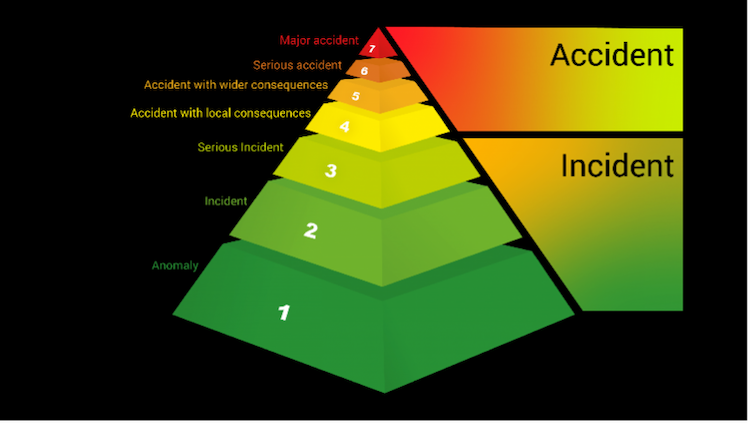
The Chornobyl (1986) and Fukushima (2011) nuclear accidents provide the primary reference points for understanding the scale of potential releases from nuclear facility attacks. Both are rated Level 7, the highest level, on the IAEA International Nuclear and Radiological Event Scale (INES).
| Parameter | Chornobyl (1986) vs. Fukushima (2011) Accidents |
| Reactor type | Chornobyl: RBMK-1000 graphite-moderated, 3,200 MWth. Fukushima: BWR, three accident units, ~2,000 MWth total. |
| Total release (excl. noble gases) | Chornobyl: ~5,300 PBq (petabecquerels). Fukushima: ~520 PBq (approximately 10% of Chornobyl). |
| Iodine-131 released | Chornobyl: ~1,760 PBq. Fukushima: ~7% of Chornobyl total. |
| Caesium-137 released | Chornobyl: ~85 PBq. Fukushima: ~10–15% of Chornobyl total (~8.8 PBq). |
| Strontium-90 released | Chornobyl: significant (fuel dispersed by explosion). Fukushima: very small amounts (no core explosion). |
| The land area severely contaminated | Chornobyl: ~150,000 km². Fukushima: ~10–15 times smaller. |
| Mechanism | Chornobyl: core explosion dispersed fuel directly. Fukushima: steam release from melted cores (no fuel dispersal). |
| Military attack analogy | A deliberate penetrating attack on a reactor is more analogous to Chornobyl (mechanical disruption plus fire) than to Fukushima (loss of cooling). The release fraction would be higher and more rapid. |
A deliberate military attack — involving penetrating munitions, explosives, and potentially incendiary effects — would likely produce a release scenario closer to Chornobyl than to Fukushima in terms of the mechanism (physical destruction rather than gradual loss of cooling) and the resulting release fraction of the nuclear fuel core inventory. The specific figures used throughout this assessment draw on published IAEA and United Nations Scientific Committee on the Effects of Atomic Radiation (UNSCEAR) reports, as well as peer-reviewed scientific data.
Bushehr Nuclear Power Plant — Iran: BNPP Profile
The Bushehr Nuclear Power Plant (BNPP) is located on the eastern shore of the Persian Gulf in Bushehr Province, approximately 750 km south of Tehran and 17 km south of Bushehr city. It is the first civilian nuclear power plant in the Middle East and Iran’s primary nuclear power installation. It is under full-scope IAEA safeguards.
| Location | Bushehr Province, Iran; Persian Gulf shoreline; 17 km south of Bushehr city. |
| Reactor type | VVER-1000 V-446 (Unit 1); VVER-1000 V-528 Gen III+ (Units 2 & 3 under construction). |
| Thermal capacity | Unit 1: 3,000 MWth; Gross electrical: 1,057 MWe. |
| Operational status | Unit 1: Operating since 2011 (commercial operation September 2013). Units 2 & 3: Under construction (target 2026–2027). |
| Fuel type | Low-enriched uranium (LEU) at ~4.5% U-235 (3.00%-4.95%); supplied by Russia (Rosatom). Initial fuel loading: ~82 tonnes. Active core: ~80 tonnes of LEU fuel assemblies. |
| Spent fuel | Spent fuel returned to Russia under a bilateral agreement; stored on-site in pools prior to transport. Several years of irradiated assemblies are present on-site at any given time. |
| IAEA safeguards | Under full-scope IAEA safeguards (Comprehensive Safeguards Agreement, IAEA INFCIRC/214). |
| Historical attacks | Bombed multiple times during the Iran-Iraq War (1984–1988); severely damaged, but no nuclear material was present at that time. |
| Recent incidents | March 2026: Iran and Russia allege projectiles struck the plant grounds near the metrology building, adjacent to the operating unit; no radiation release reported (Rosatom statement, 28 March 2026). |
| Seismic risk | Designed to withstand a magnitude 8 earthquake; it experienced a magnitude 7.7 quake in 2013 with minor damage. |
BNPP Radiological Hazard Profile
The Bushehr-1 reactor contains approximately 80 tonnes of irradiated low-enriched uranium fuel in its active core. After several years of operation, the spent nuclear fuel pool also holds multiple batches of discharged assemblies awaiting return to Russia. The irradiated fuel inventory represents the primary radiological hazard.
The VVER-1000 is a pressurised water reactor with a robust containment structure — generally considered more robust than the Chornobyl RBMK design. However, a penetrating conventional munitions attack targeting the containment structure, the reactor pressure vessel, or the spent fuel pool could breach multiple barriers simultaneously. A significant military attack scenario would likely involve:
- Penetration of the reinforced containment building using bunker-buster or heavy precision-guided munitions
- Rupture of the reactor pressure vessel and primary coolant loop
- Loss of coolant, causing rapid core uncovering and fuel damage
- Steam explosions and/or hydrogen explosions dispersing radioactive material
- Simultaneous or sequential attacks on the spent fuel storage pools
BNPP Estimated Release and Contamination
A severe attack causing core damage and containment failure at Bushehr-1 would release a significant fraction of the reactor’s volatile fission product inventory. Drawing on the Chornobyl/Fukushima comparative framework:
Estimated Radiological Release — Bushehr Attack Scenario
| IODINE-131: A Bushehr-1 reactor of 3,000 MWth has an I-131 inventory comparable to, or slightly less than, Chornobyl (3,200 MWth). Under a severe attack with containment failure, release of 30–60% of the I-131 core inventory is plausible, representing 500–1,200 PBq. This is in the range of the full Chornobyl I-131 release. |
| CAESIUM-137: Release of 10–30% of core Cs-137 inventory would represent 25–75 PBq — comparable to or exceeding the Chornobyl Cs-137 release of ~85 PBq, depending on attack severity and fire conditions. |
| STRONTIUM-90: Physical attack (unlike loss-of-coolant accident) could disperse fuel fragments containing Sr-90. Even a 1% release would represent significant long-term soil contamination across a wide area. |
| SPENT FUEL POOLS: If spent fuel pools are also damaged, the inventory available for release multiplies significantly. Spent fuel accumulates in pools for years before return to Russia; each annual batch represents a Cs-137 inventory comparable to the active core. |
| REFERENCE LEVEL: A severe attack on Bushehr-1 could produce a release in the INES Level 7 category (>50,000 TBq I-131 equivalent) with contamination extending across the Persian Gulf region. |
Geographic Dispersion and Environmental Consequences
The geographic setting of Bushehr creates exceptional conditions for regional contamination dispersal:
- Persian Gulf geography: The Persian Gulf is a largely enclosed body of water approximately 990 km long and 56–338 km wide, with an average depth of only 35 metres. Its water exchange with the Indian Ocean through the Strait of Hormuz is slow — a full water exchange takes approximately 3–5 years. Any radioactive contamination entering Gulf waters would persist at elevated concentrations for years to decades.
- Marine contamination: Caesium-137, Strontium-90, and plutonium released into Gulf waters would concentrate in marine sediments and marine food chains (fish, shrimp, shellfish) — the primary dietary protein for populations along all Gulf States’ coastlines.
- Desalination dependency: Saudi Arabia, the UAE, Qatar, Kuwait, Bahrain, and Oman collectively operate among the highest concentrations of seawater desalination plants in the world, drawing intake from the Persian Gulf. Radiological contamination of Gulf waters would immediately threaten potable water supplies for tens of millions of people. Desalination does not remove all radionuclides; Cs-137 and Sr-90 pass partially through desalination processes.
- Atmospheric dispersion: Prevailing winds in the Persian Gulf generally blow north-west to south-east (shamal) in summer and south-east to north-west in winter. An attack in the summer months could drive an atmospheric radioactive plume towards the UAE, Qatar, Bahrain, Kuwait, and Saudi Arabia. A winter attack could direct contamination towards Iran’s interior and towards Iraq.
- Transboundary States at risk: Iran, UAE (including Abu Dhabi, Dubai), Qatar, Bahrain, Saudi Arabia (Eastern Province — 12.5 million people), Kuwait, Iraq (Basra region), and Oman would all be within the primary contamination zone for a major release.
- Fish and food security: The Persian Gulf supports significant fisheries for Kuwait, Bahrain, Qatar, the UAE, Saudi Arabia, and Iran. Radioactive contamination would decimate these fisheries and impose long-term food-safety restrictions across the entire region.
BNPP Human Health Consequences
A major release from Bushehr-1 would produce the following health consequences at different distances:
| Zone / Population | Projected Health Consequences |
| Immediate vicinity (0–30 km): ~300,000 population in Bushehr city | Acute radiation syndrome in anyone near the facility at time of attack; mandatory emergency evacuation; severe thyroid dose from I-131; long-term cancer excess risk; potential acute fatalities among plant workers and military personnel. |
| Inner contamination zone (30–150 km) | Thyroid dose requiring KI administration; food and water restrictions; temporary evacuation of most contaminated areas; long-term cancer excess risk for hundreds of thousands of people. |
| Persian Gulf coastal States | Marine food chain contamination; water supply contamination; long-term dietary restrictions on fish, shellfish, and dairy; elevated caesium intake over many years. |
| Regional groundwater | Strontium-90 and caesium infiltration into shallow aquifers; long-term drinking water risk; agricultural soil contamination for decades. |
| International shipping — Strait of Hormuz | Approximately 20% of global petroleum trade transits the Strait; radiological contamination could temporarily halt or severely disrupt this transit corridor. |
Barakah Nuclear Power Plant — United Arab Emirates — BNPP4 Facility Profile
The Barakah Nuclear Power Plant with four operational reactors (BNPP4) is the UAE’s first and the Arab world’s first commercial nuclear power plant, located in the Al Dhafra region of Abu Dhabi, approximately 53 km west-southwest of Abu Dhabi’s Al Dhafra region, on the Arabian Gulf coast, approximately 300 km west of Abu Dhabi city. All four units are now operational.
| Parameter | Details |
| Location | Al Dhafra, Abu Dhabi Emirate, UAE; Arabian Gulf coastline; approx. 300 km west of Abu Dhabi; 53 km west of Al Dhannah; approximately 150 km from Qatar. |
| Reactor type | Four APR-1400 pressurised water reactors (Korean design); Generation III+; 241 fuel assemblies per reactor. |
| Thermal capacity | Each unit: ~3,980 MWth; Four units combined: ~15,920 MWth total thermal output. |
| Net electrical capacity | ~1,400 MWe per unit; Total: ~5,600 MWe (5,348 MWe net as of 2024). |
| Annual generation | ~40 TWh/year; approximately 25% of UAE’s electricity needs. |
| Operational status | All four units in commercial operation: Unit 1 (April 2021), Unit 2 (March 2022), Unit 3 (February 2023), Unit 4 (September 2024). |
| Fuel type | Low-enriched uranium 3%-4.95% U235; 4 cores, 90t fuel per core = 360t; fuel supplied by Kepco Nuclear Fuels; Framatome (US-manufactured) fuel from July 2025. Uranium sourced from multiple countries (Rio Tinto, Uranium One). |
| Spent fuel management | Stored on-site in reactor pools for up to 20 years; dry cask storage thereafter. No long-term disposal facility yet established. UAE ‘dual track’ policy: national storage + potential export for foreign reprocessing? |
| IAEA safeguards | Full-scope IAEA safeguards (IAEA INFCIRC/622); additional protocol in force (IAEA INFCIRC/622/Add.1); UAE renounced enrichment and reprocessing (‘Gold Standard‘ “123 agreement” with the US). |
| Safety design | APR-1400 designed to withstand deliberate aircraft impact; passive safety systems; no core-catcher (design choice criticized by some experts). Rather than a physical core catcher, the APR-1400 relies on in-vessel retention (keeping the molten core inside the reactor vessel) and other passive systems as its severe accident mitigation strategy. FANR’s issuance of construction licenses for all four units, as well as operating licenses, demonstrates that the plant meets the UAE’s stringent safety standards. The APR-1400 design has been certified by South Korea’s nuclear regulator and by the US Nuclear Regulatory Commission. Concrete cracking in containment buildings for Units 2 & 3 noted during construction. |
| Previous threats | December 2017: Houthi rebels claimed to fire cruise missiles toward Barakah (UAE denied any missile reached UAE territory). |
BNPP4 Risk Profile
Barakah is unique in several respects that compound the radiological risk from a potential attack:
| Risk Factors — Barakah Multi-Unit |
| SCALE — FOUR UNITS: With four operational APR-1400 reactors, Barakah represents a combined nuclear inventory approximately 4–5 times larger than Chornobyl’s single reactor. A coordinated attack targeting all four units — or a cascading failure triggered by an initial attack — could produce a release of radioactive inventory without precedent in civil nuclear history. |
| SPENT FUEL ACCUMULATION: Units 1 through 4 have been accumulating spent fuel since 2020, 2021, 2022, and 2024 respectively. Each unit’s spent fuel pool holds several years of irradiated fuel assemblies. The combined spent fuel inventory in all four pools represents an additional substantial radioactive hazard beyond the four active reactor cores. |
| NO CORE CATCHER: Unlike European Generation III+ designs (e.g., EPR), the APR-1400 does not incorporate a core catcher device. Paul Dorfman (University College London) notedthe Barakah reactor design ‘may prove inadequate defence against significant radiation release under fault conditions; in other words, an accidental or deliberate airplane crash or military attack.’ (However, according to ENEC and KEPCO, the Barakah Plant design contains all of the safety features that provide equivalent functionality to the core catcher design. Rather than using an ex-vessel core catcher, the standard APR-1400 design relies on a two-stage In-Vessel Retention strategy supported by External Reactor Vessel Cooling (IVR-ERVC) as its primary line of defence against corium escape from the reactor pressure vessel (RPV). Extensive documentation analyzed by the UAE’s independent regulator FANR, certified the safety of the plant design in the highly unlikely event of an accident and was satisfied that the design meets all modern safety design parameters. As a Generation III+ reactor, the APR1400’s safety systems are designed to prevent or mitigate severe accidents. The design incorporates passive safety systems which work to ensure safe reactor shutdown, removal of decay heat, and the prevention of radioactive releases.) |
| PROXIMITY TO MULTIPLE STATES: Barakah sits approximately 150 km from Qatar, 200 km from Bahrain, 280 km from Saudi Arabia’s Eastern Province (population ~12.5 million), and 300 km from Iran. A major release would be transboundary within hours. |
| DESALINATION CASCADES: The entire Arabian Peninsula is critically dependent on desalinated seawater. The Gulf Cooperation Council (GCC) States obtain 70%–90% of their potable water from Gulf desalination. Contamination of Gulf water intake points could constitute an existential water security crisis. |
| NO REGIONAL NUCLEAR LIABILITY FRAMEWORK: Paul Dorfman has noted the absence of any GCC regional protocol for liability and compensation should a Barakah accident or incident result in transboundary radioactive contamination — leaving victim States with no established mechanism for redress. |
| VULNERABILITY TO CONVENTIONAL ATTACK: Nuclear security expert Henry Sokolskiassessed: “I would say that they [Barakah reactors] are as vulnerable as Saudi Arabia’s Abqaiq facility was, which was protected by three layers of missile defence” — yet was successfully attacked by drones in 2019. |
BNPP4 Estimated Release — Full Four-Unit Attack
- The combined radioactive inventory of four APR-1400 reactors operating at full power represents the largest single-site nuclear inventory in the Middle East, under a worst-case scenario of sustained attacks causing severe core damage to all four units:
-
Estimated Scale vs. Chornobyl Iodine-131 (combined 4 units) Four APR-1400 units at ~3,980 MWth each = ~15,920 MWth total. The combined I-131 inventory is approximately 4–5 times that of a single Chornobyl reactor. Even a 20–30% release could represent 2,000–3,500+ PBq — well exceeding the total Chornobyl I-131 release (~1,760 PBq). Caesium-137 (combined 4 units) The combined Cs-137 core inventory is approximately 4–5x that of the Chornobyl single unit. Even a partial release of 10–15% would approach or exceed the Chornobyl Cs-137 release (~85 PBq) from a single facility. Spent fuel (all 4 pools) Units 1–4 have accumulated multiple annual batches of spent fuel. Spent fuel pools in all four units contain irradiated assemblies with a total Cs-137 inventory comparable to that of the active cores. A sustained or multi-day attack affecting pool cooling could trigger spontaneous fuel heating and zirconium fires, releasing their full volatile inventory. Reference comparison A simultaneous attack causing core damage to all four Barakah units would be, in terms of radiological release potential, approximately four to five times worse than the Chornobyl accident — the worst nuclear disaster in history.
BNPP4 Geographic Dispersion — Arabian Peninsula and Gulf
The geographic consequences of a major Barakah release would be severe across the entire Arabian Peninsula and beyond:
- Qatar (population ~2.9 million): Located approximately 150 km across the Gulf from Barakah. Qatar obtains nearly 100% of its potable water from desalination; the Ras Laffan industrial area — home to the world’s largest LNG processing complex — is on the Gulf coast. Radioactive contamination of Qatar’s desalination intake would constitute an immediate water emergency.
- Bahrain (population ~1.7 million): An island State in the Gulf approximately 200 km from Barakah, entirely dependent on desalination. No alternative freshwater sources exist.
- Saudi Arabia Eastern Province (~12.5 million people): Saudi Arabia’s Eastern Province, containing Dhahran, Dammam, Al Khobar, and the world’s largest oil processing infrastructure (Abqaiq, Ras Tanura), lies ~280 km from Barakah. The entire Saudi Arabian desalination system draws from Gulf waters.
- Kuwait (population ~4.8 million): Approximately 750 km to the north. Kuwait produces virtually all its water from desalination. Atmospheric plume could reach Kuwait within 24–48 hours under shamal wind conditions.
- UAE itself: Abu Dhabi city (~1.5 million people) is 300 km away from Barakah. Dubai (population ~3.5 million) is approximately 350 km away. Both rely substantially on desalination and Gulf fisheries.
- Iran: Under north-westerly wind conditions, an atmospheric plume from Barakah could reach the Iranian coast within hours and Iranian interior within 1–2 days, affecting millions of people.
- Strait of Hormuz — global energy security: A severe Barakah release rendering the Gulf unnavigable for shipping due to radiological contamination would directly threaten approximately 20% of global oil trade and over 25% of global LNG trade transiting the Strait of Hormuz.
BNPP4 Human Health Consequences
A major multi-unit Barakah release would produce health consequences of extraordinary scale in one of the world’s most densely interdependent economic regions:
- Immediate: Evacuation of Al Dhafra region and western Abu Dhabi; emergency distribution of potassium iodide across GCC States; severe acute radiation exposure of plant workers.
- Short-term (weeks to months): Acute thyroid dose across Qatar, Bahrain, and parts of Saudi Arabia’s Eastern Province; emergency shutdown of desalination plants drawing Gulf seawater; acute water supply crisis affecting tens of millions of people; marine food chain contamination requiring immediate fishing bans across the entire Gulf.
- Medium-term (1–10 years): Long-term thyroid cancer excess in children and adolescents across multiple GCC States; leukaemia and solid tumour excess across contaminated populations; sustained desalination shutdown until decontamination or alternative sources established; economic disruption to one of the world’s wealthiest regions.
- Long-term (decades): Caesium-137 contamination of Gulf sediments and marine food chain for decades; potential loss of coastal agricultural land; persistent strontium-90 contamination of soil and shallow groundwater; generational cancer excess across affected populations.
5. Comparative Analysis and Cross-Facility Scenarios
5.1 Comparative Risk Summary Table
| Parameter | Bushehr-1 (Iran) | Barakah (UAE, 4 units) |
| Reactor type | VVER-1000 PWR (1 unit) | APR-1400 PWR (4 units) |
| Thermal output | ~3,000 MWth | ~15,920 MWth combined |
| IAEA safeguards | Full comprehensive safeguards | Full; Additional Protocol |
| Fissile material concern | LEU fuel 3%-4.95%, ~80 t in core | LEU fuel 3%-4.95%, ~360 t in 4 cores |
| Spent fuel on-site | Multiple annual batches (awaiting return to Russia) | All 4 units accumulating since 2020–2024 |
| Reprocessing | No | No |
| Location | Persian Gulf coast | Arabian Gulf coast, ~53 km from Qatar border region |
| Primary release risk | Volatile fission products (I-131, Cs-137, Sr-90) from core/spent fuel | Same, multiplied ×4; spent fuel pool fire risk; no core catcher, alternative safety systems |
| Most affected populations | Persian Gulf littoral States; desalination systems | All GCC States, Iran, global oil/LNG trade routes |
| Comparison to Chornobyl | Single unit ~comparable; spent fuel adds significantly | 4–5× Chornobyl single unit in worst case |
| Legal framework applicable | AP I Art. 56; IAEA GC resolutions; NPT safeguards | AP I Art. 56; IAEA GC resolutions; NPT safeguards |
BNPP/BNPP4 Combined Persian Gulf Scenario
The proximity of Bushehr (Iran, eastern Gulf) and Barakah (UAE, western Gulf) on the same enclosed body of water creates a scenario with no historical precedent: a conflict in which both BNPP and BNPP4 operating nuclear power plants on the Persian Gulf might be subject to threat or attack simultaneously or sequentially.
If both Bushehr and Barakah were severely damaged in a regional conflict, the combined radiological release into the Persian Gulf atmosphere and waters would represent a catastrophe orders of magnitude worse than any prior nuclear accident. The Persian Gulf’s limited water exchange would concentrate contamination for decades. All desalination systems drawing Gulf water — serving tens of millions of people across six countries — would be compromised. The global energy infrastructure transiting the Strait of Hormuz would be threatened by radiological hazard to shipping crews.
Emergency Response Considerations
IAEA Emergency Response
The IAEA maintains the Incident and Emergency Centre (IEC) and the Joint Radiation Emergency Management Plan of the International Organisations (JPLAN) for international response to nuclear and radiological emergencies. Key limitations in a conflict scenario include:
- The IAEA’s emergency response system is designed for accidents, not deliberate attacks in an active conflict zone. Access for IAEA teams would be severely constrained during hostilities.
- The IAEA’s RANET (Response and Assistance Network) system provides international emergency assistance — but only to States that have signed bilateral emergency assistance agreements. Several Gulf States do not have comprehensive bilateral arrangements in place, however it is inconceivable that the IAEA would withhold support in the event of a nuclear emergency.
- IAEA monitoring would be hampered by the potential destruction of monitoring equipment at Bushehr or Barakah.
National Emergency Response Limitations
National emergency response capabilities in the affected region vary significantly:
- Iran: Has some nuclear emergency response capacity through the Atomic Energy Organization of Iran (AEOI), but this capacity would be severely tested by a major Bushehr release occurring during active hostilities when military and civil defence resources are already fully committed.
- UAE: FANR has developed emergency response plans for Barakah; however, these plans are designed for accidents, not military attacks. The IAEA reviewed emergency plans in 2015 and 2019 through EPREV missions.
- Jordan and Palestine Have extremely limited nuclear emergency response capacity. A major release affecting Jordan and the West Bank would overwhelm both national response systems and would require major international assistance.
- Gulf States broadly: Qatar, Bahrain, Kuwait, and Saudi Arabia have limited national nuclear emergency response capacity. The GCC has no regional nuclear emergency framework equivalent to Europe’s ECURIE
Conclusions
The Bushehr and Barakah nuclear facilities examined in this assessment represent the most significant radiological risks in the Middle East. Each presents a distinct hazard profile, but both share the potential to cause transboundary radiological contamination affecting civilian populations in multiple States that would persist for decades.
Bushehr-1, as an operating civilian power reactor under IAEA safeguards on the Persian Gulf, poses a Chornobyl-scaleradiological risk to the Gulf’s enclosed ecosystem and to the desalination-dependent water supplies of all Gulf States. Projectiles reportedly already have struck the plant grounds in March 2026 thus far without causing a radioactive release — but these incidents demonstrate that the risk is no longer hypothetical.
Barakah, with four operating APR-1400 reactors, represents a radiological hazard potentially four to five times greater than any single reactor accident in history. Its location directly across the Gulf from Qatar, Bahrain, and near Saudi Arabia’s Eastern Province — combined with the region’s total water dependency on desalination — makes a severe attack on Barakah potentially the worst single nuclear event in history.
The conclusion is unambiguous: the radiological consequences of attacks on any of these facilities would be catastrophic, transboundary, and irreversible on human timescales. These consequences provide the humanitarian and environmental basis for the legal prohibitions on attacks on nuclear installations — and should give serious pause to any State contemplating such action, in the current regional conflict or any future one.
The IAEA Board of Governors cannot continue to shirk their Statutory responsibilities and further delay raising the alarm regarding the vulnerability of five operating nuclear power reactors in the war zone of illegal US/Israel attacks against Iran, and Iran’s attacks against the UAE. The Board urgently must call for an immediate cessation of the war, and call on the IAEA to deploy nuclear safety and security teams at BNPP and BNPP4 (just as it has deployed such teams at Ukrainian nuclear and energy facilities since 2022),
The risks are unacceptably high that sooner or later, a misplaced air attack, or a cruise or ballistic missile, an armed drone, or a shot down missile, drone or combat attack aircraft, will land directly on the BNPP and/or BNPP4 installations with the attendant risks of a major radiological calamity beyond the response capabilities of States. Such an unfortunate occurrence could be beyond Level 7 on the INES scale – in addition to the human toll in the region, the world would also suffer from the total loss of hydrocarbon supplies, leading to economic collapse, starvation, and disease! A slide into a lawless nuclear world without nuclear arms reduction treaties and attacks on safeguarded nuclear installations is underway, unless it is stopped, the Doomsday Clock will strike midnight – and it will be game over for all of us. [IDN-InDepthNews]