UAE candidate Lana Nusseibeh faces questions over Sudan as Türkiye weighs a last-minute entry by former foreign minister Feridun Sinirlioğlu.
By Ramesh Jaura
BERLIN | 29 October 2026 (IDN) — The contest to succeed António Guterres as United Nations Secretary-General should be moving toward a decision by now. Instead, it is growing more crowded—and harder to predict.
Six informal polls among Security Council members have failed to produce a candidate acceptable to all five permanent members. Rebeca Grynspan of Costa Rica has often led the field, but she has not escaped opposition from veto-holding countries. Nor has any other contender.
The deadlock has opened the door to latecomers.
The United Arab Emirates nominated Lana Zaki Nusseibeh on 21 October, little more than two months before Guterres leaves office. Türkiye is now considering nominating Feridun Hadi Sinirlioğlu, a former foreign minister and UN ambassador who currently heads the Organisation for Security and Co-operation in Europe (OSCE).
Ankara has not yet formally submitted his name. Turkish media reported on 28 October that a decision could follow the Security Council’s next straw poll. If nominated, Sinirlioğlu would become the eighth serving candidate.
The prospect of another late entry has stirred an old argument. Governments have the right to put forward candidates as long as the process remains open. But is it fair to those who entered months ago, underwent public questioning and disclosed their campaign finances? And can a newcomer be examined properly before the Council must make its choice?
No agreement among the five
The seven candidates currently in the race are Ivonne A-Baki and María Fernanda Espinosa of Ecuador, Rafael Grossi of Argentina, Rebeca Grynspan of Costa Rica, Lana Nusseibeh of the UAE, Olara Otunnu of Uganda and Carolyn Rodrigues-Birkett of Guyana.
Former Chilean president Michelle Bachelet and senior UN official Virginia Gamba withdrew earlier. Burundi withdrew its nomination of former Senegalese president Macky Sall on 20 October.
Grynspan, a former Costa Rican vice-president who now heads the UN Conference on Trade and Development (UNCTAD), has performed well in several Council polls. But doing well is not enough.
A candidate needs at least nine votes in the 15-member Security Council. More decisively, the candidate must avoid a negative vote from China, France, Russia, the United Kingdom or the United States. Any one of the five can end a candidacy.
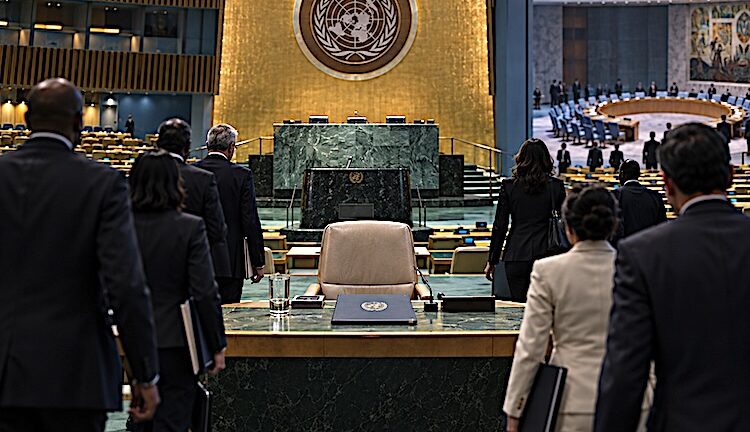
Once the Council agrees on a name, it recommends that person to the 193-member General Assembly, which makes the formal appointment. The Assembly holds public meetings with the candidates, but the Council—and above all its permanent members —retains the real decision.
The rules allow governments to present candidates at any stage before the Council makes its recommendation. Nusseibeh’s late entry was therefore entirely permissible. So would a Turkish nomination.
The rules do not settle whether such a late start allows enough time for serious scrutiny.
Sudan follows Nusseibeh into the race.
Nusseibeh entered the contest with advantages few candidates possess. She represented the UAE at the UN for more than a decade and served during her country’s 2022–23 Security Council term. Diplomats in New York know her as an experienced negotiator with a detailed understanding of the organisation.
But her General Assembly appearance on 27 October showed that familiarity with the UN would not shield her from difficult questions.
The Toughest Questions Turn to Sudan
Hours before she appeared before member states, human-rights advocates held a briefing challenging her fitness to lead the UN. Their criticism focused on allegations that the UAE has supplied military support to Sudan’s Rapid Support Forces—and on Nusseibeh’s previous rejection of those allegations as a senior Emirati official.
The RSF and the Sudanese Armed Forces have been fighting since April 2023. The war has displaced more than 14 million people, destroyed towns and health services, and left millions dependent on humanitarian assistance.
UN investigators reported in September that weapons, military equipment, foreign fighters and logistical networks were helping to sustain the war. Their findings referenced individuals and entities linked to the UAE. Abu Dhabi has repeatedly denied arming the RSF.
During the Assembly dialogue, Nusseibeh described Sudan as a defining test for the next Secretary-General. She said she had taken leave from her ministerial post and would no longer answer questions on behalf of the UAE Government.
She promised support for UN investigations, accountability and transitional justice. She also invoked Article 100 of the UN Charter, under which the Secretary-General must remain independent of governments.
Her critics were not persuaded. They argued that taking leave from office could not erase positions she had defended as an Emirati minister and diplomat.
The exchange brought an uncomfortable issue to light. Every candidate needs a government to nominate and campaign for them. Yet the winner is expected to act independently—even when this means challenging the government that secured the nomination.
Türkiye waits for the next poll.
Sinirlioğlu would bring another kind of experience to the contest.
He served briefly as Türkiye’s foreign minister in 2015, held senior posts in the foreign ministry and represented his country at the UN from 2016 to 2023. Since December 2024, he has been Secretary-General of the OSCE.
That position has placed him at the centre of disputes involving Russia, Ukraine, arms control, election monitoring and human rights. His knowledge of both UN and European security could appeal to Council members looking for someone who can speak to opposing blocs.
He would also bring political baggage.
Türkiye’s differences with Greece, its poor relations with Israel and its role in Syria could count against him. Greece is currently an elected member of the Security Council and therefore has a vote in the preliminary rounds.
Ankara has for years attacked the power enjoyed by the Council’s permanent members. President Recep Tayyip Erdoğan’s familiar phrase—“the world is bigger than five”—has become the shorthand for Türkiye’s call for UN reform.
Turkish officials say the next Secretary-General must restore the UN’s place in international diplomacy and push institutional reform. Erdoğan has been discussing the selection with leaders of Council countries, including French President Emmanuel Macron.
According to Türkiye Today, Ankara may wait for the next straw poll before deciding whether to nominate Sinirlioğlu. The calculation is clear: another inconclusive vote would strengthen the case for a new candidate.
Latin America does not want to be passed over.
The arrival of candidates from the Middle East—and possibly Türkiye—has also raised concern in Latin America and the Caribbean.
The post has usually rotated among the UN’s regional groups, even though this convention is not written into the Charter. Latin America and the Caribbean have not held the office since Peru’s Javier Pérez de Cuéllar completed his second term in 1991.
Five of the seven active candidates come from the region. On the day of Nusseibeh’s public dialogue, the Community of Latin American and Caribbean States said the time had come for one of its nationals to lead the UN.
Another expectation surrounds the 2026 contest. The UN has never had a woman Secretary-General. All nine officeholders since 1946 have been men.
Nusseibeh’s entry keeps the possibility of the first female appointment alive. A Sinirlioğlu candidacy would add another man to a field where regional entitlement and gender equality already compete with the preferences of the permanent five.
Neither consideration binds the Security Council. A permanent member can reject a candidate regardless of regional backing, public qualifications or support in the General Assembly.
More public—but still decided in private.
The current selection process is more open than what the UN used for much of its history. Candidates publish vision statements, curricula vitae and information about campaign funding. They appear in webcast dialogues and answer questions from governments and civil society.
Then the doors close.
Security Council members privately mark each candidate “encourage”, “discourage” or “no opinion”. The Council does not publish the results, although diplomats often pass figures to journalists.
Late candidacies expose the limits of the reforms. Nusseibeh faced the General Assembly less than a week after entering the race. Sinirlioğlu could arrive with only weeks remaining before the next Secretary-General is due to take office on 1 January 2027.
A new name might help break the deadlock. It could also allow the permanent members to wait until the final weeks and settle on someone who has avoided the months of scrutiny earlier candidates faced.
The winner will take charge of an organisation under exceptional strain. Wars in Ukraine, Sudan and the Middle East have revealed the limits of UN authority. Humanitarian agencies face deep financial shortages. Relations among the major powers have deteriorated, and agreed reforms remain unfinished.
The dispute surrounding Nusseibeh and the possible entry of Sinirlioğlu therefore reaches beyond their individual records. It concerns how the UN chooses the person expected to defend its Charter: through an open examination of the candidates, or through a last-minute bargain among the five governments that retain the power to decide. (IDN-InDepthNews)