
By Sydney Marcus Silva*
NEW JERSEY, USA | 16 January 2026 (IDN) — Human–Elephant Conflict (HEC) has emerged as one of the most serious environmental and social challenges of our time. Across Asia and Africa, rapidly expanding human populations, shrinking forests, and intensifying climate stress are forcing people and elephants into dangerous confrontations. The results are tragic: human deaths, elephant fatalities, destroyed crops, depleting grazing lands, damaged homes, and deepening resentment and violence on both sides.
Sri Lanka today stands at the epicenter of this global crisis.
While African countries such as Botswana and Kenya have made notable progress in managing human–elephant conflict, Sri Lanka and several other Asian countries, including Thailand and Nepal, continue to struggle. Understanding why—and what can be done differently—is critical for coexistence.
Why Africa Is Doing Better
Botswana and Kenya offer important lessons, not because they have fewer elephants, but because they manage conflict differently.
In Botswana, community-based natural resource management allows villages living alongside wildlife to earn income directly from conservation. Tourism revenue, land leases, and employment give local communities a clear financial stake in protecting elephants rather than opposing them.
Kenya has taken a similar approach through community conservancies supported by organizations such as the Northern Rangelands Trust. Here, communities patrol wildlife areas, manage grazing, and benefit from tourism and conservation grants. Elephants are seen not as threats, but as valuable assets.
Land-use planning also plays a decisive role. Botswana maintains large wilderness areas such as the Okavango Delta and Chobe National Park, connected by wildlife management zones that allow elephants to move without entering farms. Kenya has invested heavily in migration corridors and wildlife crossings, reducing deadly encounters on roads and railways.
Technology strengthens these efforts. Satellite tracking, radio collars, early-warning systems, and trained rapid-response teams help prevent elephants from reaching villages before damage occurs. Low-cost deterrents—such as beehive fences, chili fences, and alarm systems—have proven effective while generating additional income through honey and chili production.
Crucially, strong government backing and a thriving tourism economy reinforce conservation. Elephants are central to national identity and economic growth, making their protection a shared national priority.
Asia’s Harder Reality
The situation in Asia—and especially Sri Lanka—is far more complex.
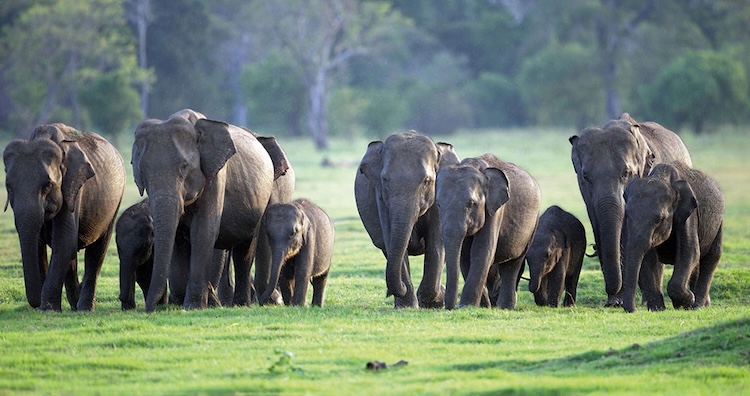
Sri Lanka has approximately 6,000 wild elephants within a land area of 61,860 square kilometers, with a human population density of over 340 people per square kilometer. More than 70 percent of elephant range lies outside protected areas, placing elephants directly in contact with villages, farms, and roads.
Large-scale irrigation and settlement schemes, particularly in the dry zone, have fragmented elephant habitats and blocked ancient migration routes. Roads, railways, and housing developments are often built directly across elephant corridors, leaving animals with no safe alternatives.
Unlike in Africa, rural communities in Sri Lanka receive little direct economic benefit from living with elephants. Compensation for crop damage is often delayed and inadequate, reinforcing the perception that elephants are a burden rather than a benefit.
Management strategies have also become politicized. Short-term measures—such as driving elephants into national parks that lack sufficient food and water—often worsen the problem, leading to aggressive behavior and repeat raids. Frequent policy changes tied to political cycles further undermine long-term solutions.
The result is a cycle of retaliation, fear, and loss—human lives, elephant lives, and public trust.
The Structural Challenge
The comparison is stark.
Botswana supports approximately 130,000 elephants across a vast landmass of 566,730 km², with a very low human density of ~4 people/km². Kenya manages about 36,000 elephants through corridors and community conservancies in a land mass of 580,609 km² and human density: ~94 people/km² Sri Lanka, by contrast, with a land mass of 61,860 km², has ~341 people/km² and ~6,000 elephants has one of the highest elephant densities in the world within one of the most densely populated countries.
This reality does not make coexistence impossible—but it demands smarter, more coordinated solutions, including national policies, collaborative planning, and stricter enforcement of laws without political interference. There is a greater probability that every tourist in Sri Lanka will have the luxury of viewing a wild elephant during their visit here than in any other country.
Land-Use Planning and Corridors
- Botswana maintains vast wilderness areas, such as the Okavango Delta and Chobe, with designated Wildlife Management Areas that link ecosystems and reduce agricultural incursions. allow elephants to migrate safely. Kenya has a vast landmass that supports such areas for elephants.
Technology and Early-Warning Systems
- Both African countries widely use modern technologies, such as radio collars, satellite tracking, and mobile apps (e.g., Kenya’s Save the Elephants Tracking App), to monitor elephant movements. In contrast, Sri Lanka’s tracking system is outdated and is ill-organized. S L Prestigious universities with branches in all provinces should be heavily involved in this field with research fellowships
- In Africa. Well-trained and equipped rapid-response units, along with trained paid community scouts, intervene before elephants reach farms. Sri Lanka should establish new specialized units within the national armed forces stationed near elephant habitats, which should lead the way in scouting, monitoring, mitigating, and resolving conflicts. The paid scouts should be recruited and trained from the border villages as economic incentives to the communities
Innovative Deterrents
- Beehive fences, chili fences, solar flashing lights, and trip-wire alarms provide low-cost, effective deterrents. They are regularly maintained and supported by community and government staff.
- Farmers also benefit economically from the sale of honey and chili.
Government Support and Tourism Value
- Strong anti-poaching policies, professional ranger services, and compensation schemes reinforce conservation.
- Elephants are central to tourism economies, making them economically valuable and socially accepted. Research on village living wildlife tourism should be sponsored and organized by the tourism industry and major tourist agencies.
Summary: African success stems from community incentives, protected corridors, technological innovation, government investment, N.G.O. support, community participation, and tourism revenue. Sri Lanka should follow the African strategies working in close collaboration in training rangers, technicians, and scouts.
A Way Forward for Sri Lanka
Sri Lanka must move beyond reactive crisis management toward a long-term, science-based strategy.
Key priorities should include:
- Strict enforcement of protected area boundaries and prevention of illegal encroachment.
- Rural and economic transformation that reduces pressure on rural land through high-density modern multi-level cluster housing and industrial development.
- Restoration and legal protection of elephant corridors, including wildlife crossings on major roads and railways.
- Community incentives, particularly eco-tourism and direct revenue-sharing models, make elephants economically valuable to local residents.
- Education and research, strengthening public understanding of coexistence and expanding university-led innovation.
- A professional, well-equipped ranger corps capable of early intervention and conflict prevention.
Most importantly, elephant conservation must be insulated from short-term political interests and treated as a national priority.
Coexistence Is Still Possible
Sri Lanka’s elephants are not only a keystone species but a powerful symbol of Religious cultural heritage, historically interwoven with the national Sinhalese Buddhist Tamil Hindu identity. Protecting them is inseparable from protecting rural livelihoods, biodiversity, and long-term economic sustainability and national identity.
African experience shows that coexistence is achievable when communities benefit, land-use planning is respected, and conservation is professionally managed. Sri Lanka’s challenge is greater—but so is the cost of failure.
With decisive action, Sri Lanka can still turn one of the world’s most severe human–elephant conflicts into a model for coexistence rather than extinction. The key remains in a noble realization for a prosperous, proud Sri Lanka, coexisting and promoting the well-being of its precious heritage of wild elephants with scientific planning and management of her land mass for agriculture, industry and well planned medium density cluster human habitations with all the modern amenities such as water electricity sanitation educational and leisure opportunities for fuller human lives for all citizens.
*The writer holds a diploma in philosophy and B.Th. in Christian Theology (Rome) and MS (Fordham University) in Social Policy, Planning, and Administration, and was affiliated with the Harvard University Program for International Conflict Analysis and Resolution (PICAR). He is reachable at: sydneysilva@hotmail.com [IDN-InDepthNews]
Image source: The Island