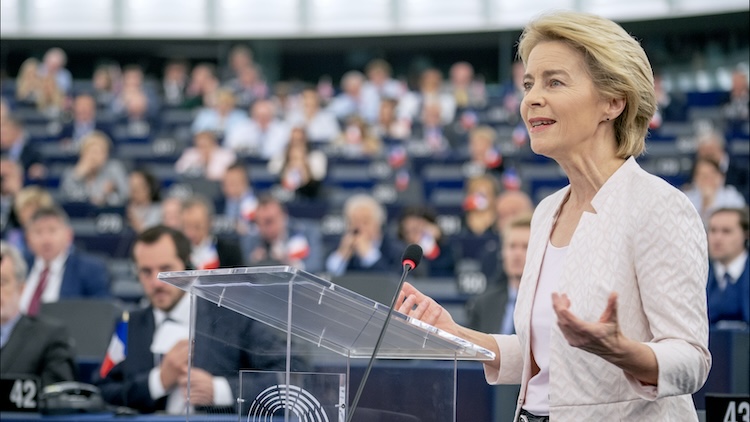
BRUSSELS. Belgium | 21 January 2026 (IDN) — “We Europeans, decide who comes to Europe and crosses our borders, and under what circumstances, and not the smugglers and traffickers” was the message in European Commission President Ursula Von Der Leyen’s speech, kicking off the Global Alliance to Counter Migrant Smuggling conference on 10 December in Brussels.
Representatives from over 50 EU and international partner states, along with UN and EU agencies, were present to discuss the global crackdown on smuggling networks.
Amidst the absence of the civil society sector, a report was published preceding the conference by the mixed migration centre (MMC), concluding that the strategy of “breaking the business model of smugglers” in practice often leads to counterproductive results.
The MMC aims to dismantle the ‘simple narratives and myths’ in the discussion including the depiction of smugglers as ruthless criminals functioning as the main instigators to migration. Instead, it highlighted that only 6% of people who used smugglers stated that smugglers had influenced their decision to migrate, drawing upon 80,000 interviews conducted with migrants and refugees globally, and 450 interviews with smugglers between 2019-2025.
Whilst Von der Leyen highlighted in her speech that migration fell sharply on key routes in 2025 and 2024, by 26% in 2025, following a 37% decline in 2024; 44% of surveyed smugglers in North Africa still reported increased demand for their services over the last two years, noting stricter migration control as a contributing factor.
With the European Commission proposing in July 2025 to triple its funding for migration, border management, and security to EUR 81 billion, the question remains whether the proposed policies can effectively translate these investments into the dismantling of smuggling networks.
Smuggling crackdown in Niger
According to the MMC, smuggling networks are highly versatile, swiftly rerouting journeys and swapping out actors whenever contexts change. In fact, 46% of questioned smugglers shared that they had changed their routes in the past six months.
This dynamic became especially visible in 2015, when Niger criminalised large parts of its migration-related economy under ‘Law 2015/36’. Introduced in response to an incident of 92 migrant deaths in the desert, and backed by Italy, Denmark, and over €1 billion in designated EU funding. Networks that had long operated legally within Niger’s open-border trade system suddenly found themselves pursued by security forces.
As a result, smugglers adapted to new, more dangerous and underground routes, with some drivers preferring to abandon their passengers rather than risking being caught red-handed in smuggling. Research by Tilburg University documents that routes had become so remote that, in one case, a driver suffered a puncture deep in the desert. “We couldn’t get the tire off, and by the time help arrived, nine people had died from lack of water.”
The same research linked the rise of ‘credit houses’ in Libya to EU-backed legislation in Niger and Libya. As fewer migrants and refugees reached Libya, and opportunities for boat smuggling shrank following the effective closure of the Mediterranean, smuggling revenues dropped in a sector estimated to account for 3.4% of Libya’s GDP in 2015, affecting the funding of local militias, and livelihoods in certain communities.
These policies contributed to a rise in human trafficking. Although human trafficking and smuggling are often conflated, with an existing grey area, smugglers in essence offer a service to refugees and migrants, whereas human traffickers exploit them.
As a result refugees and migrants started getting kidnapped, and maximally squeezed in newly established desert warehouses controled by human traffickers, where they experienced daily torturing while being forced to call relatives for large ransom payments. These sites also served as convenient drop-off points for drivers, selling off the migrants and refugees whose families failed to transfer the journey fees through underground banking systems within days of arrival.
After a coup in Niger in 2023, the new military government repealed the law upon request of migration dependent communities in the North of the country. In particular, populations of the nation’s 5th largest city, Agadez, opposed the law. Serving as a historic crossroad, one-third of inhabitants earn income from the migration sector. They declared that the EU investments had not sufficiently improved livelihoods, whilst their work had become more dangerous, and migrant deaths had increased.
Smuggling economies
The MMC further found that, while many individuals enter the smuggling business in search of higher pay, or quick money, the majority of smugglers in North Africa report having no alternative source of income. Globally, 68% of smugglers say smuggling is either the main or an important source of income in their communities, tied to activities such as hosting, transporting, selling goods to migrants and refugees, and, in cases, migrant labour.
This economic dependence complicates the picture of smugglers as mere criminal actors. In practice, the two realities coexist: 21% of migrants and refugees identify smugglers as the main perpetrators of abuse, while others describe them as bare service providers, and even as a form of protection against greater threats such as police, criminal gangs, and militias.
In Libya, the main departure point to Europe on the Central Mediterranean route, migration is not simply a flow managed by smugglers, but a complex system embedded in the country’s economic, governance, and power structures.
Shaped by a partial war economy that has persisted since 2011, where according to Chatham House, armed groups controlling territory tend to avoid extracting income directly from local communities in order to preserve their legitimacy. Instead, they have turned to illicit activities in which smuggling has become an ideal business model, often with the complicity of authorities.
Armed groups are estimated to claim 40% of the billion dollar industry where migrants and refugees are confined and extorted in human trafficking camps or detention centres; often sold between these groups, human traffickers, bandits, and authorities.
Migrants and refugees have been viewed as commodities, in a context marked by the absence of legal rights, systematic racism and dehumanization, and political instability. Especially those from countries as Eritrea, with little to none options of return, and large diasporas abroad, making them especially attractive targets for extortion and often referred to as “diamonds” or “gold”, according to interviews.
This business model has also been linked to be fueled by EU externalisation policies.
A large player in this network is Eritrean trafficker “Walid” who is said to have operated numeral warehouses in Libya, committing crimes against humanity, and currently on trial in The Netherlands. In her speech Von Der Leyen claimed that “There is hope that justice will be served… thanks to strong international cooperation.” The case marked one of the largest prosecutions of human traffickers in Libya, breaking a pattern of impunity.
Alternative measures
Apart from targeting smuggling networks, the parties at the Global Alliance to Counter Migrant Smuggling did also promote alternatives such as increasing safe and regular migration pathways for people in need of international protection, resettlement, humanitarian admission, and ending criminalization of migrants and refugeesef illegally crossing borders.
Such interventions have been consistently advocated for by civil society, including MMC, for many years, substantiating it is the most effective strategy in reducing the root causes of smuggling demand. The parties in Brussels also emphasised the importance of combatting the corruption, fraud, and digital infrastructures on which networks rely, stressing a more holistic approach where targeting only one link in the smuggling chain is inadequate.