By Benoit Lannoo*
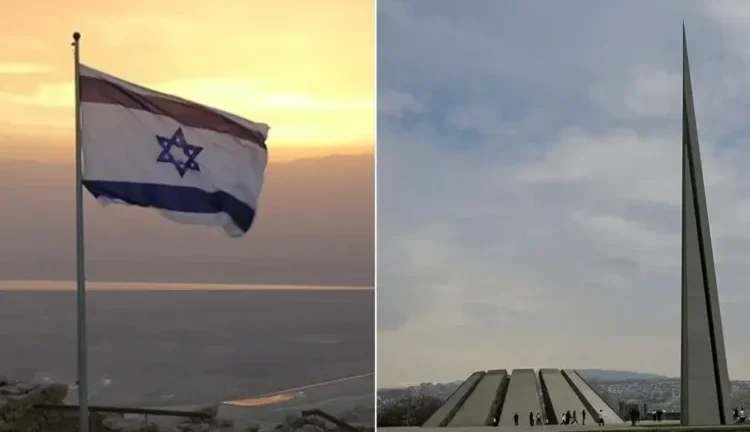
ANTWERP, Belgium | 25 July 2026 (IDN) — The relations of the State of Israel with Türkiye and Azerbaijan have been under great tension since the Israeli government submitted a bill recognising the Armenian Genocide to the parliament, the Knesset, at the end of June.
The government of Benjamin Netanyahu did not take this historic step out of respect for the one and a half million Armenians at least killed by the Young Turks in 1915 and after, nor in support of their relatives. Still, the intention was only to taunt Ankara.
Turkish President Recep Tayyip Erdoğan has been denouncing the Israeli army’s genocide of the Gaza population for months, and Netanyahu’s government has wanted to reciprocate. To the great displeasure of the Turks, of course, who still firmly deny the proven reality of this Medz Yeghern (‘Great Crime’).
Genocide for political gain
Once it is accepted that the suffering of the victims of genocide can be used for political gain, all floodgates might be open. It will provoke a situation in which everyone may react politically according to convenience and in this way the essence of the legal term ‘genocide’ will be trivialised. It is remarkable, for example, that the newly re-elected Armenian Prime Minister,
Nikol Pasinyan, did not really react to the statement of the Israeli government’s decision to recognise the Armenian Genocide. Pasinyan, hand in hand with the diplomacy (read: business deals) of US President Donald Trump, is trying to normalise relations with its two neighbours, Türkiye and Azerbaijan. He therefore wants to engage as little as possible with the dramatic past of the Armenian people of 111 years ago, nor with the recent past of the ethnic cleansing of Nagorno-Karabakh in the autumn of 2023.
Remarkable call
Even more remarkable was the call by the three Jewish communities in Azerbaijan to end the Israeli process of recognising the Armenian Genocide. Ashkenazim, Sephardim, and so-called Mountain Jews (descendants of Persian Jews living in the Caucasus since the fifth century) in Baku called on lawmakers in Jerusalem to reject the Netanyahu government’s bill.
The dictatorship in Baku is notable for its specific religious openness: all churches and denominations are welcome, except… any relationship with Armenia. As predictable as the tension between Israel and Türkiye, as murky is Jerusalem’s relationship with Azerbaijan. Baku is the main supplier of gas to Israel, and the Azeri army made massive use of Israeli-supplied drones during the 44-day war in Nagorno-Karabakh in 2020.
The extent to which a recognition of the Armenian Genocide has become a political asset appeared openly with last Monday’s announcement that the Knesset vote is postponed until after the summer parliamentary recess. An Israeli government spokesman told the Jewish News Syndicate (JNS) that government recognition of the Armenian Genocide can be reversed by a new government after the 27 October elections, which is more difficult with a law passed in the Knesset.
No coincidence
It is no coincidence that this U-turn comes just after the NATO alliance summit in the Turkish capital Ankara, where US President Trump concluded several deals with Turkish President Erdoğan. It was Trump who convinced the Israelis to stop (temporarily?) provoking the Turks with this recognition of the Medz Yeghern. The Israeli daily Haaretz has revealed that Prime Minister Netanyahu might also have been urged by a senior political adviser to Azerbaijan’s President Aliyev to block the Knesset vote.
The international community must urgently consider how to counter this instrumentalisation of the recognition or denial of genocide. The recognition of a genocide must be a purely humanitarian and legal matter, aimed at alleviating the suffering of the victims’ relatives and preventing further genocides. As soon as the recognition of genocides is ‘politicised’, the matter degenerates into mutual recriminations.
In this case: there is the Netanyahu government on the one hand which is targeting Ankara while it itself continues to sow chaos with genocidal violence in Gaza and it threatens to do the same in southern Lebanon; on the other hand, Erdoğan and his associates are unable to come to terms with Türkiye’s past nor Azerbaijan with its recent history or with its virulent ‘Armenophobia’ turned into a state ideology.
Ensure that “genocide” is neither undermined nor trivialised
In my own country, Belgium, we also must ensure that the concept of genocide is neither undermined nor trivialised. It becomes eroded if used without a legal examination of the disputed facts. Of course, concerning the genocides of the Young Turks against various Christian communities of the Turkish peninsula at the end of the First World War (not only the Armenians, but also the Pontic Greeks and the Assyro-Chaldean Christians), the facts are established.
The recognition of the Assyrian Genocide – known as Sayfo or the ‘Sword’ – has been recognised by the French Parliament, and on the proposal of the political party Les Engagés, the local authorities of Woluwe-Saint-Lambert were the first to recognise the Sayfo and the Genocide of the Pontic Greeks, a few weeks ago. It would be good if the government and parliament in Brussels, both having already recognised the Armenian genocide, now do the same, despite Ankara.
As far as the genocide in Gaza is concerned, there is – unfortunately – sufficient factual basis to recognise it and to act accordingly. Independent United Nations (UN) inquiries have proven that Israel is committing genocide in Gaza. The Belgian political parties that question this overwhelming reality are, de facto, negationists.
The denial of the horrors of the Holocaust during the Second World War is a crime in our country, and rightly so! The denial of genocide by Türkiye against Christians a century ago and in Gaza should also be criminally reprehensible. And just as no one wants to deal with neo-Nazis, our country cannot maintain normal relations with Israel, Türkiye, or Azerbaijan. ‘Never again!’ remains an empty slogan if we do not recognise and systematically fight all genocides on this planet. [IDN-InDepthNews]
*Benoit Lannoo is a historian specialised in Asian Churches, such as the Armenian Apostolic Church.