Sri Lanka: Plea For Democratic Governance

By Savitri Goonesekere, Jayantha Dhanapala and G. Usvatte-aratch* | IDN-InDepth NewsViewpoint

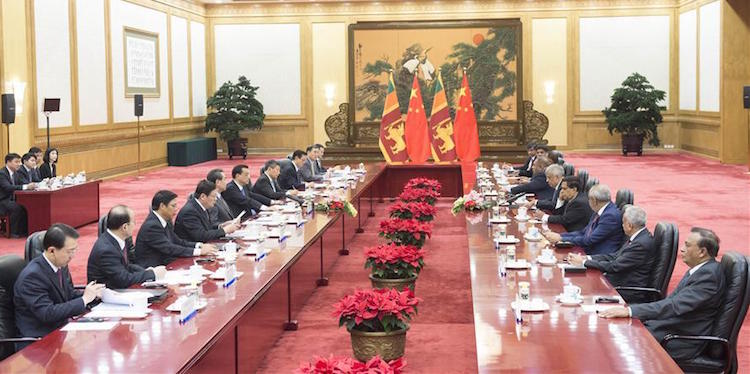
COLOMBO (IDN | Colombo Telegraph) – There has been, in recent times, public discussion in regard to whether our country is moving towards an authoritarianism that undermines democratic governance. The President, Ministers and government spokespersons have consistently denied this allegation. They refer in particular to the recent elections in three provinces as indicative of a functional and vibrant democracy responsive to the needs of the people. Infrastructure development that has taken place is also cited.

The recently concluded CHOGM hosted by Sri Lanka is considered an indication that Sri Lanka has achieved significant international stature as a country whose governance follows Commonwealth values. These values as stated in the final CHOGM communiqué refer in particular to democracy, human rights, tolerance, freedom of expression, separation of powers, rule of law, good governance, and sustainable development.

Africa’s Great Green Wall Seeks New Partners

By Jaya Ramachandran | IDN-InDepth NewsAnalysis

ROME (IDN) – More partnerships and investments are needed to support the pan-African Great Green Wall Initiative, which has become Africa’s flagship enterprise in tackling the detrimental social, economic and environmental impacts of land degradation, desertification, drought and climate change, experts say.

The initiative brings together more than 20 African countries across North Africa, the Sahel and the Horn, international organizations, research institutes, civil society and grassroots organizations, supporting local communities in the sustainable management and use of forests, rangelands and other natural resources in dryland areas. It also seeks to contribute to climate change mitigation and adaptation, as well improve the food security and community livelihoods in the Sahel and the Sahara.

Making Extractive Industries Truly Transformative For Africa

By Isabelle Ramdoo and San Bilal* | IDN-InDepth NewsEssay

MAASTRICHT (IDN) – The sustained commodity boom of the last decade provided a new impetus to a number of African countries, after decades of economic turmoil. High growth rates, recorded in recent years, uncovered new opportunities to finally address long-standing socio-economic challenges that had hindered the continent’s economic performance for decades. From an economic perspective, to be truly transformative, these opportunities will have to be translated into employment creation, improved productivity and industrialisation, and governments will increasingly be put under pressure to deliver on concrete results.

WRI Gently Criticises EU’s 2030 Climate Goals

By Jaya Ramachandran | IDN-InDepth NewsAnalysis

BERLIN (IDN) – The World Resources Institute (WRI) has greeted the European Commission’s announcement of a climate and energy package, which the 28-nation European Union (EU) heads of state would consider at their meeting on March 20-21. But the Institute points out that “the proposal does not yet ensure a clear pathway to a low carbon economy”.

When Oil Wealth Fuels Arab Conflicts

By Pir-Mohammad Mollazehi* | IDN-InDepth NewsAnalysis

TEHRAN (IDN) – In what way is the oil wealth of the Arab countries being spent? Is that wealth being used to promote sustainable social, cultural, political and economic development in Arab countries and, thus, plays a positive role in the life and livelihood of the Arab masses? Or is it being used in the opposite direction and is actually destroying the entire infrastructure in the Arab world, and instead of being a silver bullet for the maladies of the Arab countries, is only a scourge?

It is not easy to pass a simple judgment on this issue and many positive or negative arguments can be offered here. However, if the current conditions in the Arab world are examined more closely, especially after the political developments that have come to be known as the Arab Spring, one can, at least, claim that more than being a cure to their intractable ailments, the Arab oil wealth has been a scourge in disguise.

Egypt’s New Constitution No Cause For Unsullied Joy

By Hiba Zayadin* | IDN-InDepth NewsAnalysis

CAIRO (IDN) – The first step in General Abdel Fattah El-Sisi’s roadmap to “democracy” has been implemented. A new charter has replaced the 2012 constitution drafted during former President Mohamed Morsi’s short-lived presidency giving Sisi the legitimacy he seeks to strengthen the army’s grip on Egypt’s political system. Over 98% of participants voted in favour of approving the new constitution. According to officials, the voter turnout was 38.6% of the Egyptian population – higher than the 33% who voted on the constitution presented during Morsi’s tenure.

There was little doubt the new military-backed constitution would pass. On the first day of the voting process, polling stations featured women ululating in celebration, Egyptian flags being waved, and soldiers carrying flowers handed to them by people displaying their support for the army.

Implications Of Scottish Independence For Development Cooperation

By James Mackie* | IDN-InDepth NewsAnalysis

BRUSSELS (IDN) – While the debate on Scottish independence is heating up prior to the referendum in September 2014, it is important to consider what implications an independent Scotland would have for UK and European development aid. While the UK aid would undoubtedly be affected, this new donor country would need to make an effort to minimize the effect on further aid fragmentation.

Scottish independence would lead to more fragmentation of European development cooperation and a major reduction in Department for International Development (DFID) programmes as a result of an estimated GBP 1 billion cut in its budget, yet neither of these two outcomes are really dealt with in two recent reports on what a Yes vote in the 2014 Scottish referendum would mean for development cooperation.

Africa Asked To Address Nuke Proliferation Risks

By Jaya Ramachandran | IDN-InDepth NewsAnalysis

STOCKHOLM (IDN) – African countries, which are party to the 1996 African Nuclear Weapon Free Zone Treaty of Pelindaba and already contribute a significant share of the uranium used in the peaceful nuclear industry worldwide, have been asked to develop “a full understanding of their extractive industries, to avoid the risk that uranium will be supplied from unconventional sources – for example, as a by-product of other mining activities”.

The Logic Behind EU Tehran Office

By Said Khaloozadeh* | IDN-InDepth NewsAnalysis

TEHRAN (IDN) – Every time that the European Union (EU) has established an independent diplomatic mission in a country, it has been construed as a sign of the willingness of the EU member states to promote their relations with that country. Therefore, it seems that the European Union has decided to improve and promote the level of its relations with the Islamic Republic of Iran.

In order to achieve that goal, one good way is to open an independent embassy in the Iranian capital city of Tehran. This will also open the way for future negotiations between the two sides on the conclusion of a bilateral trade and cooperation agreement, and will also help Tehran and the EU to further strengthen their mutual relations. The next stage will be the opening of an independent embassy by the Islamic Republic of Iran in the seat of the EU in the Belgian capital city of Brussels, which will be a further sign of improvement in bilateral relations

ICTs Operating In A Changing Environment

By Kalinga Seneviratne* | IDN-InDepth NewsInterview

BANGKOK (IDN) – The information and communication technology (ICT) sector is undergoing a period of major transition, changing the way we communicate with each other. These technologies are introducing new players to the industry, challenging traditional business models and regulatory frameworks.

IDN’s Kalinga Seneviratne spoke to Dr Rohan Samarajiva, a former telecom regulator in Sri Lanka, at the ITU Telecom World 2012 event in Bangkok in November 2013. Samarajiva is a professor of Communication and Public Policy at Ohio State University in the U.S. and the founding Chair of LIRNEasia (Learning Initiatives on Reforms for Network Economies Asia), an ICT policy and regulation think tank active across emerging economies in South and South East Asia, and the Pacific. He was its CEO until 2012.

Begin typing your search term above and press enter to search. Press ESC to cancel.

Back To Top