
By Filmon Gebremikael, Daniel Tesfa and Shim Masha
ANTWERPEN | Belgium | 22 August 2026 (IDN) — Semhal Hadush was a civil servant in a municipal office in the Central Zone of Tigray. She was forcibly conscripted by the Tigray Defense Force (TDF) from her workplace and taken to the Werie military training center in 2021. Semhal and Filmon Gebremikael were placed in the same training unit.
Filmon saw the following:
At the military training centre where I was forcibly conscripted from the Central Zone of Tigray, I witnessed sexual violence against women that still haunts me. I have not been able to forget what I saw.
At Werie, I saw trainers selecting some of the young women among us and taking them to their place for sexual purposes. Semhal was among those threatened with sexual abuse.
The women were treated as though they belonged to the trainers. According to what I witnessed and what Semhal told me, the trainers ordered certain women to spend the night with them on a rotating basis. As a result, many trainees became pregnant. Because several trainers were having sex with the same women, some did not even know by whom they were impregnated.
One day, during the training, a handwritten letter circulated among the women in the training center.
It was widely read among the trainees.
It was written in Tigrinya by women who had undergone training at Werie before our group. The writers said that the trainers forced tens of women in their group to have sex with them. They warned the new trainees not to remain silent and urged them to defend themselves against sexual abuse as important as surviving the active battlefields.
The message was devastating: silence had not protected the previous group. But it was too late as many of the women trainees in our batch had already become pregnant, while the trainers continued to exercise power over them. In the letter, the survivors from the previous group warned that there was no effective protection available and urged the new trainees to do whatever they could to prevent themselves from becoming sexual slaves.
There were three women that I knew about their pregnancy when we finished the training. Semhal also told me what she was experiencing and advised her to avoid places that put her in a direct exposure to the trainers. She often stayed among groups of male trainees because she believed the trainers would be less likely to single her out from among the mass.
Then came an incident I have never forgotten.
As part of my attempt to escape the training centre, I asked my trainer for permission to visit my parents. He responded:
As long as you convince Semhal to spend the night with me, I can allow you the leave you requested.
From that moment, I committed myself to protecting Semhal from what I understood to be sexual exploitation by trainers and military leaders. Eventually, Semhal died at the military front a week after we were distributed to the frontlines. But her story has remained with me.
And after the Pretoria Agreement ended the large-scale war, I began asking a question that has become increasingly difficult to ignore: Why are Tigrayan women not protected after the war supposedly ended? Filmon further asks how on earth the so-called leaders of the freedom fighters become perpetrators who commit crimes by putting women fighters as their sexual slaves.

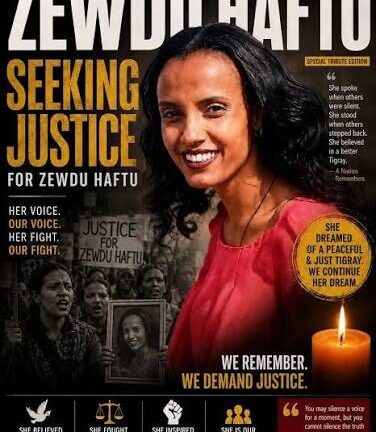
Zewdu Haftu’s photo used in demonstrations against sexual violence in Tigray. Photo from Angesom Abreha’s Facebook page.
Zewdu Haftu: A woman killed in the heart of Mekelle
Then there is the story of Zewdu Haftu.
On 19 August 2023, during the Ashenda season, 32-year-old Zewdu was walking through Mekelle with her friend, Semhal Gebregziabher.
According to subsequent reporting, an unregistered vehicle approached the two women. Witnesses said Zewdu resisted what appeared to be an attempted sexual assault. She was violently dragged by her hair and fatally crushed under the vehicle.
Zewdu died in a public place in the regional capital. Her friend Semhal survived. But survival did not mean safety.
A joint statement by Tigrayan organisations said Semhal was receiving treatment at Ayder Referral Hospital for trauma associated with the incident while under police custody. The statement said that Semhal was forcibly removed from the hospital on 30 August 2023 before being medically discharged.
Her treatment became part of the controversy surrounding the case.
The murder of Zewdu provoked widespread public anger and became a symbol of concerns about violence against women and the ability of institutions to protect witnesses.
Nearly two years later, the Mekelle High Court convicted Yared Gebresilassie and Angesom Hailemariam, sentencing both to life imprisonment without parole for the killing. The court cited extreme cruelty in the commission of the crime. Yared Gebresilassie was also sentenced to three years’ imprisonment and 1000 ETB fine for killing the late Mulubrhan Mekonen on 5 November 2025 on top of the life imprisonment for killing Zewdu Haftu.
But the case did not end with the verdict.
Questions surrounding the treatment of the principal witness and allegations of procedural interference continued to generate concern about the justice system. For women and human rights advocates following the case, the question was, therefore, whether a woman who witnessed violence could trust the institutions that were supposed to protect her.
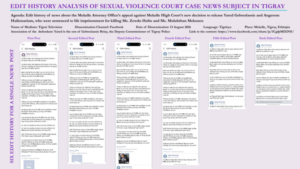
Evidence of Tigrai Television’s Facebook page edit history on its coverage about the press release of Mekelle Attroney Office’s appeal against Mekelle High Court’s verdict to release Yared Gebreslassie and Angesom Hailemariam. Compiled by Daniel Tesfa, 2026.
Media Manipulation, Impunity, and the Silencing of Victims
The defendants, Yared Gebreselassie and Angesom Hailemariam, appealed to the Tigray Supreme Court. The Supreme Court subsequently referred the case back to the Mekelle High Court, which on 5 August 2026, ruled that the defendants should be released. The way Tigrai Television reported this trial and subsequent opposition to it on its Facebook page further ignited more unresolved concerns.
As we learned from the Tigrai Television Facebook edit history, the news about Mekelle Attorney Office’s opposition to the verdict was first posted on 13 August at 11:44 AM. Then the same post was edited at 11:52 AM, edited for the third time at 11:54 AM, edited for the fourth time at 12:45 PM, fifth time at 12:49 PM and for the sixth time at 12:52 PM all in the same day.
This latest trial of the late Zewdu Haftu, as reported and later edited by Tigrai Television, offers a revealing window into the broader dynamics of justice, accountability, and silencing in Tigray. The contrast between the first post and the sixth edited post is not merely a matter of journalistic inconsistency; it is emblematic of a deeper pattern in which institutions, including state‑aligned media, reshape narratives to protect powerful actors and obscure the truth. This pattern has profound implications for victims of violence, including survivors of sexual violence, whose experiences are often minimised, denied, or erased in similar ways.
The first post was detailed as it named the defendants, outlined the evidence—witness testimony, video, and audio—and situated the case within a clear timeline of conviction, appeal, and release. It acknowledged uncertainty about the defendants’ whereabouts and emphasised that no new evidence had been presented to justify their release. In short, it provided the public with the information necessary to understand the gravity of the crime and the contested nature of the judicial process.
By contrast, the sixth edited post stripped away these details. Names were removed, evidence was omitted, and the narrative was reframed as a procedural irregularity—a 2‑to‑1 vote—rather than a substantive breakdown of justice. The post introduced a defensive tone, denying rumours of concealment, but in doing so, it concealed more than it revealed. This shift illustrates how media can be mobilised not to inform the public but to protect reputations, particularly when those reputations are tied to powerful institutions. In this case, the fact that one of the defendants, Yared Gebreselassie, is the son of Gebresilassie Belay, who is the Deputy Commissioner of the Tigray Region Police Commission, casts the edits in a stark light. The erasure of detail appears less like journalistic correction and more like institutional shielding.
For victims’ families, this manipulation is devastating. The first post validated their suffering by acknowledging the crime, the evidence, and the conviction. The sixth edition of the post reduced their loss to a sterile procedural dispute, erasing the recognition of accountability and undermining their trust in both the courts and the media. This is a form of secondary victimisation: the denial of truth compounds the original harm. Families are left not only with grief but with the suspicion that justice is being deliberately obstructed.
The implications extend beyond this single case. In contexts of widespread sexual violence, such as in Tigray, similar patterns of silencing and narrative control are evident. Survivors often face disbelief, stigma, and institutional neglect. Their testimonies may be dismissed, their evidence ignored, and their cases quietly dropped. When media outlets sanitise stories, omit names, or reframe crimes as procedural anomalies, they contribute to a culture of impunity. This culture signals to perpetrators that they can act without consequence and to survivors that their voices will not be heard.
Moreover, the involvement of powerful figures, such as a senior police commissioner’s family, highlights the intersection of sexual violence, political power, and institutional protection. In many cases, perpetrators are shielded by their connections, and survivors are silenced by fear of retaliation. The manipulation of the Zewdu Haftu case demonstrates how influence can distort both judicial outcomes and public narratives. For survivors of sexual violence, this means that even when they muster the courage to report crimes, they may find the system stacked against them, with media and institutions colluding to minimise their experiences.
This reflection underscores a critical point: patterns of sexual violence in Tigray cannot be understood solely through the acts of violence themselves. They must also be analysed through the structures that enable impunity, political system that utilise violence as a means of survival, courts that fail to deliver justice, police forces compromised by internal interests, and media outlets that obscure rather than expose. The Tigrai Television edits are a microcosm of this larger dynamic. They reveal how truth is contested, how victims are silenced, and how power protects itself.
The evidence says the violence continued
The Cessation of Hostilities Agreement (CoHA) signed in November 2022 created hopes that the violence that had devastated Tigray for two years would end. But medical evidence collected after the agreement tells a different story.
Physicians for Human Rights (PHR) and the Organisation for Justice and Accountability in the Horn of Africa (OJAH) reviewed 305 randomly selected medical records from health facilities across Tigray. Of these, 304 contained reports of conflict-related sexual violence.
The report adds:
A medical and human rights research team reviewed 305 randomly selected medical records from multiple health facilities in Tigray, Ethiopia, with the goal of documenting types and patterns of conflict-related sexual and gender-based violence perpetrated against civilians in Tigray between November 2020 through June 2023. Of the 305 records reviewed, 304 records included reports of conflict-related sexual violence, overwhelmingly affecting women and girls, with survivors of conflict-related sexual violence ranging in age from eight to 69.
Most significantly for the post-Pretoria period, the records documented 128 incidents of conflict-related sexual violence after the November 2022 agreement. The researchers found 169 incidents before the agreement and 128 perpetuated after the CoHA among the health records. The scale and nature of the violations, they concluded, had not materially changed after the cessation of hostilities.
One finding is particularly disturbing: 95% of the documented conflict-related sexual violence involving children and adolescents under 18 occurred after the agreement was signed.
The report documented conflict-related sexual violence through hundreds of medical records that show severe violations continue to be perpetrated after the signing of the Cessation of Hostilities Agreement by the government of Ethiopia and the Tigray People’s Liberation Front (TPLF).
These numbers do not represent all survivors.
They represent cases that reached health facilities and entered the medical records examined by researchers. The study found a median five-month delay between reported incidents and survivors presenting for medical care, suggesting substantial barriers to treatment and reporting.
PHR and OJAH found that 76% of the documented cases involved multiple perpetrators. Ten records described survivors being held captive while repeatedly raped by multiple perpetrators, circumstances the researchers considered consistent with sexual slavery or enslavement.
The researchers reported that survivors identified perpetrators largely as members of Eritrean and Ethiopian armed forces and associated militias.
Kokob Tsibah: Women held captive after the peace agreement
In Kokob Tsibah, in the Eastern Zone of Tigray, Eritrean Defence Force soldiers reportedly continued sexual violence against women after the cessation agreement. Amnesty International documented women being held at an Eritrean military camp for nearly three months, where they were repeatedly raped. The organisation characterised the circumstances as sexual slavery.
Amnesty International’s Regional Director for East and Southern Africa Tigere Chagutah said:
Despite the signing of the Cessation of Hostilities Agreement, atrocities against civilians in Tigray continued with Eritrean soldiers subjecting women to horrific abuse including rape, gang rape and sexual enslavement, while civilian men were extrajudicially executed.
The sexual violence was not only a memory from the war. For some women, it continued into the period that was supposed to be peaceful.
Irob: The violence continued in the borderlands
In Irob, a small ethnic community in Eastern Zone of Tigray bordering Eritrea, local officials reported continuing abductions and sexual violence after the Pretoria agreement in the Irob localities under the occupation of the region by the Eritrean Defense Force.
Analysis published in September 2023 showed that more than 30 girls and women had experienced sexual violence, while four abduction cases had been officially reported. Local sources warned that the actual number was likely higher because of insecurity, limited services and social pressure, which made reporting difficult.
The Irob evidence shows another problem: peace in a capital city does not necessarily mean security in remote communities.
Where armed forces remain present, where humanitarian access is limited and where institutions are weak, women can remain exposed to violence long after political leaders declare that hostilities have ended.
Two Semhals, two stories, one question
The stories of the two women named Semhal are separated by place and circumstance.
Semhal Hadush was a trainee at Werie. She was vulnerable to the power of military trainers. She tried to protect herself by staying among other trainees. She ultimately died at the front.
Semhal Gebregziabher was walking beside Zewdu Haftu when Zewdu was killed. She became a principal witness to the crime and subsequently faced detention and controversy surrounding her treatment.
Their experiences are different. But both stories raise the same fundamental question: Who protects women and civilian citizens when the people or institutions around them possess overwhelming power in the middle of forced military conscription and escalating tension of war and violence?
Ashenda in Black
Ashenda is a celebration of Tigrayan women and girls—a celebration of culture, identity, sisterhood and freedom. It is traditionally marked by young women dressing in traditional clothing, singing, dancing and gathering with one another.
But the memory of Zewdu has changed the meaning of the season for many people. She was killed during Ashenda. Her friend Semhal witnessed it. And thousands of women across Tigray carry stories that never reached a courtroom or a medical record.
This is why Ashenda in Black can become more than a symbol of mourning. Black is for Zewdu.
Black is for the women held captive as sexual slaves and killed. Black is for the girls who survived rape. Black is for the women whose pregnancies resulted from sexual violence. Black is for those whose stories were never documented.
And black is also a demand: PEACE MUST INCLUDE SAFETY.
The Pretoria Agreement stopped a large-scale war. But for women, peace cannot be measured only by the absence of artillery. It must be measured by whether a woman can walk through Mekelle without fear. Whether a girl can attend school safely.
Post-Pretoria sexual violence should not become another battlefield for competing political narratives. The identity of the perpetrator must be established through independent investigation and accountability mechanisms.
And now, Gebresilassie Belay, the Deputy Commissioner of the Tigray Region Police Commission and the father of Yared Gebreselassie, said in the same Tigrai Television broadcast that he is working to ensure Ashenda is peacefully celebrated in Tigray 3 years after his son took the lives of Zewdu Haftu and Mulubrhan Mekonen.
Persistent pattern of abduction, killing and sexual violence
The individual cases documented after November 2022 point to a troubling pattern of violence against women and girls in Tigray that extends beyond the battlefield. In December 2022, Harnet, 19, was reportedly abducted and repeatedly gang-raped in Western Tigray; Selamawit, 22, reported gang rape in north-western Tigray. In Adwa, 16-year-old Mahlet Teklay was abducted in March 2024 and later found murdered after her kidnappers demanded a ransom.
A report based on Mekelle City Police statistics recorded 12 women murdered, 80 raped, 10 kidnapped and 178 subjected to attempted murder during the eleven months from August 2023 to July 2024. The Tigray Women’s Association also reported that 33 women and girls were brutally killed in 2026.
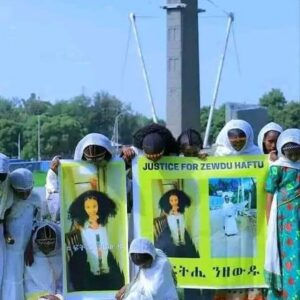
Women and girls demonstrating in Axum seeking jusitice for the killing of Zewdu Haftu and victims of sexual violence in Tigray. Photo from TGHAT.
Taken together, these cases show different forms of violence, brutal killing, sexual assault, abduction for sexual or financial purposes, and lethal violence, occurring in both urban and rural settings. Perpetrators range from armed actors in reported conflict-related cases to unidentified or criminal defendants in other cases. What they do demonstrate is a persistent post-Pretoria insecurity in which women and girls continued to face multiple and overlapping forms of violence, challenging the expectation that the cessation of large-scale hostilities would automatically translate into safety for women.
For society at large, the pattern of sexual violence in Tigray is a reminder that impunity is not only about crimes committed but also about narratives controlled. Addressing sexual violence in Tigray, therefore, requires not only supporting survivors but also challenging the institutions and media practices that perpetuate silence and shield perpetrators. Only by confronting these patterns can justice be restored and the dignity of victims upheld. [IDN-InDepthNews]