By Kester Kenn Klomegah
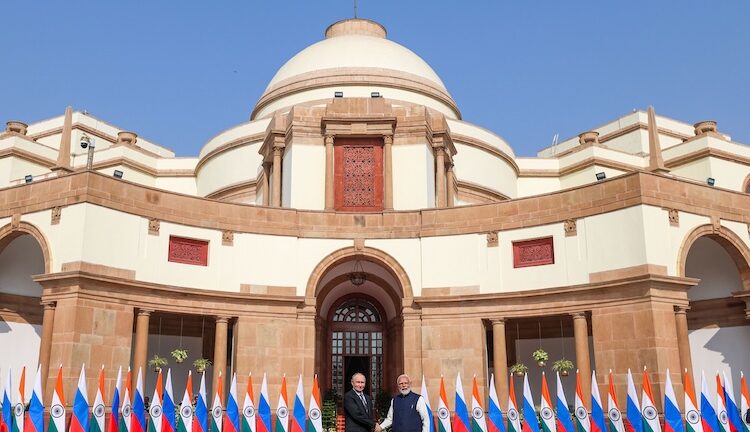
MOSCOW | 20 December 2025 (IDN) — Russian President Vladimir Putin’s December 4–5, 2025, visit to India—his first since the outbreak of the Russia-Ukraine war—carried heavy symbolism and clear strategic messaging, capped by an unprecedented public embrace with Prime Minister Narendra Modi. The trip underscored the durability of a decades-old partnership as India navigates intensifying geopolitical pressures while asserting strategic autonomy.

In this interview with Kester Kenn Klomegah, Pradeep Mehta, Secretary General of the Jaipur-based Consumer Unity and Trust Society (CUTS International) and Honorary Adviser to India’s Commerce and Industries Minister, assesses the visit’s economic outcomes, the evolving priorities in India–Russia ties, and the implications for trade, multilateral cooperation, and the wider Global South.
Several important agreements were signed during the visit as both sides sought to strengthen their partnership in New Delhi. Below are excerpts from the interview:
Strategic Signals
Russian-Indian Relations Development:
Putin’s first visit since the Russia-Ukraine conflict, marked by Modi’s unprecedented airport embrace and a private dinner, highlighted the enduring strength of the relationship despite Western pressure. The visit was a strategic reaffirmation of long-standing ties. The twenty-third annual summit marked 25 years of their “Special and Privileged Strategic Partnership,” but with a notable shift: defence announcements were conspicuously absent, signalling a move from arms-centric ties toward economic diversification and people-to-people links. This was not merely transactional; it reflected a bond forged through shared experiences, mutual respect, and political consistency across generations.
Significance for Indian Business and CUTS International:
The visit produced practical outcomes: a labour-mobility pact for Indian skilled workers, 30-day e-visas (first announced by Russia for Indians and now India reciprocating), joint ventures in fertilisers, and maritime/customs agreements advancing national-currency trade. Both leaders pledged uninterrupted energy supplies and a $100 billion trade target by 2030 from the current $68 billion. A severe trade imbalance persists, with Indian imports totalling $63.84 billion and exports of only $4.88 billion. However, we could see a surge in Indian exports to Russia and, more significantly, in joint ventures with Russia across numerous areas, including cyber and space.
For CUTS International, as we have already been working on various trade-related areas with Russia and having many friends there, this visit will most certainly buttress our commitment to work further to strengthen multilateral forums such as BRICS, WTO and G20, among others, especially given the fact that the next chair of BRICS in 2026 is India. More so, we recently organised a brainstorming session on the coming together of four countries (the US, China, Russia and India) grouping, we named ‘Quadro’. Lastly, as we have held back the development aid in Africa, we could look at India-Russia-backed development aid-funded projects here.
By the way, we have also conducted a feasibility study on a bilateral free trade agreement with the Eurasian Economic Union (for our Commerce Ministry), of which Russia is the largest member. It showed positive gains for both India and the EAEU, as much of the costly European imports into EAEU members can be supplied by India.Trade Footprint
Despite ambitious targets, India’s economic footprint in Russia remains modest and import-heavy. The imbalance is stark, with a “rupee surplus problem” emerging as billions accumulate in Special Rupee Vostro Accounts. As noted earlier, the labour-mobility agreement and fertiliser joint ventures are efforts to deepen engagement beyond energy imports. But Indian investment and a broader services-sector presence in Russia remain underdeveloped, leaving significant room for growth if both countries genuinely pursue economic diversification. If and when the India-EEC FTA is signed, that presence will deepen.
Geopolitics
The visit served dual purposes: for Russia, political legitimacy; for India, a demonstration of strategic autonomy, multialignment, and the value it places on old friendships. Challenges loom. Trump administration’s 50% tariffs explicitly target India’s Russian oil purchases. Russia’s deepening ties with China also complicate matters amid India-China tensions. Still, against the backdrop of a China-Pakistan-Bangladesh nexus, closeness to Russia offers India a strategic option.
From CUTS International’s perspective, the relationship will likely persist as “strategic diversification,” with India maintaining Russian energy ties and selective defence links while deepening Western partnerships, particularly with the US. Unlike transient partnerships, this bond’s generational consistency suggests resilience—though the economic relationship must mature beyond its current import-dependent structure.
The prospect of the Russia-Ukraine war ending in peace appears rather dim. It will likely continue to test India’s stoic aloofness and friendship with Russia.
Global South
The Global South is profoundly heterogeneous, particularly in climate change and natural disasters, where major emitters stand in sharp contrast to vulnerable low-income countries. Cooperation mechanisms remain fragmented and regionalised. Infrastructure gaps, development-financing constraints, and wide economic disparities among member states compound these challenges. Still, organisations such as the G20 and BRICS (with more new members from the south in 2025) offer a more coherent alternative vision to existing global governance structures.
The US boycott of the G20 summit in South Africa and its decision not to invite South Africa to the next G20 Summit in Miami, USA, are undiplomatic and detrimental to global peace and cooperation. Furthermore, the US’s misbehaviour towards an expanding BRICS is also worthy of strong criticism. [IDN-InDepthNews]
Image: Russian President Vladimir Putin and Indian Prime Minister Narendra Modi in New Delhi, December 5, 2025. Photo: PMO India.in.