
By Kalinga Seneviratne
BANGKOK, Thailand | 21 October 2026 (IDN) — The IMF-World Bank annual meeting returned to Bangkok last week (12 to 18 October) after more than three decades, with nervous Thai authorities going to great lengths to prevent civil society protests from disrupting it.
Inside Bangkok’s convention centre, World Bank’s turbaned American-Sikh President Ajay Banga led a charm offensive to convince the world that the Bank is transforming the development model of previous generations into one that addresses the expectations of equality among nations. He also talked about building models that develop local industries, create local jobs, and keep the value of natural resources at home. He also launched a Philanthropy Hub in Bangkok, which the Bank says will push it toward more partnerships with a variety of stakeholders.
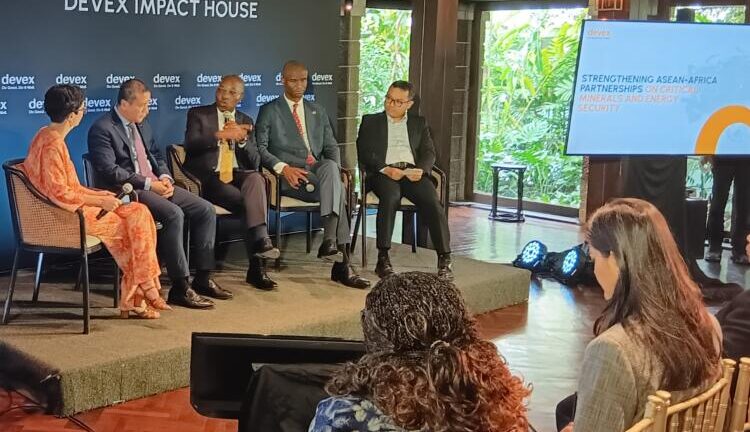
While the World Bank was talking about mobilising private funding to compensate for reducing foreign “aid” budgets from “donor” nations, at a two-day “Development Impact” side-event organised by the Washington-based development reporting social enterprise Devex, which was dominated by speakers from Africa and Asia, one felt as if the “Bandung Spirit” was returning to international development dialogue.
In 1955, 29 newly independent countries led by Indonesia, Egypt, India, and China met in Bandung, Indonesia, in a historic Africa-Asia Conference that launched the Non-Aligned Movement. Though that movement has lost its shine over the past 2 decades, that spirit seems to be awakening, with Africans feeling inspired by Asia’s economic rise, especially China and India. This was reflected in presentations by African speakers at the Forum.
For the past half a century, Western countries, in particular, have taken away Africa’s valuable mineral resources, giving it a pittance in return as “royalties”. Inspired by the Chinese model, where they used their mineral resources to build batteries and electric cars and export them to the world, Africans are now saying they can do the same by creating industries in Africa that employ Africans to process and develop products using these minerals, first for the African market and then export to the world. But they would like assistance from Asia to help train their people for this new era.
“We have a very strong (development) partnership with China. We have increasing partnerships with India and (South)Korea,” Mavis Owusu-Gyamfi, President and CEO of the Ghana-based African Centre for Economic Transformation, told IDN in an interview. “These countries have the technology, but it’s not just about adopting technology; we need to get it to work for us”.
Africans point out that, as a region, Africa has a population of 1.5 billion people, estimated to increase to 2.7 billion by 2050. Most Africans are currently poor, as Asia was fifty years ago. So Asia could share its development experience, and the two regions could work jointly to uplift both regions for mutual benefit, with Africa having the potential to be the world’s growth engine in two decades.
Pointing out how China developed its electric car industry, Owusu-Gyamfi says, “We want China not to take our raw materials, but to work with us to add value to it, to build the battery. We need to learn that technique. We need to learn the skills.”
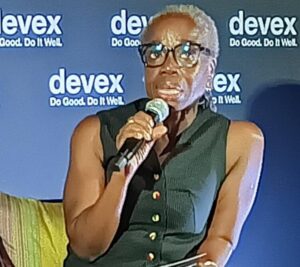
At a panel discussion on South-South cooperation at the Devex Forum, African Union Commissioner on economic policy and sustainable development, Patrick Ndzana Olomo, said, “Our endowment in terms of mineral resources is certainly high. African Continental Free Trade Area has 55 countries, and it has a population of 1.5 billion people comparable to what you have in China or in India”. Thus, he added that this calls for strategic partnerships: “processing should start locally in Africa to make sure that we keep the jobs in the continent”.
Indonesia is expected to become the world’s fifth largest economy within 2 decades. Muhammad Rachmat Kaimuddin, managing director, development investment of Indonesia’s PT Danantara Development Management Fund, speaking on the same panel, said they would be open to collaborating with Africa to see whether Indonesia’s ability to transform mineral wealth into local industrialisation could be applied in Africa. “We do have some final products industries they would also like to be interested in integrating with Africa,” he noted. “We have to move things together to ensure we have trade terms and investment facilities between the two regions. And we have to share experience on sustainable resource governance”.
In an interview with IDN, Dr Hod Anyigba, executive director and chief economist of the African Regional Organisation of the International Trade Union Confederation, warned about too much hype of Africa-Asia collaboration, especially the Chinese concept of shared prosperity in development assistance.
Pointing to a Chinese aid project in Zambia, he said, “Yes, China has built a road, a school, a bridge; it looks like a type of exchange, but they have sent the workers, even cleaners, to build that infrastructure. So no skills transfer. There is a toll on the new road, and a Chinese company collects it for 15 years because they have built it”.
“I don’t know where the shared prosperity is coming, when there is no skills transfer, there’s no upskilling, there’s no education” notes Anyighba. “These infrastructure debts are more dangerous than liquidity debts the World Bank and IMF give to pay off other debts,” argues Anyigba. “The whole concept of development assistance needs to focus more on creating local jobs and creating income for the locals, where a certain percentage of profits could go to the investor”.
Owusu-Gyamfi notes that the Chinese don’t talk about aid, “they say its investments they are making. That’s two-way and you need to make sure you get your side of the bargain. For that politicians need to be clean”. She argues that some of the debt from China “has been so much more productive than some of the other debts we’ve had,” and points to an infrastructure project in Ethiopia. “It’s a joint-venture between Chinese and Ethiopian companies that is adding value to local resources and transforming the economy”.
“When we negotiate with China we need to make sure that it is a joint venture investment and that we learn from them” argues Owusu-Gyamfi.
One of the African speakers at the Devex forum pointed out that billions of dollars are available in African pension funds. Still, they are invested mainly in Western bond markets. At the May 2025 African Development Bank meeting in Abidjan, the “hidden capital wealth” of Africa in pension funds was discussed. Senior executives from major African financial institutions presented compelling evidence challenging long-held assumptions about the continent’s capital scarcity during a high-profile panel discussion. It was revealed that in 2024, Africans invested $125 billion in cryptocurrency assets.
Owusu-Gyamfi believes these are assets that could transform Africa if invested in the continent. “We have a culture of investing overseas. We need to change the culture of investing,” she argues. “We are a high-risk market with high returns. When you are only allowed to invest 5 per cent in high risk, you’re not going to do a lot on the African continent”.
The New African Financial Architecture for Development (NAFAD), led by the African Development Bank Group, responds to this diagnosis with a system-level framework that reorganises how capital and risk are deployed across Africa’s financial ecosystem. AU Heads of State endorsed it in February 2026 in Addis Ababa, and the Abidjan Consensus adopted it on 9 April 2026.
Referring to this, Owusu-Gyamfi argues that “it’s about bringing our financial institutions together and getting them to work with each other and minimise the risk. Then we can leverage those four trillion (or so funds through these financial institutions to invest in African development”.(IDN-InDepthNews)