

By Jan Servaes
MIAMI | 28 May 2026 (IDN) — The weekend preceding Memorial Day (observed on the last Monday of May) is not only the time when Americans host their first barbecue of the summer season, but also when—during religious services, parades, and speeches—they commemorate those who have fallen in all American wars. In local cemeteries, flags and flowers are placed upon the graves of veterans. It is one of those annual occasions when patriotism becomes engulfed by nationalism.
While patriotism can be defined as a sense of love and devotion to one’s own country, nationalism is an ideology that emphasises the interests and identity of a nation, often prioritising it above that of others. The two concepts may sometimes overlap, yet nationalism is frequently regarded as more divisive, focusing instead on cultural unity and independence.
In Trump’s America, this is clearly the case today. “A history that looks back to a mythologized past as the country’s perfect time is a key tool of authoritarians. It allows them to characterise anyone who opposes them as an enemy of the country’s great destiny,” writes Heather Cox Richardson—historian and professor—on page 251 of her book, *Democracy awakening: Notes on the State of America*—the very book I am reading during these memorable days.
The book argues that Trump is not an anomaly, but rather the inevitable, logical outcome of a historic process, given the support the Republican Party has lent—over the preceding seventy years—to Christian nationalism, racism, and corporate interests. The epigraph Richardson chose to open her book comes from Walt Whitman—”the most famous American poet of the nineteenth century”—who, in his 1871 work *Democratic Vistas*, observed: “We have frequently printed the word Democracy. Yet I cannot too often repeat that it is a word the real gist of which still sleeps, quite unawaken’d.”
Thus, this book is “the story of how democracy has persisted throughout our history despite the many attempts to undermine it. It is the story of the American people, specifically those whom the powerful have to marginalize, who first backed the idea of equality and a government that defended it, and then, throughout history, have fought to expand that definition to create a government that can, once and for all, finally make it real” (p. xxi).
For anyone feeling lost amidst Trump’s media campaigns—described by his advisor Steve Bannon as “flooding the zone” (“This is not about persuasion: This is about disorientation”)—Richardson’s book comes highly recommended as a must-read.
Heather Cox Richardson has described herself as a “Lincoln Republican.” She earned her bachelor’s and doctoral degrees at Harvard and previously taught history at MIT and the University of Massachusetts Amherst. She is currently a professor at Boston College. She has authored seven books on history, political democracy, equality, and social justice—including *How the South Won the Civil War: Oligarchy, Democracy, and the Continuing Fight for the Soul of America*.
In 2019, she began publishing *Letters from an American*, a daily newsletter that frames current events within the broader context of American history. She publishes this content on Substack, YouTube, and Facebook, and also sends out daily emails. In the spring of 2025—in accordance with executive orders issued by the Trump administration—it came to light that posts by Heather Cox Richardson had been removed because they were linked to diversity, equity, and inclusion (DEI initiatives).
Nevertheless, *Letters from an American* remains one of the most popular publications on Substack. For instance, Richardson interviewed President Biden in both 2022 and 2024. By June 2026, the newsletter had garnered more than 2.9 million subscribers.
The ‘Democratic’ vs. ‘Authoritarian’ View of American History
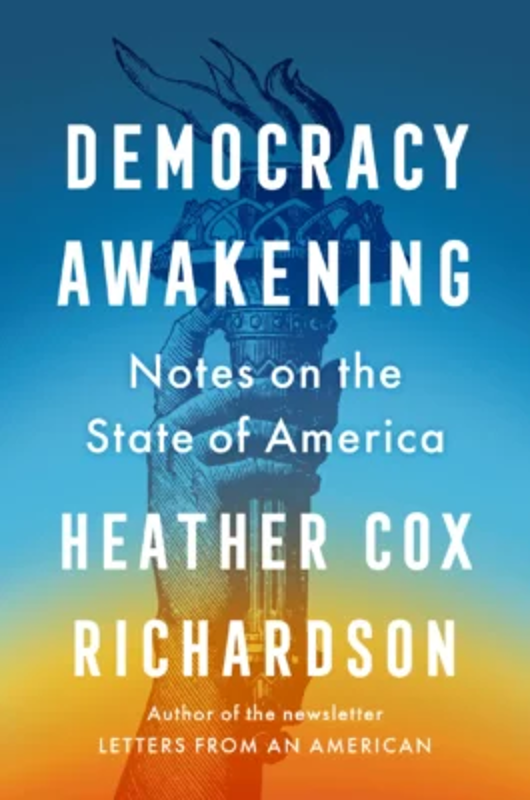 The bulk of *Democracy Awakening* is devoted to a broad history of the United States, spanning from the Revolution to the rise of Donald Trump and the January 6, 2021, attack on the Capitol. It is a highly readable historical account that consistently focuses on elaborating upon the events, movements, and ideas that have advanced either the “authoritarian” or the “democratic” narrative regarding the nation’s true purpose and origins. Which of these two narratives we accept as the truth, she argues, largely determines our reactions to current events.
Richardson approaches her subject from a progressive perspective. The key to the rise of authoritarianism in the United States, she writes, lies in the “use of language and false history”; a “strongman distorts history to mobilise his base” (p. xvi). The decline of democracy and the rise of authoritarianism in the United States today, she asserts, are predicated upon a distorted historical narrative of the nation. Therefore, historical ideas play a significant role in explaining the rise of Donald Trump and everything his MAGA movement stands for.
According to Richardson, the two competing origin stories of the United States derive their fundamental principles from different founding documents.
The “democratic” vision of American history is based on the principles enshrined in the Declaration of Independence of 1776. This nation, the Declaration asserts, was founded to “sever political ties” with the tyrannical government of the King of England—a government that taxed the colonists without granting them representation.
Richardson also highlights the inclusive language of the Declaration: the “self-evident truths” that “…all men are created equal, that they are endowed by their Creator with certain unalienable Rights, that among these are Life, Liberty and the pursuit of Happiness…” According to the “democratic” origin story, this has always been the fundamental nature and purpose of the United States, however imperfectly it may have been realised throughout the centuries.
Consequently, according to the “democratic” origin story, the primary reasons for the American War of Independence and the establishment of the United States as a nation were, first, to safeguard the rights of individuals, and second, to protect them from tyranny. After all, the authority of the government rests upon the consent of the governed.
The “authoritarian” explanation for the founding of the United States, conversely, does not look to the Declaration of Independence, but rather to the Constitution of the United States.
Richardson argues that the U.S. Constitution is an “authoritarian” document, created by the ruling “elite” out of fear of riots, uprisings, and the masses. This “origin story” thus interprets the original purpose of the government as protection against the will of the majority—against the “masses” of the population in general.
For instance, the framers of the Constitution assigned the Electoral College the responsibility of electing the President, rather than having the President chosen through a popular vote.
For the upper house of Congress (the Senate), every state—regardless of population size—was allocated two senators. For the lower house, electoral districts for each member of the House were required to be roughly equal in size. This limited the representation of cities, with their larger, more concentrated populations.
Richardson also emphasises that the Constitution recognised and enshrined slavery, as well as the “inferiority” of Black people (particularly following the Supreme Court’s infamous *Dred Scott* ruling in 1857). Thomas Jefferson, for example, was a slaveholder who was firmly convinced that Black people were inherently inferior.
According to Richardson, the “authoritarian” perspective on the origins of the United States is, therefore, that the United States has always been authoritarian, elitist, and racist. Shortly after independence, a government was established that was strong enough to maintain stability and order.
The book is divided into three parts: ‘Undermining Democracy’, ‘The Authoritarian Experiment’, and ‘Reclaiming America’. The narrative moves back and forth in time, featuring extensive footnotes that provide interesting supplementary evidence. Richardson’s ability to weave ordinary people into the story—combined with her mastery of history and lucid prose—enables her to transition effortlessly from the Founding Fathers to the abolitionists, Reconstruction, Nixon, Reagan, Trump, and the January 6th insurrection. In doing so, she also sheds light on the political legacy of the New Deal, the persistent fear of socialism, the impact of the fall of the Soviet Union, and the demise of the liberal consensus.
An Example
Richardson’s extensive knowledge allows her to select specific moments from history and explain how they have had a direct impact on current events—and to demonstrate how history can be distorted.
When people express astonishment at the number of supporters Trump has managed to retain, they can find a clear explanation for this disheartening phenomenon in her discussion of the 1776 Report.
The 1776 Commission was an advisory body established by President Trump in September 2020 to promote what he termed “patriotic education.” The commission published the “1776 Report” on January 18, 2021—two days before the conclusion of Trump’s first term in office. Historians were overwhelmingly critical of the report, asserting that it was “riddled with errors and partisan politics.” The commission was disbanded on January 20, 2021, by incoming President Biden. However, upon the commencement of his second term in office—in January 2025—Trump re-established the commission and once again promoted the ‘1776 Report.’
According to Richardson, one can read in this document “how leaders seeking to undermine democracy have co-opted American history for their own cause. The historical inequality embedded in our Constitution—specifically the notion that ‘all men are created equal’—is predicated on the subordination of minorities and women. Whenever members of marginalized groups appear to be approaching equality, anti-democratic leaders can recruit supporters by claiming that these groups are attacking national principles and reducing white men to a subordinate status. These leaders reject the very concept of equality, yet—paradoxically—they ground that rejection in our Constitution. Their vision of America is based on withholding political power and economic opportunities from Black and Brown Americans, and on confining women to roles as wives, mothers, or sexual objects—just as they were during the nation’s founding era. To justify such exclusion, it becomes necessary to define the powerless as inferior: as criminals, or as feeble-minded individuals incapable of independent thought and action.”
In short:
*Democracy Awakening* is an essential book for anyone concerned about the state of democracy in America. It is more than just a history book; it is a call to action. Richardson reminds us that democracy is a living, evolving process that demands constant vigilance and participation from us all. We can draw upon the lessons of the past to address the challenges of the present and to secure a more just and equitable future. [IDN-InDepthNews]
References
Heather Cox Richardson (2024), Democracy Awakening: Notes on the State of America, Penguin Random House, ISBN 9780593652985, https://sites.prh.com/democracyawakeningtour
Walt Whitman (with an introduction by David Bromwich) (2026), On Democracy, Library of Amerca, New York, ISBN 9781598538465,