
By Piet Gotlieb*
This article was originally published on https://phdforsociety.com/world-war-ii-analogies-ice/
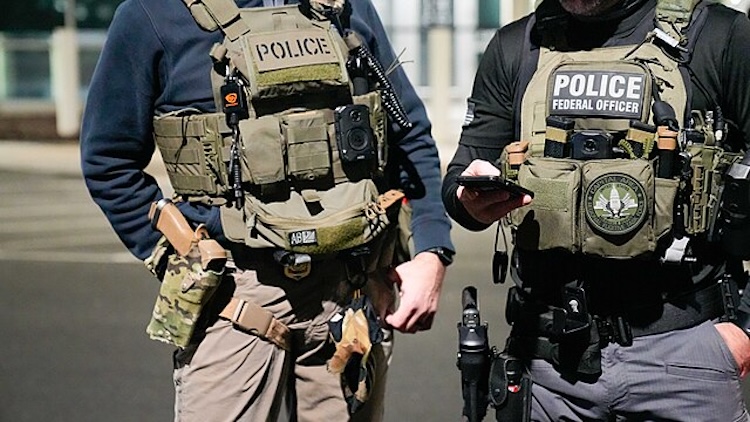
TILBURG, The Netherlands | 20 January 2026 (IDN) — On January 7, 2026, Renée Good was shot and killed by the United States Immigration and Customs Enforcement (ICE). The killing of the 37-year-old mother and author tugs at the heartstrings of the American and global public and serves as a focusing event and synecdoche for the broader harms brought about by the intensifying presence of ICE in American cities. While the official state narrative describes the shooting as self-defence and characterises Good as a terrorist, communities around the country see this as a prime example of state violence and are calling for accountability.
As ICE continues to detain, without due process, more and more people in the United States, public narratives have started comparing ICE’s actions with the Second World War (WWII). Opponents of the policy assert at least the following similarities between ICE’s presence and the historical facts of WWII:
- Various actors, including critics and politicians, have compared ICE directly to the Gestapo, the secret police of Nazi Germany. This analogy suggests that ICE operates with broad powers, little oversight, and against defined civilian populations, evoking state terror rather than lawful policing.
- Critics argue that the US government, under the leadership of Donald Trump, is broadly shifting to a fascist regime that resembles the development of authoritarian regimes in the lead-up to WWII. This comparison is built on the view that federal forces act as occupying forces, that the use of apparently military personnel for policing is a distinctly authoritarian tactic, and that these military forces perpetrate violent acts against their own civilians. It is further supported by the recent moves in the direction of war by the US government, such as its attack against Venezuela and its threat against Greenland.
- Critics see the raids on the homes of immigrants without due process as resembling the fate of the Jewish population during WWII. This comparison argues that both are distinct social, ethnic or religious groups which are being forcefully kidnapped from their homes and taken to detention centres, which are themselves sometimes likened to concentration camps.
Why are these analogies reappearing?
One might be alarmed by these comparisons, as they conjure up images and premonitions of wars to come. While fear is a potent political tool, the reference to WWII does so much more than instil fear in the public. It instantly casts social boundaries between victims, bystanders, and perpetrators, and creates a moral bottom line. After all, the predominant moral following WWII has always been “Never again.”
On the latter point, comparing ICE’s actions to WWII, to the Gestapo, is an effective moral boundary-making tool. If we all agree that the unprovoked prosecution and abduction of a group of people based on their Jewish heritage is wrong, then surely the same must apply to other groups in society defined by their ethnicity, religion, or heritage. This not being the case, the policy must be discriminatory or racist. The WWII comparison is especially effective here: The same event in our collective history is often connected to explicitly anti-racist values.
On the former point, comparing ICE’s actions to WWII equates ICE and Trump’s government to the Nazis, equates immigrants to groups that historically fell victim to the Holocaust, including Jews, Gays, and Gypsies, and equates the American public at large as bystanders. In doing so, it assigns each of these groups their associated moral and societal standing. ICE is the Gestapo, and Trump’s government is a Nazi government – they are both immoral, racist murderers; Immigrants are helpless victims, a group lacking agency, and in desperate need of defence; The public is a bystander. It is their duty to come to the defence of the prosecuted. After all, had you been in WWII, wouldn’t you have tried to resist the Nazi regime?
Asserting moral claims, like what standing each group has, or what actions are or aren’t justified, requires a certain moral authority. This, too, can be drawn from the WWII analogy. Any historical tie between the person asserting the claim and WWII may serve to undergird their “expertise”, as exemplified by Senator Blumenthal. This US senator directly compared his family’s experience in Nazi-era Europe to ICE’s recent undertakings:
My father escaped Germany in 1935 and came to America after seeing what was to come in those same Gestapo-type tactics in Germany, […] He would have seen paramilitary force going door to door, rounding up people just like him — exactly the kinds of tactics we now see unfolding. ICE, as a paramilitary force … seizing people, dragging them out of their cars or homes.
Senator Blumenthal, being of Jewish descent, gave him moral credit: Being associated, even historically, with the victim group means he possesses a certain knowledge about what the atrocities leading up to WWII might have looked like, and how they compare to the contemporary US.
So, is it wrong?
The above is meant to illustrate how our collective memory serves a powerful purpose in present-day politics. This is not to say that these comparisons are factually incoherent, or shouldn’t be given the consideration they currently are. While it might seem strange that the moral conclusions drawn from past events, including the moral credit enjoyed by some groups, are applied to events that are yet to completely unfold, this is not without reason. Senator Blumenthal’s father probably did really pass on his experiences through family stories. The country as a whole enjoys its own family stories, institutionalised in history classes across all levels of education. And we should strive to learn from the past, even if the past doesn’t one-to-one resemble the present. If you were wearing a red cap when you were bullied as a kid, you would teach your children not to bully other people, whether they were wearing a red cap or not.
*Piet Gotlieb is a Researcher at Tilburg University specialized in political and cultural sociology, and works at the Europe External Programme with Africa as a Grants Officer. He teaches a course on cultural trauma and memory politics at PhD for Society.