By Jan Servaes*
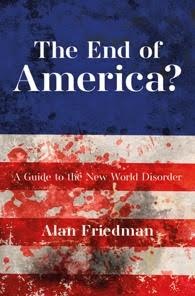
BRUSSELS, Belgium | 18 December 2025 (IDN) — “We Americans have never been very good at managing empire. It is not one of our skill sets. But what is coming next may be a great deal worse than the naïve and incompetently managed American empire of the past eighty years. We may come to view the American century, with its rules-based system and multilateralism, with great nostalgia“, writes Alan Friedman at the end (p. 250) of his recently published book.
Alan Friedman, the American-born journalist, TV commentator and writer, who has worked for the Financial Times, International Herald Tribune, Wall Street Journal and RAI, among others, and now lives in Switzerland, has always been a keen observer of contemporary politics and society. The End of America? contains some of the sharpest criticisms he has ever written about his native country.

‘The End of America?’ takes the reader into the America of Donald Trump and Joe Biden and helps us understand the 2024 presidential campaign, which, according to the author, was the dirtiest in American history. However, the reasons why America is so deeply divided into two alternative realities extend far beyond the 2024 presidential elections.
Is the current decline of the American empire the result of presidential mismanagement, or of the arrogance and hypocrisy of American exceptionalism? Is the liberal world order designed by America truly crumbling? Will dictators like Putin and Xi succeed in attacking Western democracy? Will the European Union even matter anymore?
After decades of disastrous foreign policy, lost wars, and weakened credibility, can the United States ever regain its leadership role? Or are we now irrevocably heading towards a new world disorder, a more dangerous and unstable world, and above all, a world that no longer functions on the ‘rules-based system’ designed by America?
What will this new world disorder look like?
These are just some of the questions that Alan Friedman asks and answers in this exciting story about the rise and fall of the American empire, and about the ‘Bad Guys’ who are currently trying to fill the power vacuum left by America’s lack of leadership. According to Friedman, the ‘Bad Guys’ seem to be winning, and the world that awaits us will be even more terrifying.
He writes with a fluent style and passion, and he paints vivid and intimate portraits of the serious mistakes made by a number of American presidents, including Roosevelt, Truman, Kennedy, Johnson, Bush senior and junior, Bill Clinton, Barack Obama, Donald Trump, and Joe Biden. During his career, he has had the opportunity to extensively interview many prominent figures, including Trump, Vladimir Putin, Janet Yellen, and Giorgio Armani. His authorized biography (with accompanying documentary) of Silvio Berlusconi, released in 2015, has been published and screened in 19 languages (including on Netflix).
A bleak future?
Friedman sees the immediate future as rather bleak: “Trump’s love of trade wars will lead to disastrous economic results for the US, mainly in the form of higher inflation, higher unemployment and slower growth” (p. 246).
But he is even more concerned about the European Union. In an interview during a meeting of UBS Regione Ticino on June 16, 2025, he stated unequivocally: “One thing is certain: America is sending unambiguous signals about its gradual withdrawal from the European chessboard. Europe must therefore completely revise its strategies, but so far, apart from declarations of intent, we see no concrete actions that could change the existing power relations.”
In a remarkable statement in Social Europe of 15 December 2025, the German social philosopher Jürgen Habermas attempts to skirt the issue: “In most western member states of the EU too, the domestic political forces for decentering or rolling back the EU—at least for weakening Brussels’s competences—are stronger than ever. For this reason, I consider it likely that Europe will be less able than ever to decouple itself from the USA’s leadership. Whether it can maintain its normative, and thus far still democratic and liberal, self-understanding in this undertow will then be the central challenge.” As the subtitle of his statement clearly indicates: The declining American leadership and China’s new world order are forcing Europe to unite, otherwise it risks ending up on the sidelines.
The National Security Strategy recently published by Trump’s White House is more explicit. The Center for Strategic International Studies (CSIS) concludes regarding Europe: “This National Security Strategy is a harsh, painful, and shocking wake-up call for Europe. It represents a moment of enormous divergence between Europe’s self-image, and Trump’s vision of Europe. If Europe still had any doubts about the Trump administration’s determination to take a tough approach, it knows better now. The administration is asking—or rather, demanding—that Europe secure its own part of the world, and above all, pay for it itself.”
Friedman is also critical of the contemporary field of journalism. When asked about the role of the media in shaping public opinion in an era where misinformation is widespread, he replies: “In America, 70% and in Europe 50% of the news is disseminated via social media. This means that one of the fundamental requirements for information has now disappeared, namely that it is essential to exercise strict control over the reliability of the sources from which the news originates. Newspapers, at least the most prestigious ones, offer this guarantee, while on the web everyone seems authorized to publish whatever they deem most appropriate, and this determines the spread of fake news. The fake news published daily about ongoing wars is a striking example of the disinformation that is now rampant.”
Towards a new world disorder?
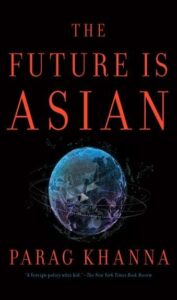
Book ‘The future is Asian‘
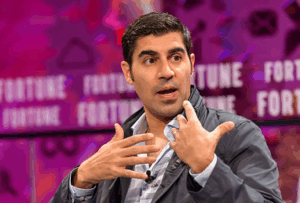
It seems that Friedman has found a kindred spirit in Parag Khanna on the geopolitical other side of the world. This Indian-born, but Western-educated strategic advisor and author, now affiliated with the Lee Kuan Yew School of Public Policy at the National University of Singapore, studies the future of global civilization from an Asian perspective.
Khanna examines the resurgence of Asia as the dominant force shaping the 21st century, paying attention to economic, political, cultural, and governance aspects. Khanna defines Asia broadly, from the Mediterranean to the Pacific Ocean, and emphasizes its diversity and interconnectedness.
He begins with a detailed summary of world history from an Asian perspective. His basic premise is that most of early civilization was located in Asia, and how briefly (but intensely) Western powers intervened in this picture through colonialism and their current reintegration and influence on the world. The author emphasizes that: “Asian connections have been continuously strengthened through trade, conflict, and culture.”
After the historical narrative, Khanna continues with “Asia-nomics,” or how each country developed its own economic strength. After the first wave of modern Asian growth in post-war Japan and South Korea, followed by China, the current wave is now driven by South Korea. Asia prioritizes investment in infrastructure, technology, and industry, thus defying the Western economic dogma that promotes consumption-driven growth.
The author then discusses the phenomenal Asian diaspora in America and Europe; China’s ventures into Africa; and how liberal democracy is probably less suitable for Asian countries than the technocratic model based on ‘soft despotisme’ of Lee Kuan Yew’s Singapore. Individual freedoms and human rights therefore receive less attention from Khanna.
Unsurprisingly, the chapter on the technocratic future of Asia is considered important. Asian countries often prefer technocratic, meritocratic governance models that emphasize stability, long-term planning, and data-driven policies. Clearly inspired by Singapore, his homeland, Khanna therefore advocates for a pragmatic, meritocratic technocracy instead of democracy.
Such a statement, however, is diametrically opposed to the aspirations of people at the grassroots level of society in India, Hong Kong, Southeast Asia, China… (where isn’t it?). This reveals his sometimes explicit elitist and ethnocentric view of his surroundings and fellow human beings. In other words, he sometimes mixes the economic and cultural contexts he wants to analyze in a questionable way.
A positive aspect of the book is its multipolar and multicultural focus. The book emphasizes that Asia is not a monolith, but a complex, multipolar region with diverse civilizations and systems.
The book offers a from the inside-out perspective on Asia and helps readers understand why Asia is now the world’s greatest economic and demographic power. It also provides a nuanced geopolitical analysis as Khanna offers insight into the multipolarity of Asia, the roles of major powers, and the mechanisms that drive regional integration.
Belt and Road Initiative
The rise of Asia is changing global norms, trade, technology, and culture, leading to a hybrid world order. Unlike Friedman, Khanna views this evolution as a rather positive development.
The Belt and Road Initiative (BRI), a transformative infrastructure project and symbol of Asian leadership, is a major Chinese initiative to connect Asia, Europe, and Africa through trade corridors, ports, and railways. Khanna presents the BRI as the most important diplomatic project of the 21st century, marking Asia’s return to global leadership.
Moreover, while often seen as an instrument of Chinese hegemony, the BRI accelerates modernization and competitiveness, with many Asian countries participating voluntarily and balancing Chinese influence.
The role of soft power and identity is discussed in detail. Asian countries are investing in cultural diplomacy and branding, using their cultural products and philosophies to expand their global influence. Asian communities abroad contribute economically, culturally, and politically, strengthening ties with Asia.
This global influence of the diaspora, for example, has not only made K-pop incredibly popular in Asia but has also inspired young people in the West. Bollywood and Asian cuisine also fit into this category. In other words, Asian pop culture, film, and philosophies are gaining popularity worldwide and influencing trends in entertainment, fashion, and lifestyle everywhere.
Pros and cons
‘The Future Is Asian’ received mixed reviews. Many praise its comprehensive overview of Asia’s growing influence, historical context, and future potential. The author’s insights into Asian governance models and economic developments are widely appreciated.
However, some criticize the book for being too optimistic about China and technocracy, and for lacking sufficient depth on certain topics, such as the role and impact of conglomerates and family businesses in state-driven capitalism.
The book’s poorly organized structure also draws criticism.
Despite this criticism, many consider it an important supplementary reading that challenges Western perspectives, and provides valuable information about Asia’s growing global importance.
Towards a New World Disorder?
“A new chapter of global history is being written before our eyes, one in which Asian and Western civilizations, the North American and Eurasian continents, all play profoundly important roles. Today, Westerners prefer the phrasing ‘global rules-based order’ while Asians favor the Chinese phrase ‘community of common destiny’. Tomorrow we will realize that they are two sides of the same coin – and that both the rules and the destiny must be made together. That is where we are on the wheel of global history”, claims Khanna at the end of his book (p. 359).
Like Friedman, I think we have reached a turning point with respect to the old order. We can no longer argue that the rules-based order is the defining anchor point of the global system, and that there are problems with its implementation. We now have a baseline situation of disorder, a baseline situation in which non-compliance with rules has become the norm rather than the exception.
It is far from certain to me that we will evolve towards a world of spheres of influence. I don’t think that if you’re Thai, you’ll readily submit to a Chinese sphere of influence. If you’re European, you won’t easily adapt to a Russian sphere of influence. Or if you’re Latin American, Mexican or Venezuelan, the American sphere of influence seems close yet far away.
Nor is it clear that regional organizations such as the EU will somehow remain decisive. I think we are rather living in a chaotic form of globalization where the law of the strongest prevails, which is not the opposite of globalization. It is rather an anarchic form of globalization without rules.
*Jan Servaes (PhD) was UNESCO Chair in Communication for Sustainable Social Change. He has taught International Communication in Australia, Belgium, China, Hong Kong, the United States, the Netherlands, and Thailand, in addition to several teaching and research stints at about 120 universities in 55 countries. He is known for his ‘multiplicity paradigm’ in “Communication for Development. One World, Multiple Cultures” (1999). Servaes was Editor-in-Chief of the Elsevier journal “Telematics and Informatics: An Interdisciplinary Journal on the Social Impacts of New Technologies.” He is the Editor-in-Chief of the Handbook of Communication for Development and Social Change (2020), the Springer Book Series “Communication, Culture and Change in Asia”, and the Lexington Book Series “Communication, Globalization and Cultural Identity”. [IDN-InDepthNews]
References
Alan Friedman (2025), The end of America? A guide to the New World Disorder, BiteBack Publishing, London, 270pp. ISBN 978-1-78590-957-3
https://www.bitebackpublishing.com/books/the-end-of-america
Parag Khanna (2019), The future is Asian. Global order in the Twenty-First century, Weidenfeld & Nicolson, London, 433pp. ISBN 978-1-4746-1068-1