Trade, Trust, and the Return of Strategic Memory
By Ramesh Jaura
This article first appeared on https://rjaura.substack.com
BERLIN | 4 February 2025 (IDN) — When India and the European Union finally inked their long-anticipated Free Trade Agreement on January 27, 2026, the fanfare barely masked the unease that had driven both sides to the table. Leaders hailed a “historic milestone,” a “new chapter,” and a “shared vision for prosperity.” Yet beneath the triumphant rhetoric, a deeper reality surfaced: this treaty was born not from a resurgence of faith in globalisation, but from its unravelling. It was shaped less by confidence than by uncertainty, less by plenty than by the fear of becoming dependent.
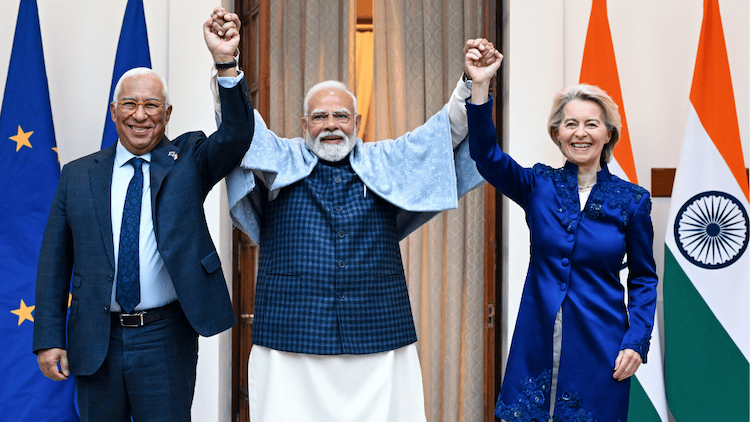
The agreement was signed during the State Visit of António Costa, President of the European Council, and Ursula von der Leyen, President of the European Commission, who were invited as Chief Guests for India’s Republic Day celebrations. This invitation alone carried strategic meaning. India rarely accords such honour to leaders of a regional bloc, having done so only once before with ASEAN in 2022. The spectacle of the two European leaders riding with President Droupadi Murmu down Kartavya Path and being received by Prime Minister Narendra Modi was carefully choreographed to signal that Europe had re-entered India’s strategic imagination not merely as a trading partner but as a geopolitical interlocutor.
The Joint Statement at the end of the visit wrapped the relationship in the usual diplomatic phrases—democracy, pluralism, human rights, and a rules-based order anchored by the United Nations. But a closer reading revealed cracks beneath the surface. Mentions of supply-chain resilience, economic security, strategic autonomy, and institutional reform were not mere formalities; they signalled a quiet admission that the foundations of international cooperation had shifted.
This agreement, then, is less a return to a lost global consensus than an effort to steady scattered fragments of order in a world where trust is scarce, and power is traded like currency.
From Strategic Partnership to Strategic Drift
India and the European Union first declared a “strategic partnership” in 2004, at the height of post–Cold War optimism. The global economy was expanding, multilateral institutions retained legitimacy, and the belief that economic interdependence would temper geopolitical rivalry was widely shared. India was liberalising its economy; Europe was expanding eastward and consolidating its single market. Both assumed that time was on their side.
Negotiations for a comprehensive trade and investment agreement began in 2007, reflecting this confidence. The logic appeared straightforward: India would open markets gradually, Europe would provide investment and technology, and mutual prosperity would follow. Yet even at that early stage, the relationship contained unresolved tensions. India resisted European demands on automobiles, intellectual property rights, labour standards, and regulatory harmonisation. Europe, for its part, grew increasingly frustrated with India’s protectionism, bureaucratic complexity, and insistence on policy space.
By 2013, negotiators nearly reached an agreement. But the political will had faded. India was preoccupied with elections and domestic pushback from industry and farmers. Europe, meanwhile, was consumed by the eurozone crisis, the rise of populism, and a growing wariness of trade liberalisation. What ensued was not just a pause, but a deeper strategic drift.
Annual summits faded away. Trade talks were officially shelved. India looked inward, championing industrial policy, “Make in India,” and strategic autonomy. Europe, for its part, saw India as a challenging but secondary player, choosing instead to strengthen economic bonds with China, which seemed both more profitable and more predictable.
For almost a decade, the India–EU “strategic partnership” was little more than a phrase—trotted out in speeches, but hollow and adrift.
The Trump Shock and the Collapse of Assumptions
The renewed urgency in India–EU relations was sparked not in Delhi or Brussels, but in Washington. Donald Trump’s presidency cracked open the old order of global trade. Tariffs became tools of pressure. Trade deficits were recast as security threats. Allies were handled as mere transactions, and the line between economic policy and strategic rivalry vanished.
Even after Trump departed, the forces he set in motion persisted. Economic nationalism, supply-chain fortification, and strategic decoupling became bipartisan fixtures in the United States. The multilateral trading system, already fragile, lost much of its moral weight.
For Europe, the lesson cut deep: dependence had become a liability. Relying on China for manufacturing, pharmaceuticals, and rare earths, and on the United States for security and markets, now seemed dangerously short-sighted. Europe’s once-proud industrial base suddenly looked exposed.
For India, the lesson was different but no less urgent. The global marketplace could no longer be trusted to remain open, predictable, or governed by rules. Strategic autonomy now demanded selective integration, not sweeping liberalisation. Trade deals would serve as tools of strategy, not articles of faith.
This shared disillusionment created the conditions for renewed India–EU engagement. As the Joint Statement later observed, both sides recognised “the interlinkages between the security and prosperity of Europe and the Indo-Pacific”. They committed themselves to building “resilient, diversified, and secure supply chains.”
Europe’s Strategic Anxiety and the Rediscovery of India
Europe’s renewed outreach to India was fuelled more by necessity than by kinship. The European Union found itself caught between a bolder China and an unpredictable United States. The old belief that Europe could simply be a benign trading power in a steady world had crumbled.
India, by contrast, brought scale, growth, and a stance of political non-alignment. It was neither an ally seeking security guarantees nor a rival chasing dominance. Instead, India was a rising power with its own brand of strategic autonomy—sometimes exasperating, often careful, but now impossible to ignore.
This shift played out in a parade of high-level visits. UK Prime Minister Keir Starmer arrived in October 2025, followed by German Chancellor Friedrich Merz in January 2026, with French President Emmanuel Macron set for February. Yet it was the EU’s top leadership at India’s Republic Day that truly transformed the relationship, lifting it from mere transaction to genuine strategy.
As former Indian Ambassador Rajiv Bhatia has argued, this moment marked not merely a revival but a repositioning of India–EU ties. “The European pivot to India,” he noted, “reflects a shared recognition that the old hierarchies of global power are shifting, and that cooperation among rising and middle powers is no longer optional.”
Germany’s Quiet Pivot: From China Bet to India Hedge
Within Europe, Germany stands as the clearest symbol of this transformation. For years, its prosperity rested on three pillars: export-led growth, deep ties with China, and the reliability of multilateral trade rules. Suddenly, all three began to falter.
China was no longer just a market, but a systemic rival, able to undercut German industry even as it bought German goods. Trade rules grew more politicised, eroding the predictability on which German manufacturing depended. Meanwhile, Germany’s export engines sputtered under the weight of energy transitions, shrinking demographics, and industrial overcapacity.
Germany did not opt for a dramatic break, but for careful diversification. India became its crucial hedge—not a substitute for China, but a new growth axis. India could absorb capital, supply skilled workers, and help anchor Germany’s industrial future in a more diverse global landscape.
Chancellor Merz’s January 2026 trip to India brought this shift into sharp focus. The visit yielded deals on green hydrogen, skilled worker mobility, defence manufacturing, pharmaceuticals, and advanced industry. These agreements turned the trade treaty from paper into practice, converting tariff charts into a real industrial strategy.
As Rajiv Bhatia observed, “While the agreement is formally between India and the European Union, its early and most decisive beneficiaries are likely to be German firms—capital-intensive, technologically advanced, and already embedded in European regulatory ecosystems.”
The Joint Statement as a Text of Power
The 28-paragraph Joint Statement released after the summit is often brushed off as empty diplomacy. That is a misreading. On closer inspection, it is a text of power—charting not just shared hopes, but also mutual anxieties.
The statement upholds democracy and multilateralism, but its refrain is economic security, strategic autonomy, and supply-chain resilience. UN reform is cast not as a lofty aspiration, but as a remedy for institutional gridlock. The Indo-Pacific is presented as a shared strategic arena, quietly signalling Europe’s growing security ambitions.
What stands out most is what the statement leaves unsaid. There are no pledges of ideological unity, no calls to band together against outsiders. Instead, it proposes cooperation without alliance, integration without hierarchy.
The Six Pillars Revisited
The agreement stands on six pillars, each helping to reshape the relationship.
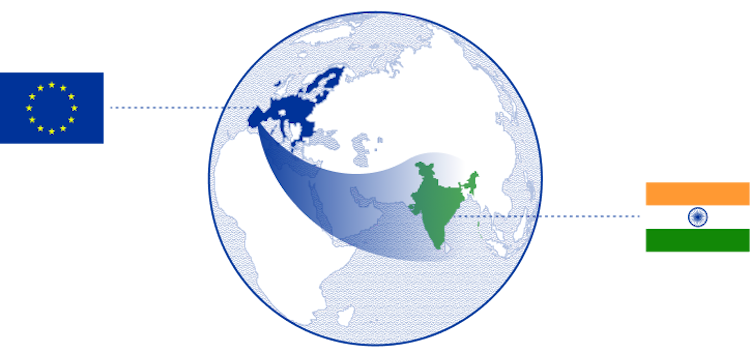
The Free Trade Agreement itself eliminates duties on 99.5 per cent of Indian exports and reduces tariffs on 97 per cent of European exports. It creates a market of nearly two billion people and is expected to cut tariffs by up to €4 billion annually. EU Vice President Kaja Kallas described it as “the mother of all trade deals,” noting that it “provides a chance to reduce reliance on China, Russia, and the United States.”
The Security and Defence Partnership elevates India to the EU’s third defence partner, after Japan and South Korea. Their cooperation now stretches from maritime security and cyber threats to hybrid warfare, space, and vital infrastructure.
The proposed Security of Information Agreement will enable the exchange of classified information, signalling a level of trust previously absent.
The Mobility Pact opens doors for Indian students, researchers, and professionals to Europe, forging a direct link between European technology and Indian talent.
The Strategic Agenda for 2030 puts supply-chain resilience, economic security, innovation, development cooperation, and stronger institutions at the forefront.
Finally, the Joint Statement’s focus on multilateral bodies—the UN, WTO, G20, and Security Council reform—signals a joint effort to rescue global governance from further decay.
Who Gains, Who Risks Losing
From a political-economy angle, the winners and losers are clear. European exporters of high-value goods gain right away. Regulatory alignment rewards firms already in step with EU standards. Germany gets skilled labour without paying the full price for education and training.
India’s gains are tangible but focused. Big exporters, IT, pharma, and engineering firms come out ahead. Consumers enjoy more choice and possibly lower prices. Yet small and medium businesses face new compliance burdens and fiercer competition.
This imbalance is no accident. It mirrors deep divides in capital, technology, and regulatory muscle.
PL-480 Revisited: Strategic Memory as Warning
Bringing up PL-480—the US food aid program that shaped India’s early post-independence economy—is not mere rhetoric. It is a deliberate act of strategic memory.
PL-480 brought food security but also warped domestic incentives and limited policy freedom. India’s later drive for agricultural self-reliance was born from that very experience.
The India–EU treaty is no repeat of PL-480. India bargained from a position of strength, keeping sensitive sectors shielded and policy space intact. Yet a quieter risk lingers: premium-market dependency, where India becomes essential as a market, workforce, and assembly hub, but lags in innovation unless domestic policy steps in.
History may not repeat itself exactly, but it echoes. The spectre of dependency remains—not as fate, but as a caution.
China: Displacement Without Declaration
China need not see the treaty as outright containment. Yet it cannot ignore its gradual effects. Supply-chain diversification gains credibility when backed by trade rules. German investment looks elsewhere. Standards shift, bit by bit.
China is not displaced wholesale—but exclusivity erodes, sector by sector, corridor by corridor.
Multilateralism After China is not pushed out all at once, but its exclusivity erodes—sector by sector, corridor by corridor. Its emphasis on reform reflects recognition that existing institutions no longer function automatically. Cooperation now aims to stabilise fragments of order rather than restore a vanished whole.
India’s Central Question: Upgrade or Absorb
In the end, the treaty hands India a challenge only it can meet. Without upgrading industry, building skills, and tightening regulations, India risks settling for the role of a premium market rather than a rule-maker.
As Rajiv Bhatia warned, credibility depends on alignment—between rhetoric and strategy, means and ends.
A Treaty Written in Caution
The India–EU trade treaty is, at heart, a strategic compromise hammered out in uncertain times. Germany’s part in it reveals its own calculations: hedging against China, securing labour, and anchoring its future to India’s ascent.
India’s task is to ensure this hedge does not become a new hierarchy.
As Ursula von der Leyen observed in Delhi, “A successful India makes the world more stable, prosperous, and secure.” Whether that success translates into autonomy or asymmetry will depend not on Brussels or Berlin, but onIndia’s domestic choices.
The shadow of PL-480 remains—not as destiny, but as a warning. [IDN-InDepthNews]
Original link: https://rjaura.substack.com/p/indiaeurope-at-a-geopolitical-crossroads
Related links: https://www.eurasiareview.com/02022026-india-europe-at-a-geopolitical-crossroads-analysis/
https://www.world-view.net/india-europe-at-a-geopolitical-crossroads/
About the author: Ramesh Jaura is affiliated with ACUNS, the Academic Council of the United Nations, and an accomplished journalist with sixty years of professional experience as a freelancer, head of Inter Press Service, and founder-editor of IDN-InDepthNews. His expertise is grounded in extensive field reporting and comprehensive coverage of international conferences and events. Readers are invited to subscribe tohttps://rjaura.substack.com for complimentary updates or to support the author through paid subscriptions.