
By Dr. Alon Ben-Meir*
NEW YORK | 9 March 2026 (IDN) — Back in the 1950s in the United States, even a whisper of sympathy for Russia or the Soviet Union was unthinkable and seen as almost traitorous. The eventual rise of McCarthyism was all about rooting out what were presumed to be “un-American activities,” i.e., anything that could be perceived as socialist or communist.
When we look at the global landscape today, it is much more nuanced. Inside the United States, however—especially at the top echelons of the Trump administration—there is almost a reversal of the 1950s McCarthy spirit.
Instead of assuming that every activity critical of the U.S. government favors communism, it is the government itself that has given up even the most basic forms of prudence when it comes to Russia.
From the 1950s American Demagogue to the 2020 Edition
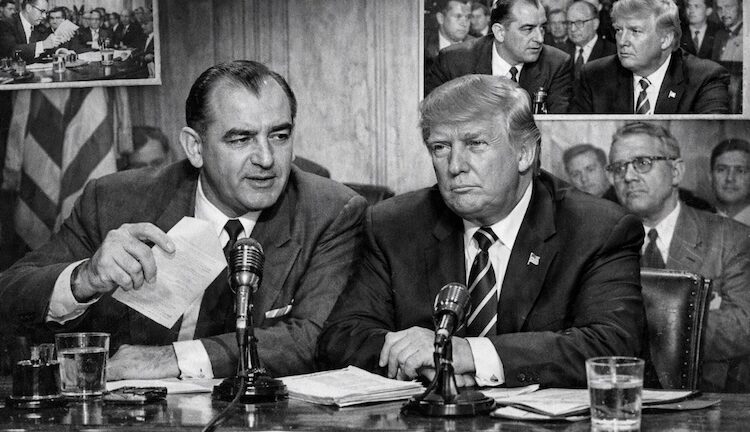
The irony—if not the tragedy—in the age of Trump is that a system built on checks, balances and pluralism has once again succumbed to a single demagogue.
In contrast to McCarthy, Trump has moved the United States in the opposite political direction. He favors Russia in every conceivable way and is deliberately and completely disarming the well-resourced U.S. government apparatus designed to monitor even clearly illicit activities on U.S. soil.
Then as now, this reflects structural vulnerabilities in U.S. political culture, including:
- the intense personalization of politics, especially the presidency
- weak party gatekeeping among Republican members of Congress
- a recurring appetite for crusades against “internal enemies,” aka the Democrats
- the use of foreign policy as a stage for domestic symbolic battles
What McCarthyism Actually Was
It is important to note that the phenomenon called “McCarthyism” rested on a broad bipartisan anti-communist consensus that long predated Senator Joseph McCarthy (R-WI) and extended far beyond him.
President Truman’s doctrine explicitly framed U.S. foreign policy around resisting Soviet expansion. That approach fed back into a domestic security state in which communism became a master threat linking espionage, subversion and ideological dissent.
McCarthy’s innovation was to turn that consensus into a personalized, media-driven movement that targeted not only Soviet agents. He also applied it to liberal internationalists, State Department professionals, intellectuals and artists, casting all of them as quasi-traitors.
The senator fused foreign policy fear—of Soviet expansion, “losing China,” and the division of Korea—with a populist narrative that portrayed a weak multicultural elite as betraying the “real America.”
Five Illustrative Cases
McCarthy also tied anti-communism to ideas of race and national identity, even without explicitly invoking race. The following examples illustrate how the fervor of McCarthyism swept the nation.
- Alger Hiss: A State Department official accused by journalist and former communist Whittaker Chambers of belonging to a Communist cell. Convicted of perjury in 1950 for denying he passed documents to the Soviets, he was sentenced to five years in prison. The case became a defining symbol of McCarthyism.
- Owen Lattimore: An Asia scholar accused by McCarthy of being “the top espionage agent in the United States.” Indicted for perjury, the charges were dismissed by a federal judge in 1955. Nevertheless, Lattimore was professionally sidelined for five years.
- Pete Seeger: The folk singer was called before the House Un-American Activities Committee (HUAC) in 1955 and refused to answer questions about his political beliefs. He was convicted of contempt of Congress and sentenced to a year in prison, though the conviction was overturned in 1962. He remained blacklisted from network television for over a decade.
- John Stewart Service: A career Foreign Service officer and China expert accused by McCarthy of being a Communist sympathizer. Fired in 1951 despite being cleared six times by loyalty investigations, his dismissal was overturned by the Supreme Court in 1957. His career never fully recovered.
- Klaus Fuchs: A German-born physicist who confessed in 1950 to passing atomic weapons data from the Manhattan Project to Soviet intelligence. His confession triggered arrests that eventually led to the prosecution of Julius and Ethel Rosenberg.
These cases illustrate the wide scope of the FBI’s Cold War mission—from cracking Soviet codes and prosecuting atomic spies to running covert domestic disruption programs. All were driven by the conviction that Soviet infiltration posed an existential threat to the United States.
How Trump Dismantled Monitoring of Russian Activities
The opposite pattern appears in Trump’s approach to Russia and Vladimir Putin. Several developments illustrate how agencies and mechanisms created after 2016 to counter Russian hostile activities have been dismantled or weakened.
- Attorney General Pam Bondidissolved the FBI’s Foreign Influence Task Force, which had led investigations into election interference after 2016, citing resource reallocation and concerns about “weaponization.”
- The National Security Councilhalted key interagency coordination against Russian sabotage and cyberattacks, paused consultations with European partners, and the Justice Department ended an oligarch-asset task force.
- Defense Secretary Pete Hegsethordered U.S. Cyber Command to pause offensive cyber and information operations against Russia, disrupting operations previously used against Russian troll farms before the 2024 election.
- Trump dismissed NSA and Cyber Command chief Gen. Timothy Haugh and his deputy, while Director of National Intelligence Tulsi Gabbard revoked security clearances for Russia-focused experts and reduced staff in related agencies.
- Proposed budget cutsto the Cybersecurity and Infrastructure Security Agency (CISA) and the Office of the Director of National Intelligence reduced election security programs and support for state cyber defenses.
Representative Jim Himes, ranking Democrat on the House Intelligence Committee, summarized the situation:
“Vladimir Putin is sneering with satisfaction as Donald Trump, aided and abetted by his director of national intelligence, guts the intelligence community in pursuit of his political vendettas.”
Structural Parallels Between McCarthy and Trump
Analysts increasingly view McCarthy not as an isolated aberration but as an early template for later demagogic politics, including Trump’s. Key parallels include:
- Branding and spectacle— Both turned their names into political brands and prioritized media conflict over institutional governance.
- Conspiratorial politics— McCarthy warned of hidden communists; Trump speaks of a “deep state,” immigrants and “globalists.”
- Elite-bashing populism— Both attacked national security elites as weak or treacherous.
- Lack of governing strategy— Neither developed a coherent long-term policy framework.
A personal link between the two eras is Roy Cohn, McCarthy’s legal counsel who later mentored Trump in New York, shaping his aggressive legal and political tactics.
From Anti-Russian McCarthyism to “Pro-Russian” Trumpism
Cold War anti-communism framed the Soviet Union as the central external enemy and justified an expansive national security state.
Trumpism appears to reverse this by treating Russia less as an existential adversary and more as a potential partner, while casting domestic political opponents and some allies as greater threats.
This shift reflects three trends:
1. Anti-liberalism at home
Admiration for strongman leaders and hostility to liberal internationalism make engagement with Moscow a symbolic rejection of the post-1945 bipartisan order.
2. Transactional nationalism
Proposals to recognize Russian control over Crimea, weaken sanctions or establish bilateral working groups are framed as pragmatic deal-making.
3. Reassignment of “treason”
Officials supporting sanctions, NATO cooperation or Ukraine aid are increasingly portrayed as undermining American interests.
Why Can One Man Grip a Pluralist System?
Both McCarthy and Trump rose to prominence because of recurring features of American political culture:
- Crisis-driven politics— National insecurity fuels demand for aggressive leaders.
- Weak party oversight— U.S. parties struggle to discipline charismatic outsiders.
- Media dynamics— McCarthy used early television; Trump dominates cable news and social media.
- Leader-centered nationalism— Loyalty to a political leader becomes equated with loyalty to the nation.
McCarthyism and Trumpism reveal how the U.S. system of checks and balances depends heavily on informal norms and elite restraint. When those erode, constitutional structures alone cannot prevent the concentration of personalized power.
Both periods used external conflicts to manage internal social tensions related to race, identity and the meaning of “real America.”
During the Cold War, anti-communism helped define the boundaries of loyalty and national identity. In the Trump era, selective rapprochement with Russia coexists with confrontation elsewhere—such as with Iran, China and Venezuela—while reinforcing narratives about “strong” nations versus “globalist” or “woke” adversaries.
Russia as a Tool in America’s Domestic Political Struggle
Seen in this light, the shift from anti-Russian McCarthyism to pro-Russian Trumpism is not simply a reversal but a cyclical repurposing of Russia as the political “other.”
First it served as the indispensable external threat that justified a global liberal order. Now it functions as a counter-liberal symbol used by segments of the American right in their struggle against domestic liberalism and multilateral institutions.
The odds are that this cycle of Trumpism will end in tragedy unless the public recognizes the dangers posed by the current political trajectory and demands a restoration of pluralist governance. [IDN-InDepthNews]
This article was originally published in The Globalist.
Dr. Alon Ben-Meir is a retired professor of international relations, most recently at the Center for Global Affairs at NYU, where he taught international negotiation and Middle Eastern studies.