
The Merz Doctrine, and the Cost of Strategic Adulthood
This article first appeared on https://rjaura.substack.com
By Ramesh Jaura*
BERLIN | 1 March 2026 (IDN) — For nearly eight decades, Europe thrived under the sturdy canopy of a security order that felt immovable. The United States was the bedrock of NATO, its power a shield against danger. Through elections, crises, and ideological storms, the Atlantic alliance endured.
That structure remains, yet its aura of permanence has quietly dissolved.
At the Munich Security Conference (13-15 February 2026), European leaders did not mourn a broken transatlantic bond. Instead, they spoke as if it now came with conditions. The conference’s theme, “Under Destruction,” captured not just Ukraine’s suffering but the slow crumbling of the strategic certainties that once defined Europe’s postwar self-image.
Donald Trump’s return to the White House left NATO standing but splintered the old certainties that once held it together.
Nowhere did this new sense of uncertainty crystallise more vividly than in Davos.
Davos and the Greenland Shock
At the 2026 World Economic Forum (19-23 January) in Davos, President Trump reignited his longstanding interest in acquiring Greenland, framing the Arctic island not merely as a geopolitical prize but as a vital component of U.S. national security. Trump reiterated that Greenland was “crucial” for American defence because of its location between Europe and North America and its role in supporting Arctic surveillance and early warning systems. European leaders saw the rhetoric — including the suggestion that stronger measures could follow if negotiations faltered — as more than a negotiating gambit. They saw it as a symbolic rupture in the norms governing alliance discourse.
Greenland’s strategic value is clear. Its geography anchors the western edge of the GIUK (Greenland–Iceland–United Kingdom) gap, a key maritime and air corridor critical to Western defence. The island hosts Pituffik Space Base, the northernmost U.S. Department of Defense installation — now known as the Department of War — from which ballistic missile early warning radars and space surveillance systems feed data into North American Aerospace Defense Command operations. These systems detect missile launches and monitor space objects — functions central to deterrence and early warning across the North Atlantic.
Under longstanding agreements dating back to 1951, the United States maintains military facilities in Greenland as part of collective defence arrangements with NATO allies. But Trump’s rhetoric, even if intemperate, carried strategic implications. If the United States casts its alliance members as transactional variables in a geopolitical equation, then the psychological solidity of those alliances cannot be taken for granted. That perception alone was enough to unsettle European capitals.
Danish authorities and strategic planners did not interpret the episode as a direct threat of invasion — the Danish Defence Command emphasised that it did not expect the United States to use force in Greenland. But the suggestion that political debate could entertain the notion of acquiring allied territory was unprecedented. Scholars noted that if any nation — even an ally — used force against a NATO member, Article 5 could be interpreted as an armed attack on another member, raising questions about the alliance’s internal cohesion in a crisis.
European governments responded not with panic but with planning. Denmark launched Operation Arctic Endurance, a Danish-led NATO presence operation designed to strengthen Arctic deterrence and reassure sovereign control. Multiple European allies — including Germany, Sweden, Norway, and the United Kingdom — deployed reconnaissance units and strategic planners to Greenland to reinforce collective defence in the Arctic.
The Greenland episode was never simply about territory. It forced European NATO members to confront a disquieting truth: even allies could no longer be taken for granted. When President Trump insisted — repeatedly and at times without ruling out the use of force — that the United States must “get” control of Greenland for security reasons, it melded Arctic strategic logic with a transactional view of alliance relations that many Europeans found destabilising.
Denmark, Greenland, and a coalition of European states all rejected the notion that Greenland was “for sale,” bluntly insisting sovereignty belonged to its people and that any foreign acquisition would violate international norms and the foundational principles of the alliance. European political leaders warned that the very idea of one NATO member pressuring another over territorial status could, if taken seriously, undermine the inviolability of sovereign borders that NATO’s collective defence is supposed to protect — a dynamic that reverberated far beyond the Arctic’s frozen horizon.
The End of Strategic Permanence
For most of the post–Cold War period, European security rested on a quiet premise: American power was structurally embedded in European defence. NATO’s Article 5 was not merely a clause; it was a psychological constant.
That constant has faded, not because of any change in the treaty, but because the political landscape has shifted.
The Trump administration’s emphasis on burden-sharing thresholds, defence spending metrics, and economic reciprocity reframed the alliance in measurable terms. The Greenland conversation extended that logic into alliance psychology.
European leaders understood the message: solidarity would no longer be assumed; it would be evaluated.
For a continent whose unity rested on the promise of outside protection, this shift has struck a deeply unsettling chord.
Europe invested deeply in regulatory authority, trade integration, climate leadership, and institutional governance. Defence remained formally organised through NATO, but materially underwritten by American capabilities in intelligence, surveillance, logistics, missile defence, and nuclear deterrence.
The assumption was never that Europe did not need power. It was that power would remain reliably aligned.
That belief has reached its end.
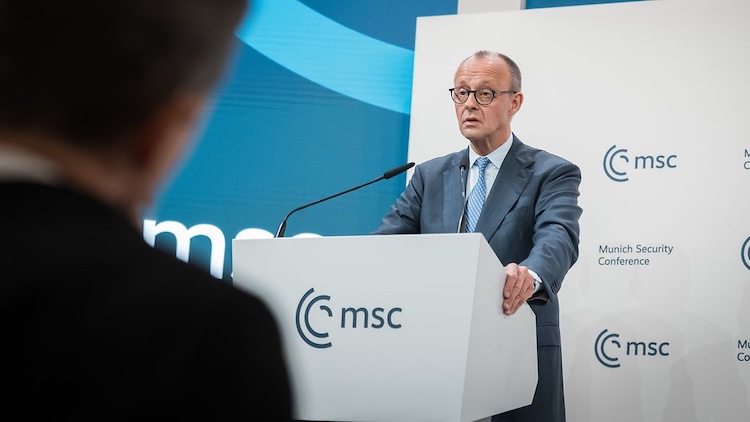 A strong network of global partnerships is important for future international cooperation, according to Federal Chancellor Friedrich Merz. Photo: Federal Government/Steffen Kugler
Munich 2026: Recognition, Not Rhetoric
In this new reality, the Munich Security Conference 2026 became less a stage for outrage and more a moment of shared reckoning.
Germany’s new chancellor, Friedrich Merz, delivered a keynote that reflected this moment of transition. Merz observed that Europe and its allies had “crossed the threshold into a time once again openly characterised by power and great-power politics,” explicitly acknowledging that the rules-based international order “no longer exists in its original form.”
Merz did not frame the conversation as an attempt to decouple from the United States. Rather, he presented a hybrid strategy in which Europe strengthens its own capabilities while renewing the transatlantic partnership on more reciprocal terms. “Freedom,” he said, “is made possible by security and economic strength,” and this reality must inform Europe’s approach to both internal capacity and external alliances.
He also rejected domestic American political rhetoric, arguing that it did not reflect European values: “The culture wars of MAGA in the U.S. are not ours,” Merz said, emphasising Europe’s commitment to broader multilateral frameworks and collective defence.
On nuclear deterrence, Merz disclosed exploratory discussions with France on reinforcing a European component within NATO’s nuclear posture — not to rival the U.S. umbrella, but to introduce redundancy and credibility across the alliance.
By sharpening his vision, Merz embodied the spirit of Munich 2026: Europe must forge its own strategic strength, not in opposition to its allies, but to reinforce the alliance from within.
Germany’s Strategic Acceleration
The transition from Olaf Scholz to Merz was more than a change in leadership; it was an acceleration.
Scholz’s Zeitenwende, following Russia’s invasion of Ukraine, broke longstanding taboos in German security policy, committing substantial funds to modernising the Bundeswehr. Yet implementation was cautious and iterative, shaped by coalition dynamics and historical restraint.
Merz seized that transformation and brought it into sharper focus. Germany has accelerated procurement of air defence systems, expanded ammunition production, prioritised rapid military mobility within NATO, and advanced dialogue on the European dimension of nuclear deterrence. This reframing positions Berlin not just as a contributor to collective defence but as a central driver of European capability development.
In this, Germany reflects a broader European shift: discarding old assumptions and embracing deliberate capability.
The Industrial Foundations of Autonomy
Strategic autonomy is no longer a slogan; it is taking shape as an industrial reality.
Europe’s defence-industrial base remains uneven and fragmented. The war in Ukraine exposed weaknesses: artillery shells consumed faster than factories could produce them, logistical shortfalls in sustainment and repair, and supply chains vulnerable to disruption.
Europe must scale production in key domains:
- Conventional munitions and armour to sustain high-intensity conflict
- Integrated missile defence capable of layered protection across multiple vectors
- ISR capabilities, including expanded satellite constellations and secure communications
- Cyber and digital defence infrastructure, from hardened cloud systems to secure AI analytics
These are not luxuries. They form the bedrock of deterrence in a world where guarantees hinge on politics rather than structure.
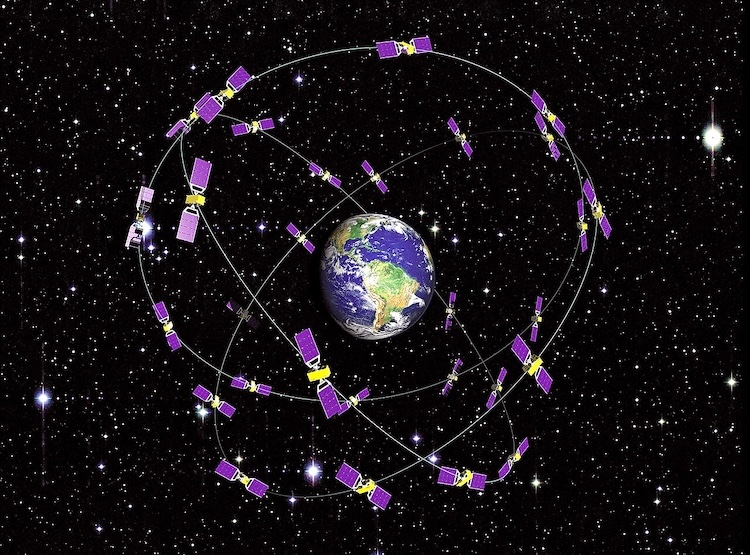 Artist’s impression of the Galileo constellation. The completed Galileo system will be based on a constellation of 30 navigation satellites. satellites. Credit: DLR Galileo Special
Space and Sovereignty
The Arctic debate revealed an even deeper strategic imperative: the domain of space.
Space-based assets — for navigation, early warning, secure communications, and missile tracking — underpin modern defence. Europe’s Galileo system provides civilian positioning, but military resilience requires hardened, encrypted, and redundant systems.
True autonomy in space would entail independent launch capacity, resilient satellite constellations, anti-jamming technologies, and integrated space-domain awareness — capabilities that currently depend on cooperation with the United States.
Without independent access to space, strategic autonomy remains a distant aspiration.
France and Strategic Convergence
President Emmanuel Macron long urged European strategic autonomy. That position, once seen as doctrinal, now informs practical planning.
The Franco-German partnership remains central. France contributes nuclear deterrence and expeditionary experience; Germany contributes industrial heft and economic scale.
Under Merz, Berlin appears more receptive to strategic clarity, urging Paris and Berlin to draw closer on everything from production to alliance design. Yet intent has not yet become action.
Eastern Europe’s Imperative
For Eastern European states bordering Russia, the debate over guarantees has always been concrete.
They rely on NATO commitments precisely because geography does not bend. For them, European autonomy must reinforce — not replace — transatlantic deterrence.
This divide within Europe itself exposes the delicate balance between national sovereignty and the alliance’s unity.
Ukraine and the Lesson of Delay
Russia’s full-scale invasion of Ukraine reshaped Europe’s strategic consciousness. At Munich, Volodymyr Zelenskyyreminded leaders that deterrence delayed becomes deterrence denied. His message was not abstract. It relied on battlefield analysis.
In 2025, European support for Ukraine increased significantly. According to data compiled by the Kiel Institute for the World Economy, European military aid allocations rose by 67 per cent compared to the annual average between 2022 and 2024. Financial and humanitarian assistance increased by 59 per cent over the same baseline. In other words, Europe did not retreat when the war dragged on; it scaled up.
Yet the aggregate numbers reveal a harder reality.
Following the full withdrawal of the United States from military support in 2025, total military aid allocations to Ukraine that year were still 13 per cent below the annual average recorded between 2022 and 2024 — even after Europe’s surge. The decline in financial and humanitarian allocations was smaller, roughly 5 per cent compared to the previous three-year average, with overall volumes still exceeding the levels recorded in 2022 and 2023 (all figures inflation-adjusted).
The data tell a clear story: Europe substantially increased its efforts, but the absence of the United States created a structural gap that Europe alone could not immediately close.
The implications extend beyond Ukraine. They illuminate the scale of Europe’s dependency on high-intensity conflict. American withdrawals do not merely shift political symbolism; they alter the quantitative balance of material support. Replacing U.S. contributions requires not only political will but industrial scale, logistical depth, and intelligence infrastructure that Europe is still building.
The war has therefore served as both a catalyst and a caution. It demonstrated Europe’s capacity to mobilise rapidly. It also demonstrated the limits of that mobilisation under conditions of sudden alliance retrenchment.
Ukraine’s struggle underscores the central dilemma confronting Europe: solidarity without sustained capability cannot substitute for deterrence. If guarantees are uncertain, capacity must be structural.
A Continent in Strategic Transition
Europe is not severing ties with the United States at present. It is planning for a world in which alliance behaviour, like all political behaviour, is shaped by domestic politics and national interest.
This shift in mindset may ultimately prove as consequential as the industrial transformation now unfolding.
For decades, Europe advanced with the quiet confidence that security was assured. Now, security demands a deliberate choice.
The postwar years allowed Europe to believe that history’s sharp edges had softened. They have not. Power politics has returned, bringing the unmistakable lesson that sovereignty depends on strength. The United States may remain Europe’s closest partner, but the alliance is no longer a safety net. If Europe fails to build its own defence, it will discover that ideals without power invite only pressure. The age of guarantees has ended. The age of responsibility has begun.
About the author: Ramesh Jaura is affiliated with ACUNS, the Academic Council of the United Nations, and an accomplished journalist with sixty years of professional experience as a freelancer, head of Inter Press Service, and founder-editor of IDN-InDepthNews. His expertise is grounded in extensive field reporting and comprehensive coverage of international conferences and events. [IDN-InDepthNews]
Original link: https://rjaura.substack.com/p/europe-confronts-a-world-without
Related links: https://www.eurasiareview.com/25022026-europe-confronts-a-world-without-guarantees-analysis/
https://www.world-view.net/europe-confronts-a-world-without-guarantees/