
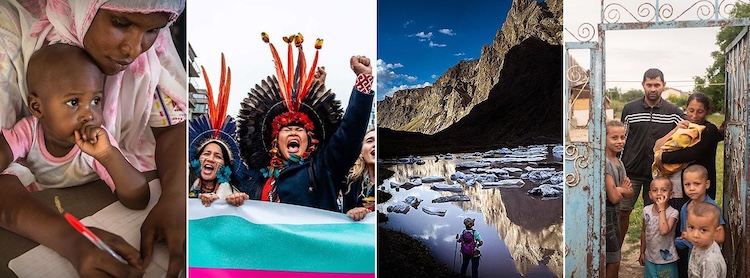
Our Everyday Essentials
By Ramesh Jaura
This article was first published on https://rjaura.substack.com
BERLIN | 13 December 2025 (IDN) — Human Rights Day has arrived with a strange, almost jarring double exposure. In UN conference rooms and on official social feeds, the language is familiar: dignity, equality, universality. Outside those rooms, the world feels harsher—war footage as routine, hunger as background, prisons filling with critics, borders hardening into moral walls. The phrase “human rights” still travels the globe. The question is whether the world still treats it as a binding promise—or a decorative slogan.
The United Nations’ theme this year—”Human Rights, Our Everyday Essentials“—is almost disarmingly plain. Yet in the current geopolitical climate, it lands like a warning label. Rights are not ornaments for peaceful times. They are the minimum conditions that make ordinary life possible: being able to speak without vanishing, to worship—or not—without fear, to be judged by law rather than whim, to raise children without calculating the risk of an airstrike or the next knock on the door.
The UN Secretary-General, António Guterres, does not sound celebratory in his Human Rights Day message. He sounds alarmed. Civic space is shrinking, he says. Institutions meant to protect people are being weakened. Rights are being pushed aside in the name of “profit or power.” If there is a single sentence that captures the mood of this year’s observance, it may be that: rights pushed aside—not by accident, but by design.
And this is why a blunt, even uncomfortable question has begun to surface in private conversations among diplomats, activists, and journalists: should December 10 be marked less as a celebration now, and more as a day of mourning? Not as a defeat. Not as performative grief. But as a sober acknowledgement that normal commemoration can sound hollow when civilian deaths climb, when prisoners of conscience proliferate, when “international norms” are treated as optional.
A day of mourning would not replace Human Rights Day. It would tell the truth about it. We commemorate the Universal Declaration of Human Rights—the 1948 pledge that the world, emerging from the wreckage of fascism and world war, would never again allow governments to strip people of their basic humanity. Human Rights Day exists because the world once learned, in blood, what happens when rights are treated as privileges, and some lives are defined as less worthy than others. The trouble is that the world seems to be relearning those lessons now—in real time.
The promise made in 1948 was strategic
The Universal Declaration of Human Rights, adopted on December 10, 1948, was never intended as poetic wallpaper. It was an attempt to pour concrete around the foundations of civilisation. It offered a moral floor beneath which no government should push human beings again. It was not a treaty, but it became the blueprint: the covenants, the courts, the constitutional language, the civic movements, the everyday vocabulary of dignity used by people resisting abuse.
The Declaration’s radical move—still radical in many places—is its simplest: rights are inherent. They do not emanate from rulers. They are not gifts. They are not conditional upon being helpful, obedient, or conveniently located. Authoritarian geopolitics, by contrast, begins from the opposite assumption: that people are instruments—labour to be exploited, populations to be managed, opponents to be crushed, minorities to be scapegoated, refugees to be traded like bargaining chips.
If you want to understand why human rights matter in 2025, start there. Rights are the world’s most ambitious answer to the oldest political temptation: treating human beings as disposable.
War has returned as the organising principle of world politics—and rights are what it destroys first
When Volker Türk, the UN High Commissioner for Human Rights, calls human rights a “compass in turbulent times,” he is not being rhetorical. A compass does not end the storm; it stops you from steering straight into the rocks.
The storm is obvious. Conflicts have multiplied and metastasised; the International Committee of the Red Cross has spoken of roughly 120 conflicts worldwide. Violence that once would have shocked the global public now competes with other tragedies for attention. The world’s emotional bandwidth feels exhausted.
And the measurable human cost has surged. UN human-rights casualty recording shows a sharp rise in conflict killings, with 48,384 people recorded killed in 2024, most of them civilians. Behind that number are families who will never be “whole” again: children who will grow up with a single photograph and an absence, parents who will never stop listening for a voice that will not return. UN data also shows violence against women and children in armed conflict spiking over 2023–2024, with a large share of recorded deaths concentrated in Gaza.
War is not only a battlefield problem. It is a human-rights failure that spreads. It leaks into food prices, fuel costs, political extremism, hate speech, militarised policing, and mass displacement. It corrodes norms. What begins as “exceptional” brutality in one theatre becomes precedent elsewhere.
This is what makes the human-rights argument more than moral. It is also practical. In a world of competing powers and brittle alliances, rights are not a distraction from security. They are part of the security system. They are the rules that keep the powerful from turning the weak into collateral.
Displacement is produced by rights collapsing
If war is the headline, displacement is the long tail. It is the silent map of rights failing: people voting with their feet because they cannot survive at home.
UNHCR reported that by the end of June 2025, 117.3 million people were forcibly displaced—because of persecution, conflict, violence, or human-rights violations. Later in 2025, UNHCR noted that the figure reached 122.1 million by the end of April. These are numbers so large they risk becoming abstract. But everyone is a person carrying documents in a plastic bag, a child whose schooling has been interrupted, a family trying to become “invisible” enough to pass safely through checkpoints, a mother calculating whether to risk the sea.
Displacement is not only a humanitarian crisis. It is a geopolitical accelerant. It strains host states. It fuels xenophobia. It becomes ammunition for demagogues who sell cruelty as competence. And when those demagogues gain power, they often tighten the screws on rights further—creating a feedback loop: war → displacement → backlash → repression → more instability.
Sudan remains a devastating illustration of how quickly a country can fall through the floor: close to 12 million displaced, with waves of people pushed across borders as fighting shifts. For the displaced, the “international system” is not a set of institutions; it is whether a border guard waves you through or turns you back, whether a camp has water, and whether your daughter is safe walking to a latrine after dark.
Human rights are indispensable because they stand between displacement and dignity—between being treated as a person and being processed as a problem.
When governments criminalise the oxygen of democracy
The human-rights system depends on something so ordinary we rarely name it: space—the space to speak, to organise, to investigate, to protest, to defend. Without it, rights become paper.
Guterres’s warning about a “shrinking of civic space” is echoed across the rights world. Türk has spoken of deliberate efforts to weaken the rule of law and human rights, and he has urged states to strengthen the “human rights ecosystem.” That ecosystem is not just the UN. It is independent judges, credible journalists, principled civil servants, unions, local NGOs, community leaders, and human-rights defenders who document abuses when it is dangerous to do so.
The targeting is not anecdotal. UN human-rights data reports that at least 625 human-rights defenders were killed or disappeared in 2024. Journalists and media workers killed also rose, most of them in conflict zones. These are not only tragedies. They are signals. They tell you what kind of future is being built: one where truth is treated as sabotage.
The political trendlines add to the picture. The V-Dem Democracy Report 2025 estimates that 72% of the world’s population lived in autocracies as of 2024, while Freedom House’s Freedom in the World 2025 describes a19th consecutive year of global freedom decline. It is not that democracy has vanished. It is under siege—sometimes by coups and bullets, sometimes by laws and algorithms, sometimes by the slow erosion of norms until people wake up and realise how much they have surrendered.
Human rights are indispensable because civic space is indispensable. Without it, society cannot correct itself peacefully. And when peaceful correction becomes impossible, violence becomes more likely.
Digital repression and the silencing of women
The most decisive shift of the last decade is that repression is no longer only physical. It is increasingly digital, scalable, and automated.
Freedom House’s Freedom on the Net 2025 reports that global internet freedom declined for the 15th consecutive year, as authoritarian leaders refine online control—and democracies also struggle with the temptation to regulate speech in ways that backfire. The internet was once imagined as a force that would make censorship impossible. Instead, states have learned to turn it into a tool of surveillance and manipulation.
A new UN Women report, “Tipping Point,” gives this shift a gendered and deeply political edge. It finds that more than two-thirds of women journalists, activists, and human-rights defenders surveyed experienced online violence, and a significant share reported real-world attacks linked to it. Deepfakes, harassment swarms, doxxing, “swatting”—the digital realm becomes a pipeline to physical danger.
This is not a “culture war” footnote. When women are driven out of public life, politics narrows. The field is left to those most comfortable with intimidation. Societies become more brittle. Democracy becomes more performative than real.
Human rights are indispensable because the digital world is now where public life happens—and where it is being strangled.
The politics of abandonment
Human rights are often framed through civil and political liberties—arrests, censorship, torture. But the current moment demands a broader lens. People rarely turn toward authoritarian promises because they love authoritarianism. They turn because they feel abandoned—economically, socially, geographically, culturally. Rights, to remain credible, must be experienced, not merely invoked.
UN human rights reporting points to the persistence of discrimination—one in five people worldwide report experiencing it, according to data cited by the UN human rights office. Amnesty International’s 2025 global review ties together war, repression, discrimination, climate injustice, and the misuse of technology, warning that the rules-based order is being weakened in ways that block solutions affecting millions.
This is the crisis beneath the crisis: credibility. If rights are seen as selective—shouted at enemies, whispered for allies—then human rights become another geopolitical instrument. That is precisely what authoritarians want: to turn “rights” into just another propaganda word.
So should December 10 be a day of mourning? There is a compelling moral case for saying: yes, at least in part. Not because the project has failed, but because the world is paying a catastrophic price for treating rights as optional.
What would we mourn? Not only the dead, though they must be mourned. We would mourn the normalisation of cruelty—the way mass suffering becomes background noise, the way children killed in war become statistics, the way hunger becomes a “complex emergency,” the way accountability is postponed until it becomes meaningless.
But we should be careful. Mourning without movement becomes paralysis. Cynics can exploit it: Nothing matters. Everything is hypocrisy. Look away.

This is where Amnesty International’s long-running practice—Write for Rights—feels important. It insists that solidarity is not a sentiment; it is a tactic. People have been freed, trials have been influenced, and disappearances have been challenged because strangers abroad refused to look away. Amnesty frames today’s moment as a choice: allow freedoms to erode, or resist together.
So perhaps Human Rights Day needs a new tone more than a new name. Less ceremony, more truth. Less congratulations, more commitment. A vigil rather than a party.
Five pressure points for the next decade
If human rights are indispensable, the next question is how to make them durable again in an era of hard power. Here are five pressure points—places where action is possible.
1) Treat human rights as conflict prevention, not post-conflict decoration
Türk has argued for joining the dots between abuses and crisis prevention. This means investing in early warning and protection mechanisms before atrocities become “too big to stop.” It means supporting monitors and investigators, not harassing them as “biased.” It means understanding that torture, discrimination, and political imprisonment are not “internal matters.” They are signals of coming instability.
2) Defend civic space like strategic infrastructure
Civic space is not a luxury. It is the oxygen of nonviolent politics. Protecting defenders and journalists is not charity; it is a stabilising investment. When you silence critics, you do not remove problems—you remove alarms.
3) Build serious guardrails for the digital public square
Rights in the digital age require enforceable protections against deepfake abuse, doxxing, and coordinated harassment; transparency around algorithmic amplification; and credible safety mechanisms for journalists and defenders. The internet will not self-correct. It will follow incentives unless societies impose guardrails.
4) Make social and economic rights tangible
The most effective antidote to authoritarianism is not moral lecturing. It delivers fairness and competence: decent services, anti-corruption enforcement, economic rules that do not treat people as expendable, and climate adaptation that protects the vulnerable rather than displacing them.
5) Stop treating international law as selective
Double standards are the acid that dissolves human rights. If states demand accountability for rivals and excuse allies, the universal promise dies. Human rights are not credible if they function as a rhetorical weapon rather than a constraint on power.
Human rights are indispensable today for a simple reason: the alternatives are already here.
Where rights are treated as optional, we see the same pattern—civilian harm normalised, displacement surging, civic space shrinking, digital violence spreading, discrimination hardening, and institutions weakened until law becomes a costume for power.
Human rights do not guarantee peace. But without them, peace becomes a temporary pause between coercive episodes, and politics becomes the management of fear.
So yes: in 2025, December 10 can feel like a day of mourning. But it should be the kind of mourning that refuses to accept the world as it is. The kind that insists rights do not take second place to profit or power. The kind that keeps faith with the 1948 promise—not as nostalgia, but as a survival strategy.
If Human Rights Day is a vigil now, then let it be a vigil with purpose: grief sharpened into resolve, memory turned into pressure, and ideals translated into protection for real people—today, not someday. (IDN-InDepthNews)
Ramesh Jaura is a journalist with 60 years of experience as a freelancer, head of Inter Press Service, and founder-editor of IDN-InDepthNews. His work draws on field reporting and coverage of international conferences and events.
Original link: https://rjaura.substack.com/p/divine-rights-of-humans
Related links: https://www.eurasiareview.com/12122025-divine-rights-of-humans-oped/