
By Kalinga Seneviratne
BANGKOK, Thailand | 16 March 2026 (IDN) — The US President Donald Trump may like to believe that it is the US with its powerful military that is driving the global order, but, the recently concluded 13th Asia Pacific Forum on Sustainable Development (APFSD) reflected the newly evolving global order is driven with new technology and financial systems that the Americans don’t control anymore.
The United Nations Economic and Social Commission for Asia and the Pacific (ESCAP) released its ‘Asia and the Pacific SDG Progress Report 2026’ at the beginning of the forum on February 24th, which warned that with only 5 years left until the deadline of reaching the 2030 United Nations Sustainable Development Goals (SDGs), the region is falling behind on the pursuit of the SDGs, except for China that has reached 9 of the goals.
“The data in this report delivers a stark warning: at the current pace, we risk missing a staggering 88 per cent of the measurable targets. The question before us is clear – will we act decisively to change course, or will we allow the current trends to continue unchallenged?” asked Indonesian Economics Professor and the Executive Secretary of ESCAP, Armida Salsiah Alisjahbana, in a Foreword to the report.
In a press release by ESCAP, Alisjahbana said, while the recent weakening of multilateralism threatens to erode the global partnerships we have forged, yet, “with Asia and the Pacific now a stronghold for both technology and finance, the region holds the means of implementation for sustainable development in its hands.”
This new global reality was evident at the APFSD here. Chinese and other Asian development, technology and economic experts played a major role at the conference, with Europeans playing a distant second fiddle, and the Americans were largely missing in action. For someone who has covered such UN conferences for over 3 decades, it was a welcome breath of fresh air, where Westerners were not lecturing to the Asians anymore.
Another welcome change I noted from such UN conferences I have covered since the 1990s, is that ESCAP has brought the civil society groups and the universities right into the mainstream of the conference proceedings. The so-called ‘side events’ that featured them were held within UN conference venue adjoining the main conference hall, and most of them were also hybrid events. The official program schedule was drafted with time slots made available for the parallel ‘side events’ in the late mornings and early afternoons without clashing with ESCAP official sessions.
ESCAP officials, including the Executive Secretary, attended and addressed some of these ‘side events’ sessions and so were official government delegates especially from emerging member states. The Pacific Island states were well represented at these events with a large civil society presence at the conference.
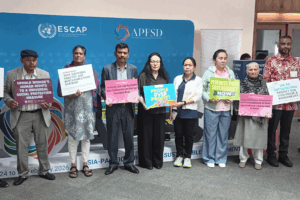
With universities and civil society groups playing a significant role at the conference, localization of SDG solutions, appropriate use of AI, sufficiency economic models, and localized architectural remedies for the housing crisis were addressed. Even a group of civil society activists held a brief protest just outside the main conference hall door calling for development justice and people-centric solutions for the SDGs.
China shared their success story in making safe drinking water available to 96 percent of their rural population with the Changjiang Water Resource Commission(CWRC) organizing a session that also brought together water experts from Thailand, Japan, Maldives and Sweden.
Professor Li Yalong, of CWRC’s Changjiang River Scientific Research Institute in Wuhan, said that China has already achieved SDG 6 Clean Water and Sanitation, and he described the process from the 1980s to 2025 to achieve it, that included disease prevention in the 1980s, addressing distribution difficulties in 2000, launching water safety projects in 2005, and advancing rural water security since 2024. “Comprehensive rural water supply system is a major contribution to poverty alleviation” he argued.
Thailand, which has also achieved the SDG 6, presented their 20-year master plan on water resources management. Patcharawee Suwannik, Deputy Secretary General of the Office of National Water Resources explained that they were able to achieve this by promoting “community water security” focusing on 3 key areas of “upgrading water supply system and its resilience, and reinforcing good governance and stakeholder participation”.
At a well-attended side event, Thailand also presented its Sufficiency Economics Philosophy (SEP) drawn from the Buddhist teachings that is based on moderation, reasonableness and resilience. “It was developed through the decades of practical development work and close engagement with the rural communities across Thailand’, explained Arunee Hiam, Deputy Director-General of Thailand International Cooperation Agency. “SEP is not against economic growth, rather it promotes balanced and sustainable development. At the community level, SEP has strengthened self-reliance, enhanced food security, promote diversified agriculture, support local enterprises, and improved resilience to climate variability.”
‘Universities and Frontier Technology for the SDGs’ was a well-attended side event at the APFSD which was addressed by Alisjahbana as well. It was organized by China’s Tsinghua University that demonstrated their state-of-the-art AI technology that is successfully being applied in the SDG arena in China and overseas. In addition to speakers from Tsinghua, it included panelists from the University of Indonesia, Nazarbayev University, Seoul National University, Chullalongkorn University, and the Chief of the Energy division from ESCAP. There were lively discussion on the benefits and dangers of AI to achieve the SDGs.
Invoking the Year of the Horse, Vice Chancellor of the Tsinghua University Council, Professor Buo Yong said that the horse symbolize speed, vitality and hope, and “today’s global governance is precisely this spirit of the horse”. The AI technology will provide the speed to advance the 2030 agenda.
Interestingly, affordable housing is not a SDG, though “adequate housing” is one of 10 criteria in SDG 11, Sustainable Cities and Communities. Habitat for Humanity International (HFHI) along with Asian Coalition for Housing Rights (ACHR) held a side event at the main APFSD conference center to raise awareness to this important issue under the theme of ‘Resilient Housing Solutions Through Partnerships’.
Approximately 600 million people in the region lack access to adequate housing according to HFHI. Nevertheless, promising developments are emerging with innovative housing solutions. solutions.
“Affordability is an important component of access to housing,” Enid Madarcos, Associate Director, Urban, Land and Policy Program Department of HFHI told IDN in an interview. “We have various approaches and various interventions as to how we address affordability, to develop financial products that are affordable to low income groups”.
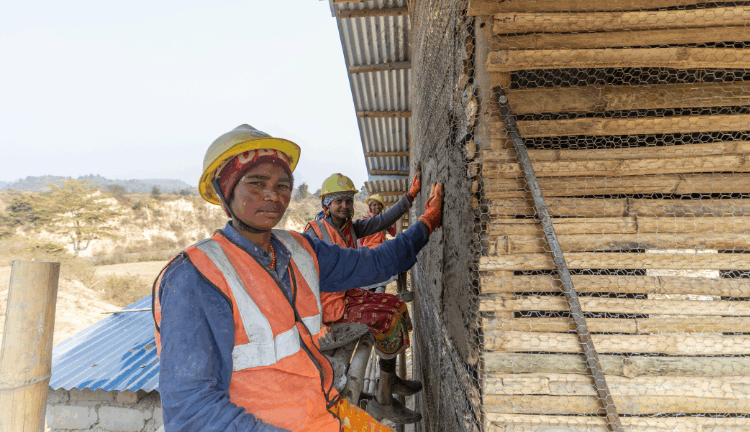
The bricks and cement housing model copied from the West may not be the solution for sustainable housing for local climatic conditions in the Asia-Pacific region. Professor Josua Bolchover, an architect from Hong Kong University raised this point, and argued that the region needs to look at new architectural practices to build housing that are suitable for local climates and use localized material in building them. “Our objective is to innovate different development models that can change this pattern towards the creation of more sustainable climate resilient communities,” he said.
One such method is bamboo housing currently promoted in Nepal and the Philippines. Prakash Shreshtha, Vice Chair of the National Planning Commission of Nepal said 68 percent of Nepal is covered by bamboo trees and with people increasingly migrating to the cities, there are more barren land available for bamboo cultivation. “If we use bamboo widely in housing and it is commercialized, it will be an income source for farmers and the people, it will be sustainable”.
These are part of the diversity of opinions and ideas that emanated from APFSD, and these came almost exclusively from the region, not dictated by the West. [IDN-InDepthNews]