How the U.S. Retreat Is Reshaping the Global Economy
By Ramesh Jaura*
This article was first published on https://rjaura.substack.com/
BERLIN | 12 January 2026 (IDN) — For most of the last eighty years, the world economy—unequal, quarrelsome, and often unfair—rested on a stubborn assumption: when the system came under strain, the United States would still show up.
Not always generously. Not always consistently. But often enough to keep the scaffolding standing: institutions funded, rules defended, and crisis cooperation maintained when trouble threatened to spread across borders. The presence mattered less for its perfection than for its predictability. Someone, at least, would help hold the centre.
That assumption is fading fast.
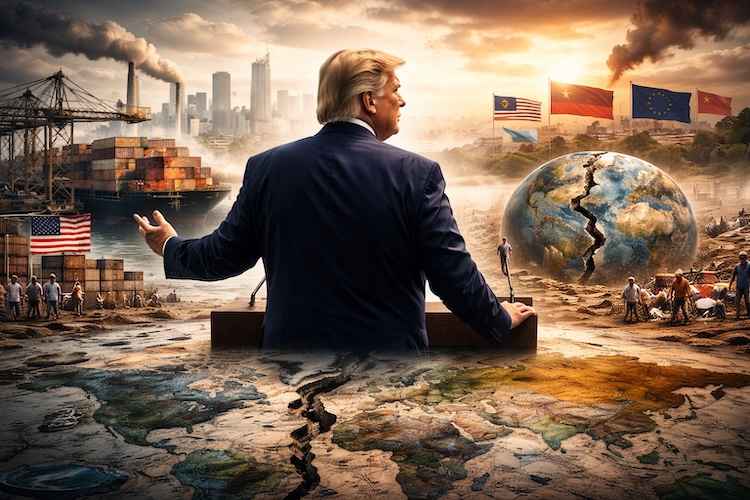
On January 7, President Donald Trump signed a Presidential Memorandum ordering U.S. departments and agencies to stop participating in and funding 35 non-UN international organisations and 31 UN entities, where legally permitted, on the grounds that they run counter to U.S. interests or sovereignty. The decision signals a withdrawal from parts of the machinery that underpins cooperation on climate, development, humanitarian coordination, labour standards, peacebuilding, and governance.
For ordinary people, this can sound distant—bureaucracies and acronyms. But the consequences are not abstract. Multilateral bodies are the plumbing of the global economy: the quiet systems that reduce uncertainty, coordinate standards, help prevent crises from cascading, and organise support when they do. When a major funder and rule-shaper steps back, the pipes do not burst overnight—but pressure drops, leaks spread, and countries and companies start planning for a harsher reality: fewer shared rules, slower coordination, and more risk priced into everything.
That is why this shift matters as 2026 begins. The United States is stepping back from multilateral stewardship—and the rest of the world is being forced to recalibrate without a reliable anchor.
The timing makes the contrast stark. On January 8, the United Nations released the World Economic Situation and Prospects 2026 (WESP), its annual assessment of global economic health. The report does not frame U.S. withdrawal as its headline—UN reports rarely do—but it describes the kind of world such decisions accelerate: trade rules that feel less predictable, debt coordination that is slower and more fragmented, climate finance that remains uncertain, and technology governance that hardens into blocs.
Read together, the message is simple: the global economy is still moving, but it is losing alignment. Growth continues, but coherence thins. Confidence persists, but convergence slips away. The system runs—but increasingly without a dependable centre of gravity.
The top-line numbers can look almost soothing. Global output rose by an estimated 2.8 per cent in 2025 and is projected to ease to 2.7 per cent in 2026 and edge up to 2.9 per cent in 2027. On paper, that resembles continuity—perhaps resilience after years of pandemic shocks, war, inflation, and tight financial conditions.
Yet the figures carry a quieter message. Growth at this level is not strong enough to do the heavy lifting the world now requires: reducing poverty at scale, narrowing widening inequality, and financing the investments demanded by climate adaptation and sustainable development. And it arrives at a moment when the world has less cushion: debt levels are higher, fiscal space is thinner, and climate shocks are more frequent. A modest slowdown that once would have been manageable can now tip vulnerable economies into prolonged stress.
In earlier eras, a slowdown like this might have triggered coordinated stimulus, renewed trade cooperation, or multilateral debt relief. Today, it coincides instead with higher tariffs, strategic rivalry, and persistent uncertainty—much of it emanating from the country that once championed openness.
The Cost of Walking Away
The United States’ renewed embrace of tariffs in 2025 mattered for more than its immediate economic impact.
The first shock was managed. Companies shipped early. Inventories rose. Consumers kept spending. The system absorbed the initial blow.
But the more serious damage was psychological—and it spreads in slow motion.
Tariffs are not just a tax at the border; they are a signal about how disputes will be handled. When rules feel conditional, companies act accordingly: they delay investment, diversify suppliers defensively, and keep more cash on hand. That is rational behaviour—but it comes at a collective cost. Less investment today means weaker productivity tomorrow, and weaker productivity means slower wage growth, fewer good jobs, and tighter public budgets.
And the uncertainty does not stop at trade. Once participation and funding become conditional, it affects everything that depends on long-term commitments:
Debt becomes harder to manage because coordination weakens and restructurings take longer. While negotiations drag on, governments divert funds from schools, clinics, and infrastructure to debt service.
Climate finance is becoming less reliable, making it harder for vulnerable countries to invest in disaster-prevention measures before disasters strike. When disasters do strike, they borrow more—often at worse terms—locking in a cycle of fragility.
Technology becomes more gated, as standards and supply chains split into rival systems. Countries that are already behind face higher barriers to entry—missing the productivity gains that could lift incomes.
The global economy is, in effect, learning to function without a dependable backstop—and the first to feel it are the countries and communities with the least margin for error.
Resilience Without Momentum
To be fair, the world economy has not collapsed. In 2025, it proved sturdier than many expected. Inflation eased, some monetary conditions loosened, labour markets stayed broadly stable, and activity held up.
But resilience is not the same as strength.
The WESP is explicit that growth remains below the pre-pandemic average and that fiscal space has narrowed across much of the world. High public debt and rising interest costs squeeze governments’ ability to act. Many countries are trapped in a hard choice: protect people now, or keep creditors calm. Often, they cannot do both.
This is where global averages stop being reassuring and start being misleading. A “soft landing” in one part of the world can feel like suffocation in another—because the ability to absorb shocks is distributed as unevenly as income itself.
A World No Longer Converging
The most consequential shift now unfolding is the least visible in daily headlines: the breakdown of economic convergence.
For much of the early 21st century, globalisation—despite its distortions—enabled many developing countries to grow faster than advanced ones. The promise of “catch-up” felt plausible.
That momentum has slowed—sometimes stalled.
Per capita income growth is weakening across large parts of the developing world, including the least developed countries. Poverty is increasingly concentrated where conflict, fragility, debt distress, and climate vulnerability overlap.
This is not random. It reflects a world where access to markets, capital, and technology is increasingly mediated by power rather than principle—where opportunity flows along alliances and strategic supply chains, not simply along comparative advantage.
Advanced Economies: Stability Turned Inward
The advanced economies remain broadly stable and are projected to grow modestly. But their response to uncertainty has been increasingly inward-looking.
Industrial policy—once mainly associated with development—has become a form of strategic insulation. Supply chains are “secured” through reshoring and friend-shoring. Technology is managed through restrictions rather than shared norms.
For citizens in these countries, such policies can feel protective. For citizens in poorer countries, they can feel like a door quietly closing: investment diverted elsewhere, technology harder to access, market entry more conditional.
China, India, and the Limits of Substitution
It is tempting to assume others will replace the lost anchor—China, perhaps, or a group of large emerging economies. But the WESP’s outlook suggests this is unlikely. China’s growth is slowing as it manages structural transition and debt-related headwinds; India’s growth remains strong but cannot carry global demand on its own.
A single fast-growing economy cannot replace a rules-based multilateral system. Its stabilising role comes from predictability: common standards, dispute settlement, burden-sharing, crisis coordination. In a patchwork world, those functions weaken—and smaller economies pay first.
Debt Without a Referee
Debt is where institutional drift becomes brutally concrete.
Debt has always been part of development. What has changed is the absence of an effective referee. When coordination weakens, and uncertainty rises, capital becomes more cautious—and more expensive—especially for countries without deep markets or reserve currencies.
For millions of people, this shows up as underfunded schools, understaffed hospitals, delayed infrastructure, and shrinking social support. Countries cut investment not because they reject development, but because the room to pursue it has vanished.
Climate as a Multiplier of Fragility
Debt would be a challenge enough. Climate change ensures it never operates alone.
Climate shocks now behave like macroeconomic events: they disrupt output, destroy infrastructure, inflate food prices, and strain public budgets. Each shock increases borrowing needs. Each loan makes the next shock harder to survive. ([Reuters][4])
This is why climate finance matters so much. It is not charity; it is preventive investment. When it fails to arrive, countries rebuild after disasters rather than preparing for them—and the bill grows each year.
Food, Energy, and the Everyday Crisis
At street level, these structural failures show up as something simpler: the cost of living.
Inflation may ease, but prices stay high relative to incomes. Food insecurity persists where climate disruption, conflict, and fragile supply chains collide. Energy costs remain a burden for import-dependent countries.
For households, the decisions are immediate: less nutritious meals, delayed medical care, children pulled from school, small businesses shut down. For governments, the pressure is relentless—but fiscal room is limited. When hardship spills into unrest, markets price in risk, borrowing costs rise, currencies weaken, and imports become more expensive—tightening the squeeze further.
Growth Without Transformation
Many developing regions are still growing. But growth without transformation is fragile.
Population growth absorbs much of Africa’s expansion, leaving per capita gains thin. Infrastructure gaps persist. Human capital investment is squeezed by debt. The SDG growth target for the least developed countries remains out of reach—not necessarily for lack of effort, but because the environment for late development is harsher, more fragmented, and more conditional than it used to be.
Technology: The Next Divide
Technology—especially AI—arrives as both promise and peril.
The WESP is cautious for good reason. Productivity gains may come, but they are likely to be uneven. AI development depends on data, computing power, skilled labour, and capital at scale—resources concentrated in a handful of countries and firms.
For countries already constrained by debt and limited fiscal space, the barriers to entry are formidable. Automation threatens routine jobs while rewarding high-skill roles. Without strong social protection, displacement becomes insecurity—and insecurity becomes political instability.
Technology does not land on a blank slate. It amplifies what is already there—including inequality.
Multilateralism in Retreat
Step back, and the pattern is clear.
Trade rules fragment. Debt coordination stalls. Climate commitments lag. Technology governance hardens into blocs. The multilateral system still exists, but without the political backing needed to enforce or evolve its rules.
The U.S. retreat accelerates this drift. Others fill parts of the space selectively, but no one replaces the lost coordination. The system becomes more reactive—treating crises after they erupt, rather than preventing them.
A Low-Growth, High-Risk Equilibrium
The danger is not collapse. It is entrenchment.
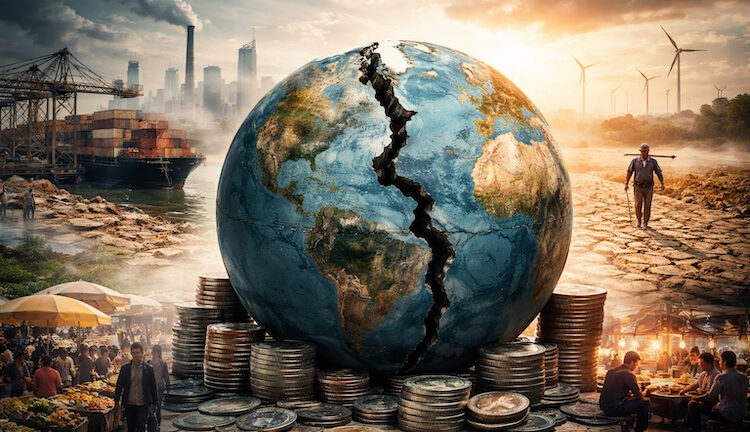
The world risks settling into a low-growth, high-risk equilibrium: shocks more frequent, recoveries less complete, inequality more durable. Growth continues, but without convergence. Innovation advances, but without inclusion. Stability is maintained, but at the cost of long-term resilience.
That is a combustible mix. When wages stagnate, prices bite, and opportunity narrows, people lose faith—not only in governments, but in the idea that the system can deliver a fair future.
The Quiet Indictment, and the Narrowing Choice
The WESP 2026 does not assign blame. That is not its role. But taken as a whole, it reads like a quiet indictment of drift: of multilateralism eroding not through a dramatic collapse, but through neglect—coordination giving way to competition, the long term repeatedly deferred.
The future it sketches is not inevitable. The tools that once built a more integrated global economy—coordinated finance, shared rules, collective investment—still exist. What is missing is the will to use them.
Rebuilding multilateralism would demand political courage: reforming the debt architecture, mobilising climate finance at scale, governing technology more inclusively, and accepting a fundamental truth: the crises of one region do not stay neatly contained.
Absent such effort, the world continues on its current path: growing, but drifting; innovating, but dividing; surviving, but not progressing.
*Ramesh Jaura is a journalist with 60 years of experience as a freelancer, head of Inter Press Service, and founder-editor of IDN-InDepthNews. His work draws on field reporting and coverage of international conferences and events. [IDN-InDepthNews]
Original link: https://rjaura.substack.com/p/a-world-adrift
Related links: https://www.other-news.info/a-world-adrift-2/
https://www.eurasiareview.com/12012026-a-world-adrift-oped/